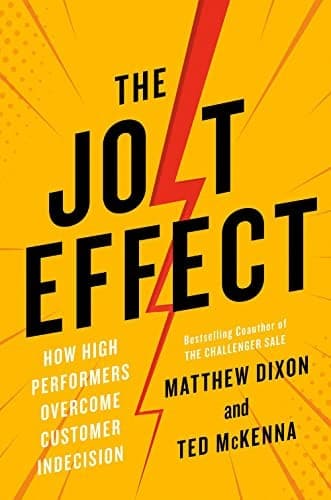
The JOLT Effect
On this pageWhat I like
What I like about this book
It goes after a problem most sales books ignore: the deal that dies because the buyer simply does nothing. The research behind it is large, and the four behaviours it recommends are simple enough to try on your next call. I like that it treats the buyer's fear as the thing to solve, rather than pushing harder on value.
Why read it
It explains why so many deals end in no decision and gives you four behaviours to help a hesitant buyer commit.
The problem it solves
Most sales training assumes the enemy is the competitor. You learn to differentiate, to prove value and to handle objections about price. The authors argue that this misses a bigger loss: deals that end with no decision at all. The buyer likes you, agrees there is a problem and then does nothing. In the authors' research on a very large set of recorded sales conversations, this was the most common way to lose.
That changes where you put effort. If the biggest threat is a stall, a sharper pitch is not the fix.
What changes in how you work
After reading it, you start to listen for hesitation. You notice when a buyer asks for another demo, another reference or more time, and you ask whether more information is really what they need. In most cases it is not. They are afraid of picking the wrong option and being blamed for it.
The practical change is a switch from persuading to guiding. You tell the buyer what you would do, narrow the choices and lower the cost of being wrong. It feels more direct than a typical consultative approach, and I think that is right for tired buyers who have too many options.
When to read it, and when not to
Read it when your pipeline has plenty of interest and not enough closed deals. It suits any sale with a committee, a budget and a risk of looking foolish: software, services, anything priced above an impulse purchase.
It will help less at the top of the funnel, where the problem is finding buyers rather than closing them. It is also written mainly for sellers in larger business-to-business deals, so a very small, quick sale may not need the full method. The core idea still holds: people avoid decisions that feel risky.
How it connects to running and growing a business
Every business owner should know their loss reasons. If you log why deals die, and you separate lost to a competitor, lost on price and lost to no decision, you will probably find the third is the largest. That is a decision you can act on.
The four steps also make a good playbook. Write down what your best salesperson does at the point where a buyer stalls: what they recommend, how they narrow the options, what risk they remove. A repeatable version of that is easier to train, to review and to hand to a new hire than a feeling about who is good at closing.
Who it's for
Key take-aways
Book summary
Dixon and McKenna argue that the biggest competitor in most sales is the status quo, and that buyers stay with it because of indecision rather than because they prefer it. Their research suggests that sales teams spend most of their effort on beating rivals and proving value, while a large share of lost deals, in the 40 to 60 per cent range by their account, end in no decision. The book then offers a method, summarised by the letters JOLT, for helping hesitant buyers decide.
Why deals die in silence
The opening argument is that the usual explanation, that the buyer was not convinced of the value, does not fit the data. Many of the buyers who stall have agreed there is a problem and seen a solution that works. They are stuck anyway. The authors say this is why a better pitch, one more case study or a deeper discount so often fails: it addresses the wrong problem.
The fear of messing up
The key idea is that buyers are driven less by the fear of missing out than by the fear of messing up. Picking the wrong supplier can cost them money, time and reputation. Doing nothing feels safer, because the current pain is familiar and nobody gets blamed for it. Dixon and McKenna say a seller who understands this stops treating hesitation as a lack of interest and starts treating it as a risk problem.
Judge the indecision
The first step is to identify when a buyer is indecisive and what kind of indecision it is. Reps tend to hear a request for more information at face value and supply it. The book teaches you to look for signs that the buyer is stuck rather than short of facts, such as repeated requests for the same material, a lack of momentum or vague reasons for delay. Reading the situation correctly comes before any action, because the right response to a stalled deal is different from the right response to a buyer who needs a fact.
Offer your recommendation
The second step is to give a clear recommendation. Many sales methods tell reps to stay neutral, ask questions and let the customer find the answer. The authors argue that this puts the entire burden of the decision on the buyer. A confident view from someone who knows the market, tied to the buyer's own situation, gives them something to react to and lowers the effort of deciding. The recommendation should be specific and supported by reasons.
Limit the exploration
The third step is to stop the buyer from going round in circles. Buyers who keep gathering information, comparing options and asking for more research feel they are making progress, but the pile of data makes the choice harder. The seller should draw a boundary around what is useful, say when the buyer has enough to decide and avoid adding more material to the pile. Fewer options and fewer documents make for easier choices.
Take risk off the table
The last step deals with the fear directly. If the buyer worries about a bad outcome, you reduce what is at stake. The ways to do this include trials, pilots, phased rollouts, guarantees and clear commitments about support. The point is to make the downside of saying yes smaller than the downside of waiting. Raising the value of the offer does not help when the buyer's concern is cost of failure.
Using it in coaching
The book is also aimed at sales managers. A manager can use the four steps as a checklist when reviewing a stuck deal: has the rep judged what kind of hesitation this is, given a recommendation, limited the exploration and removed risk? That turns a vague conversation about why a deal is not moving into a specific one, and it gives reps a way to practise the behaviours on calls they have already had.
Why it works with the rest of selling
Dixon is also known for earlier work on challenging customers' thinking, and this book fits alongside it. The earlier approach helps you create urgency and get a buyer to move. JOLT helps once the buyer wants to move and cannot. Used together, they cover the beginning and the end of the sale.
What to do with it
- Review your last twenty lost deals and sort them by reason: competitor, price or no decision.
- Pick three stalled deals now and write down what is stopping each buyer, in terms of risk rather than information.
- Prepare a clear recommendation for each one, with the reasons, and share it on your next call.
- List the ways you could reduce a buyer's risk, such as a pilot, a shorter contract or a guarantee, and decide which you can offer.
- Train your team to say when a buyer has enough information to decide, and to stop sending more.