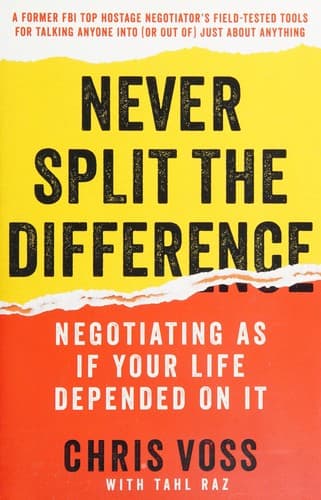
Never Split the Difference
On this pageWhat I like
What I like about this book
It is a negotiation book written by someone who negotiated when lives were at stake, and the techniques are small enough to use on your next call. The focus on listening before pushing is the right order. I'd read it for the questions and the labels, and skip the urge to treat every conversation as a fight.
Why read it
Teaches negotiation through listening: tactical empathy, labels and calibrated questions that move a deal forward.
The problem it solves
Most people negotiate by preparing an argument. They work out their position, list the reasons and push. Then the other side pushes back, the call turns into a contest, and one of you gives way on price. Never Split the Difference starts from a different view: people decide with emotion first and justify with logic after, so a negotiation is mainly a conversation about how each side feels about the deal.
What changes after you read it
You talk less and ask more. You repeat a key phrase to draw out more detail. You name the feeling you hear, such as hesitation about a price, before you answer it. You ask "how am I supposed to do that?" in place of arguing. The effect is that you learn what is really blocking the deal, and the other side feels heard, which tends to make them easier to work with.
Where it helps a business
Every owner negotiates all the time: with customers over price and scope, with suppliers over terms, with staff over pay and with partners over who does what. The techniques are most useful in conversations that matter and are not too hostile, such as a renewal or a proposed discount. They are less suited to a one-off exchange where you will never speak again and have nothing to learn from the person.
Use it with care
Some of the tactics can feel like tricks, and people notice when they are being handled. I'd use them as ways to listen better, not to manipulate. The strongest message in the book is that you should be curious about the other side. If you use a label to show you understand, mean it. If you use a question to uncover a constraint, listen to the answer.
How it connects to decisions and playbooks
A negotiation is a series of decisions about what to give and what to ask for in return. Writing down what you offered, what the other side said and what you agreed gives you a record you can learn from. The pricing and discount conversations a company has most often can be turned into a short playbook, with the questions and the limits agreed before the call.
Who it's for
Key take-aways
Book summary
Chris Voss spent years as an FBI hostage and kidnapping negotiator, and the book turns that experience into a method for everyday negotiation, written with Tahl Raz. Its main argument is that negotiation is about emotion and information, not about being clever with arguments. The techniques are designed to build trust, find out what the other person really wants and steer the outcome without conflict. It also warns against the popular habit of compromising for the sake of it.
Tactical empathy
The base of the method is what Voss calls tactical empathy. This means understanding the feelings and the viewpoint of the other side, and showing that you understand, so that they feel safe to talk. It is not the same as agreeing with them. You listen closely, you notice what they care about, and you use that knowledge to guide the talk. The approach treats the other person as a source of information, and the more they tell you, the better your options.
Mirroring
Mirroring is the simplest technique. You repeat the last few words, or the key words, of what the other person said, in a curious tone, and then wait. They usually respond by saying more. It sounds too basic to work, and it works because people like being heard and fill silence with detail. In a sales call it often reveals the real objection, which is rarely the first one mentioned.
Labelling
Labelling means naming the emotion you detect, with a phrase such as "It seems like you are worried about the timing." Voss's point is that saying the feeling aloud lowers its intensity and shows you are paying attention. Negative feelings, once named, tend to lose some of their force. You do this without arguing, and you pause afterwards so that the other side can correct or confirm.
Calibrated questions
Instead of closed questions that invite a yes or a no, you ask open questions starting with how or what, such as "How am I supposed to do that?" These force the other side to think about the problem and your constraints. A request for something you cannot accept becomes a question for them to solve. Voss suggests avoiding why, because it can sound accusing and cause defences to go up.
The power of no
The book challenges the idea that you want a yes early. A quick yes can be a way to end the conversation, with no real commitment behind it. A no, on the other hand, gives people a sense of control and often opens the door to an honest talk. Voss also describes aiming for the response "that's right", which signals that the other side feels understood, as different from "you're right", which can be a polite way to end the talk.
Tone of voice
Voss pays attention to how you sound as well as what you say. He recommends a calm, slow and warm delivery for most of a negotiation, which he calls the late-night radio voice, and a more direct tone when you need to hold a point. The reasoning is that a relaxed voice lowers tension and invites the other side to relax too. Pace and pauses do a lot of work, and silence after a question often gets you the answer.
Naming the worst first
One of the more memorable ideas is the accusation audit. Before the other side can raise their fears about you, you list the bad things they might be thinking, such as that you are overpriced or will push them. Saying them first takes away their sting and shows you understand how it looks from the other side. It is a way of using labels in advance, and it works in a proposal as well as on the phone.
Bargaining and the hidden facts
When it comes to numbers, Voss describes a way of making offers in steps, with the final one landing on an odd number and a clear sign that you have reached your limit. He also warns against splitting the difference, since it often leaves both sides with a poor deal. Throughout, he urges you to look for the information that has not been shared yet, the unknown facts that could change the shape of the agreement.
Black swans
The last big idea is that every negotiation has a few pieces of information nobody has mentioned yet, which Voss calls black swans. They might be a deadline, a hidden rival, a personal worry or a rule inside the other company. Finding one can change the deal entirely. Mirroring, labels and open questions are the tools for uncovering them, and the book encourages you to keep asking until you have learned something that surprises you.
What to do with it
- Before your next negotiation, write down what you think the other side fears and what they want, and test it with a label.
- Use mirroring twice in your next call and note what new detail it brings out.
- Replace one demand with a how or what question, and listen to the answer.
- Say no, or invite them to say no, once without a hard sell, and see how the talk changes.
- After each negotiation, write down what was agreed, what you gave and what you learned.