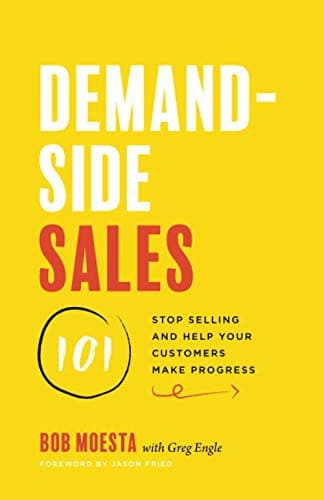
Demand-Side Sales 101
On this pageWhat I like
What I like about this book
It treats a sale as a decision the buyer is already struggling with, and it gives you a concrete way to find out what that struggle is. The four forces model is simple enough to hold in your head during a call. I also like that it is short and practical, with the focus on how to listen rather than how to pitch.
Why read it
It shows you how to sell by finding the progress your buyer wants to make, so you stop pitching features.
The problem it solves
Most sales training starts with your product and works outwards: features, benefits, objection handling. The buyer, meanwhile, is somewhere else entirely. They have a situation that is bothering them and a fear of making things worse. Demand-Side Sales 101 starts from that side of the table. If you sell something that people have to change their habits to adopt, this shift matters more than any new pitch script.
What changes after you read it
You stop asking whether the prospect is qualified and start asking what was going on when they began looking. You listen for the moment things became uncomfortable enough to act. You also notice the forces that hold people back, which are usually habit and worry about the switch, and rarely price. Your follow-up changes too. Instead of sending another feature list, you address the specific anxiety the buyer mentioned.
Where it fits in running a business
This is a book about demand, and demand is the thing a growing business cannot buy in bulk. If you understand why your best customers switched, you know what to put on the website, what to say in the first call and what to build next. The same interview technique works for product research and for churn conversations. I would treat it as a customer research book that happens to be filed under sales.
When to read it, and when to skip it
Read it when your pipeline is full of interested people who never decide, or when you cannot explain why customers chose you. It is most useful for considered purchases with real switching costs, such as software, services and anything that changes how a team works. If you sell a low-priced product that people buy on impulse, the model still applies but you will get less from a full interview process.
How it connects to logging decisions
A buyer's decision is a decision like any other, with a trigger, options, forces for and against, and an outcome. If you write down what you learn from each interview in the same shape every time, patterns appear quickly. Those patterns are the start of a repeatable sales playbook, and once the questions are consistent you can hand parts of the work to someone else, or to software.
Who it's for
Key take-aways
Book summary
Bob Moesta argues that people never buy a product for its own sake. They buy because they want to make progress in some part of their life or work, and they hire a product or service to do that job. A salesperson who understands the progress the buyer is after can help them decide. A salesperson who only describes the product is leaving the buyer to work it out alone. The book teaches this through the jobs to be done approach, which Moesta developed with Clayton Christensen and others, and turns it into a sales method.
Supply side and demand side
Moesta separates two ways of looking at a sale. The supply side starts with what you have: features, pricing, positioning. The demand side starts with the buyer's situation: what they were doing before, what changed and what they hope will be different. He argues that most selling is supply side, which is why so many pitches miss. The demand side view does not replace product knowledge. It tells you which parts of the product matter to this person right now.
Progress and the struggling moment
The central idea is progress. A buyer has a gap between how things are and how they would like them to be, and a purchase is an attempt to close that gap. Moesta pays particular attention to the struggling moment, the point at which the current way of doing things stops being good enough. If you can find that moment in the buyer's story, you learn what the product is really being hired for. It is often something quite different from the reason the seller assumes.
The four forces of progress
Moesta describes four forces that act on every decision. Two push towards change: the push of the current situation, and the pull of the new solution. Two push against it: anxiety about the new solution, and the habit of the present way of working. A deal moves when the first pair outweighs the second. Most sales effort goes into increasing the pull, usually by adding features and benefits. Moesta argues that easing anxiety and weakening habit is often the quicker route, and that you can only do that if you know what the specific worries are.
The competitor is no decision
A consequence of the four forces is that the most common outcome of a sales process is nothing. The buyer keeps their current way of working because the habit is comfortable and the change feels risky. Moesta encourages sellers to treat this as the main competitor and to ask what would have to be true for the buyer to move. That reframes follow-up from chasing a signature to resolving whatever is keeping the buyer where they are. It also changes how you read pipeline: a deal that has stalled usually has an unresolved worry behind it.
The buyer's timeline
A purchase is not a single moment. Moesta describes a timeline that runs from a first thought that something might need to change, through a period of passive looking and then active looking, to the decision and then to using what was bought. People need different things at different points. Someone passively looking wants to understand their problem, not to receive a quote. Someone about to decide wants reassurance about risk. Selling the wrong thing at the wrong stage creates resistance.
Interviewing to understand demand
The method is built on interviews that reconstruct what happened. You ask the buyer to walk you through the story: when they first thought about changing, what else they tried, who they talked to, what nearly stopped them. The aim is to learn the real circumstances behind the decision, not to collect opinions. The same technique is used with past customers to learn why they bought, and with lost deals to learn why they did not. Moesta presents it as a skill that can be practised, with the discipline of staying curious and not steering the buyer towards your offer.
Selling as helping someone decide
The last theme is the stance of the seller. If you are trying to understand progress, you are not trying to push the buyer over a line. Sometimes the right outcome is that the buyer sees the change is not worth the cost, and Moesta treats that as a legitimate result. Trust built this way tends to carry into later deals and referrals, because the buyer has experienced someone helping them think and not just closing them.
What to do with it
- Interview your five most recent customers about the story behind their purchase, starting from their first thought, and write the answers in the same format each time.
- For every open deal, note which of the four forces you know about and which you are guessing.
- Ask each prospect what they would do if they did not buy anything, and take that answer as your real competitor.
- Match your next message to the stage the buyer is in, and stop sending feature lists to people who are still passively looking.
- Review lost deals for anxiety and habit before you look at price.