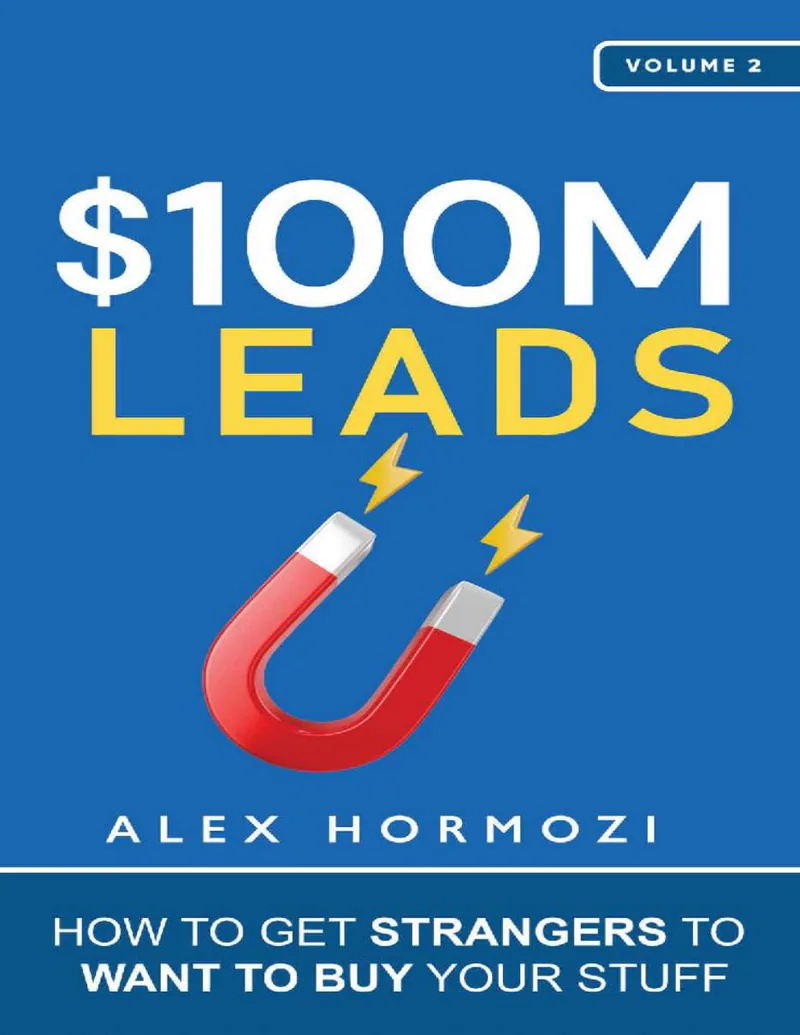
$100M Leads
On this pageWhat I like
What I like about this book
It treats lead generation as a short list of things a person can actually do, not a mystery. The frameworks are named, numbered and easy to apply the same week you read them, and the author is blunt about volume: most people stop long before an approach has had a fair test. I would read it with a pen, because nearly every chapter ends in an action step.
Why read it
It gives a business that has an offer but not enough customers a complete, ordered plan for getting strangers to show interest.
The problem it solves
Plenty of businesses have a product people would like and still struggle because not enough of the right people know it exists. The book names that problem plainly and answers it with a structure: define what a lead is, get leads to engage, use the four ways of reaching people, then bring in other people to do the reaching. Because the order runs from a first lead to a large operation, you can start at whichever level fits you today.
What changes in how you work
You stop saying "marketing" and start counting actions. The book asks you to pick one of the four methods, set a daily number, and do it long enough to see a result. It also gives you a way to diagnose a stall. Find the step where most people drop off, test one change there, and keep the result. After reading, a flat month is a question about volume, the weakest step or the channel, not a verdict on the market.
Where it is strongest
The sections on warm outreach, free content and cold outreach are the most usable for a small business, because they need time and effort more than budget. The paid ads chapters add something many ad guides skip: a plain view of money. Track first, expect to lose while testing, and compare your cost of getting a customer with the industry average to decide whether the ads or the business model need work.
When to read it, and when not to
Read it when you already have an offer and your next problem is lead flow. It is a poor first book if you do not yet know what you sell or who it is for: the author says so himself and points to his earlier book on offers. It also stops at the raised hand. Closing the sale is left for a future book, so do not expect a sales method here.
How it connects to running the business as a system
Almost every method in the book is a repeatable routine with a number attached: a daily count, a test per week, a cost per engaged lead, a payout rule. That makes it easy to write the routine down, log what you tested and what the result was, and later hand it to an employee or an agency. The book itself recommends keeping a log of all tests, and its three-step training model for new hires is document, demonstrate, duplicate. If you want decisions you can log and work you can turn into a playbook, the lead-getting chapters are a good place to practise.
A caution on the numbers
The results quoted are the author's own and come from his companies, so treat them as examples, not forecasts. The method matters more than the figures: pick one thing, do it at volume, measure it and improve the weakest step.
Who it's for
Key take-aways
Book summary
This book argues that a business grows when more people who have the problem and the money learn about its offer, and that this takes sustained, measurable advertising effort. It splits that effort into four core methods, then shows how to get other people to do it for you.
How I Got Here
The author opens with his own story: a gym business that went wrong, a large refund problem, and a rebuilt business funded by selling online fitness programmes through paid ads and phone sales. His point is that knowing how to get leads gave him repeated second chances. It frames the rest of the book as a skill, not a trick.
The Problem This Book Solves
Growth, he says, comes from two things: more customers, and customers worth more. This book covers the first. More customers means more leads, better leads, cheaper leads, and leads from many places. He also explains his business model and who he is writing for, and lays out five sections that run from the first lead to a large lead machine.
Leads Alone Aren't Enough
Here he defines the word the whole book depends on. A lead is a person you can contact. As he puts it, "a lead is a person you can contact. That's all." What matters is the engaged lead, someone who has shown interest, such as giving contact details, replying or following. Engaged leads are the real output of advertising, so the next question is how to get leads to engage.
Engage Your Leads: Offers and Lead Magnets
A lead magnet is a complete solution to a narrow problem, usually free or cheap, that reveals the next problem your core offer solves. He gives three types: reveal their problem, offer a sample or trial, or give one step of a multi-step process. They can be delivered as software, information, services or physical products. His seven steps cover choosing the problem, the solution, the delivery, the name, easy consumption, quality, and a clear call to action with reasons to act now. He tests names with polls, and notes that making the lead magnet available in more formats raises take-up.
Section III: the core four
Before the methods, he sets out two audiences and two ways to communicate. Warm audiences know you and cold audiences do not. Communication is either one to one or one to many. Crossing them gives four methods, which are the only ways one person can let others know about something.
#1 Warm Outreach
You already have more leads than you think: contacts in your phone, email accounts and social platforms. Start with the platform where you have the most, personalise each message, and contact 100 people a day, up to three times each. When they reply, he suggests acknowledge, compliment, ask: restate what they said, praise it, then ask a question that moves towards your offer. The first offer is usually free for a handful of people, asking only whether they know someone. Once referrals start, begin charging, raising the price after every five clients, and keep the list warm afterwards.
#2 Post Free Content Parts I and II
Free content builds an audience, and the audience, not any single post, is the asset that compounds. Each content unit has three parts: hook, retain, reward. Hooks come from topic, headline and format; curiosity keeps people watching, through lists, steps and stories; the reward is the value delivered. To monetise, keep the give to ask ratio heavily on giving, then ask in one of two ways: integrate the ask into the content, or ask now and then. He adds that content warms people for every other method, and tells you to post consistently and measure audience growth and reach each month.
Free Goodwill
A short chapter in which the author asks readers to leave a review, explaining that it helps other entrepreneurs find the book. It is a small example of the give and ask idea the book teaches.
#3 Cold Outreach
Strangers do not trust you, so three problems follow: you cannot contact them, they ignore you, and they are not interested. The answers are building a list yourself or through databases and brokers, personalising so the message looks warm, and offering big, fast value as the lead magnet. He then makes the case for volume: multiple contact attempts, in multiple ways, and going back to the top of the list again. Costs are mostly labour, and he walks through a worked return calculation for a cold calling team.
#4 Run Paid Ads Part I: Making An Ad
Paid ads rent other people's audiences. The aim is to start from the whole world and narrow it: pick a platform that meets four tests, target the right people, then write an ad that repels everyone else. The ad has three parts: callouts to get noticed, value to create interest, and calls to action. For value he uses the elements of the value equation and their opposites, and shows how to apply it across past, present and future and the viewer's social status. Most of the effort should go on the first seconds.
#4 Run Paid Ads Part II: Money Stuff
Efficiency matters more than creativity. He describes three phases of spending: track money, lose money while testing, then print money by spending as much as you can once returns are clear. His test budget is twice the cash a new customer brings in the first thirty days. If cost to acquire a customer is above three times the industry average, fix the ads; if below, fix the business model. Client financed acquisition means making back acquisition and delivery costs within 30 days so cash never limits growth.
Core Four On Steroids: More Better New
When one method stops growing, do more of it, make it better, then try something new. Better means finding the constraint, the step with the biggest drop off, and testing one change per week per platform. New means new placements first, then new platforms, then a new core four activity. He argues most owners fall for the size of the pie fallacy, assuming a niche is saturated after using one platform in one way. The Rule of 100 sets the volume: 100 primary actions a day for 100 days.
Section IV: lead getters
Other people can run the core four for you, which he calls lead getters. He shows four scenarios, from doing it all yourself to recruiting people who recruit more lead getters, with the return on your effort rising each time.
#1 Customer Referrals - Word of Mouth
Referrals lift lifetime gross profit and lower acquisition cost, and they compound. Customers who get the most value have the most goodwill, so deliver wins early and often, especially in the first forty-eight hours, and always book the next meeting from the current one. Then ask, treating the ask as an offer with a benefit for both sides. He lists seven ways to ask and mentions well-known referral programmes as proof.
#2 Employees
He argues that "nobody can do it like I do it" is a belief that keeps owners small. You hire people to do lead getting, train them with document, demonstrate, duplicate, and compare payroll with the engaged leads they produce to get a cost per lead and a customer acquisition cost. Keep your attention on the employees that bring the best returns.
#3 Agencies
Good agencies cost money, so if you have none you learn by doing. When you can afford one, use it to learn skills and transfer them to your team, not to outsource and wait. He gives a ten-point checklist for choosing, including a clear sales process, realistic expectations, simple reporting and a good offer. And he suggests talking to several before you decide.
#4 Affiliates and Partners
Affiliates are businesses with your kind of customers already in their audience. Find them by asking what your best customers buy, where they go and what they like. Pay for the actions you want, with the amount set by your maximum allowable acquisition cost. He describes a launch built from a whisper phase, a tease and then the launch, and a pattern of launching an affiliate programme and then integrating your lead magnet into their offer.
Section IV Conclusion: Get Lead Getters
The four lead getters come in a natural order: referrals first, then employees, with agencies and affiliates alongside. He ends with advice to set aside a share of the advertising budget for tests with no expected return, as an investment in learning, and recalls how tripling a budget changed his own results.
Advertising in Real Life: Open To Goal
A story about handing out only 300 flyers sets up the lesson that the right action in too small an amount still fails. Open to goal means you work until the daily advertising target is met. He adds a one-page checklist: choose the type of engaged lead, choose Rule of 100 or open to goal, fill in the checklist, repeat daily until you can pay someone to do it, then target employees.
The Roadmap - Putting it All Together
Seven levels describe how advertising scales, from telling friends, through consistent personal output, then employees, referrals, more places and methods, and finally experienced executives running whole channels. The seventh level is left blank for now. He estimates the climb takes five to ten years even for owners who know what to do.
A Decade in a Page
A numbered recap of the book, followed by a fable about rolling a many-sided die, where the lesson is to keep rolling. It ends with further resources and a list of what to read next, depending on whether your problem is who to sell to, what to sell or how to sell.
What to do with it
- Write down your engaged lead definition and the one lead magnet or offer you will advertise.
- Pick one core four method, set a daily number, and commit to it for a fixed run, such as 100 days.
- Keep a test log, and each week test one change at the step where most people drop off.
- Before spending on ads, set up tracking and a test budget, and work out your acquisition cost against the industry average.
- Once the routine works, document it and train or hire someone to run it, then repeat with the next lead getter.