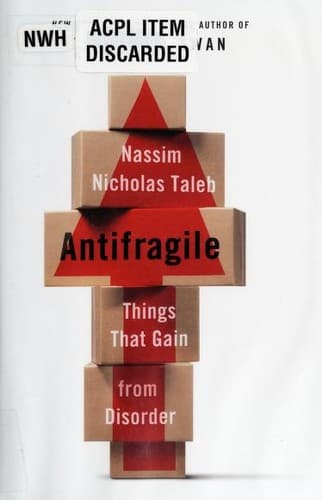
Antifragile
On this pageWhat I like
What I like about this book
It gives you a word for something most business books skip: things that get better when they are shaken. The split into fragile, resilient and antifragile is simple enough to use in a meeting. The tone is combative and the book wanders across many fields, but the core idea is short and travels well.
Why read it
A way to judge a plan, contract or business by what happens to it when you are wrong, instead of trying to predict the future.
The problem it solves
Most planning tries to forecast the future and then protect against it. Taleb argues that rare, large events shape history and that our models cannot track them. A business built on a forecast is then at the mercy of whatever the forecast missed: a single big client, a single supplier, a thin cash buffer.
His alternative is to stop asking what will happen and ask what happens to you if you are wrong. In his words, fragility can be measured, while risk cannot. That is a more useful question for an owner, because you can answer it today with your own numbers.
What changes in how you work
You test every decision for its downside and upside separately. A choice with a capped loss and an open-ended gain is attractive even when the odds are poor. A choice with a small gain and a loss that could end the business is dangerous even when the odds look good, because the book stresses that survival comes before growth.
You also look for hidden fragility: concentration in one client, channel, person or tool. And you start to value what a spreadsheet calls waste, such as spare capacity and cash reserves, because the book shows how tightly optimised systems are squeezed when something goes wrong.
When to read it, and when not
Read it when you are choosing between lean and resilient, planning a project, or deciding how much risk a new bet may take. The book notes that projects tend to run late and rarely early, which is worth remembering before you commit a deadline.
Do not expect a step-by-step method. It is long and mixes finance, medicine, ancient history and personal stories. If time is short, start with the prologue, the barbell chapter, Thales' Sweet Grapes and the large stone chapter.
What to be careful about
Taleb is combative and sure of himself, and many of his examples come from trading, medicine and politics. Treat his claims about those fields as his opinion and test the ideas against your own business.
He also warns against a lazy reading of the saying that what does not kill you makes you stronger. Survivors can look stronger because the weak did not make it, and a system can gain from failures that are painful for its parts, such as individual start-ups. Do not use the book to justify putting your team through stress.
Connecting it to a repeatable system
Every big decision has an exposure you can write down: the most it can cost, the most it can bring, and what you would do if it went wrong. Log those, then set a limit on the loss before you start. Small bets with a logged outcome are the practical form of optionality, and the log tells you which ones to repeat. Routine work with a known result can be written as a playbook, which frees time and money for the few uncertain bets worth making.
Who it's for
Key take-aways
Book summary
Taleb argues that some things do more than survive disorder: they depend on it. He calls this property antifragility and says modern institutions often make systems fragile by removing small stresses and hiding large risks. The book shows how to spot fragility, how to build the opposite, and who should carry the risk. It is organised in seven books, and the points below follow its chapters.
Prologue
The prologue sets the claim. As Taleb puts it, "the resilient resists shocks and stays the same; the antifragile gets better." Because rare events cannot be predicted, he says to stop forecasting and to measure how a thing responds to harm. A simple test is asymmetry: anything with more upside than downside from random events is antifragile, and the reverse is fragile. He introduces the fragilista, who mistakes what he does not understand for what does not exist.
Between Damocles and Hydra
The opposite of fragile is not sturdy, since a sturdy parcel is merely unharmed. It would be a parcel that asks to be mishandled. Taleb uses three myths: the sword hanging over Damocles for the fragile, the Phoenix for what returns to its old state, and the Hydra for what grows stronger when attacked. He also describes small doses of poison that build immunity as a mild form of the idea.
The Cat and the Washing Machine
Living things are antifragile up to a point, while machines wear out under stress. Stressors carry information: bones thicken under load and weaken without it. Taleb says we harm complex systems when we remove all stress, and he calls this modern habit of smoothing life the denial of antifragility.
What Kills Me Makes Others Stronger
Antifragility works in layers, and the whole can gain from the failure of its parts. Individual businesses must be fragile for an economy to improve, and every failed start-up teaches the rest of us something. Taleb warns that survivors can look stronger only because the weak were removed.
The Souk and the Office Building
Book II turns to modernity. Taleb prefers bottom-up systems, such as city-states and small trades, to top-down ones. Removing all noise from a system makes it brittle, and he calls the stability produced that way a time bomb.
Naive Intervention
Healers can do harm, a problem he names iatrogenics. Acting on noise as if it were signal makes things worse. The rule is to leave alone what you do not understand unless the case for acting is strong, and he praises patient delay over frantic activity.
Fat Tony and the Fragilistas
Fat Tony is a recurring character who senses fragility by instinct and bets against the fragilistas, the people who rely on forecasts. The point is that you can judge sensitivity to harm without predicting the event, and that those who act on a problem tend to grasp it faster than those who write about it.
Seneca's Upside and Downside
Seneca is the example of someone who reduced the downside of life, using Stoic habits to take the sting out of loss. Taleb ties this to the foundational asymmetry of the book: something is antifragile when it has more to gain than to lose.
Never Marry the Rock Star
Here comes the barbell. Keep one end extremely safe and the other open to many small, speculative bets, and avoid the middle. With 90 percent in cash and 10 in risky assets, the most you lose is known. The chapter also stresses that damage can be permanent, so cutting the downside comes first.
Thales' Sweet Grapes
Thales reserved the olive presses cheaply before a good harvest, so he profited without having to know what would happen. That is optionality: you pay little for the right to act and are not forced to. The more uncertain things are, the more such an option is worth.
Lecturing Birds on How to Fly
Taleb argues that growth owes more to asymmetric payoffs and trial and error than to theory delivered by academics. He calls the opposite belief the Soviet-Harvard delusion. Tinkering with small, cheap errors is how real progress tends to happen.
On the Difference Between a Large Stone and a Thousand Pebbles
Harm often grows faster than the size of the shock. A large stone hurts far more than the same weight in pebbles, and traffic delays leap once a road is slightly over capacity. Size and tight efficiency make a system fragile, and squeezes force you to pay any price. The same nonlinearity explains why projects run late.
The Philosopher's Stone and Its Inverse
Taleb tells how a leaked risk report of the lender Fannie Mae showed losses that accelerated with each move in one direction, which he read as a sign it would blow up. You can detect fragility by looking at the shape of the payoff, without having to forecast what will go wrong.
Time and Fragility
Time exposes fragility. For what does not perish, such as an idea or a technology, each year of survival suggests a longer remaining life, which is the Lindy effect. Taleb distrusts the love of novelty for its own sake and favours subtraction: knowledge grows more by removing what is wrong than by adding what seems right.
Medicine, Convexity, and Opacity
He applies the ideas to health: intervene when the case is strong, such as for the very ill, and be cautious for the healthy where harm is easy to hide. The point is that nature's logic is opaque, so be slow to override it.
Skin in the Game
Under complexity, people can hide risks and hurt others. Taleb recalls Hammurabi's rule that a builder pays if the house collapses, and calls the transfer of risk to others the worst problem of modernity. His rule is "Thou shalt not have antifragility at the expense of the fragility of others."
Conclusion
The ending distils the book to one line, relayed by a friend: everything gains or loses from volatility. All other ideas in the book follow from it.
What to do with it
- List your hidden concentrations: one client, one channel, one tool, one person, one pot of cash.
- Cap the worst-case loss on each big decision before you take it, and write the cap down.
- Keep a safe base, such as cash and reliable income, and place a small part of your time and money on several cheap experiments.
- Remove one thing that causes harm or complexity before adding something new.
- Make the people who propose a plan share its downside, and log the outcome so you learn which bets to repeat.