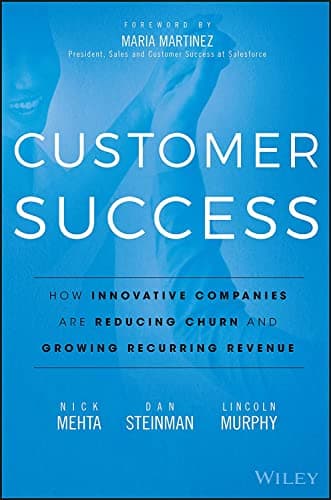
Customer Success
On this pageWhat I like
What I like about this book
It treats customer success as a business function with a job you can measure, and it backs that up with ten chapters written by people who ran the function at real subscription companies. I like that the practical half is organised by company size and touch level, so a small team can find the part that fits. The history of Salesforce's churn problem at the start is the best argument I have seen for why retention deserves its own owner.
Why read it
Shows why a subscription business has to own customer outcomes after the sale, and gives ten practical laws for doing it.
The problem it solves
A one-off sale pays out at the point of purchase. A subscription pays out over time, and only if the customer stays. The book starts from that shift and argues that many companies still behave as if the sale were the finish line. They add customers at the top of the funnel while customers leak out of the bottom, and no amount of new business fixes a high churn rate.
Customer success is the authors' answer: a function and a philosophy aimed at making sure customers get the result they paid for, so that they renew and buy more.
What changes in how you work
You stop waiting for a complaint. You decide what a healthy customer looks like, you track it, and you contact the customers who are slipping before the renewal date. The book is blunt that this is a different job from support, with different people, different data and different targets.
It also changes the conversation inside the company. Sales qualification, product priorities and onboarding all become questions about whether a customer can be made successful, and the book gives examples of how each team's decisions look different once someone owns retention.
The ten laws are the practical core
About half of the book is the ten laws, each written by a different practitioner. They cover who to sell to, how customers and vendors drift apart, customer health, loyalty at scale, product, time-to-value, metrics and top-down commitment. Each chapter says how well it applies to B2B software, subscription, pay-as-you-go, consumer and traditional businesses, so you can skip what does not fit.
I would read the chapters on health, time-to-value and churn metrics first. They are the ones you can turn into a spreadsheet and a weekly routine within a month.
When to read it, and when not to
Read it when you sell on subscription, retainer or any repeat contract and you see churn, slow adoption or weak renewals. It is also useful when you are deciding where the function should sit and who should own the retention number.
It was written in 2016 by people at a customer success software company, and the examples lean towards large software vendors. Some practices, such as a scored health model or a chief customer officer, need scale. A small team can take the principles and run them on a short list of accounts. Be aware too that the book makes the case for its own subject, so read the claims about inevitability with a sceptical eye.
Decisions you can log, work you can repeat
This fits how I like to run a business. Each account has a goal, a state and a next step, and those are decisions worth writing down: what the customer wanted, what was agreed and how it went. The book's push to define what success means for each use case is the same idea at company level.
The recurring work it describes, such as onboarding milestones, usage alerts, check-in emails and renewal preparation, is the kind of thing you can turn into a playbook first and automate later.
Who it's for
Key take-aways
Book summary
Nick Mehta and Dan Steinman, both of Gainsight, argue that the move to recurring revenue changes what a company owes its customers. Because customers can leave at each renewal, the vendor has to make them successful after the sale, and that needs its own people, data and leadership. The book has three parts: the history and case for customer success, ten laws from ten practitioners, and a closing look at the chief customer officer role, technology and the future.
Chapter 1: "The Recurring Revenue Tsunami: Why Customer Success Is Suddenly Crucial"
The opening story is Salesforce in 2005. David Dempsey, who ran renewals, told the executive team that monthly churn of 8 per cent meant almost every customer was leaving within a year, despite the growth on the surface. The authors credit that presentation with starting the customer success movement.
The chapter then explains the difference between attitudinal and behavioural loyalty, using Apple's Genius Bar as an example of a company that invested in the first kind. It follows the rise of software as a service and subscriptions, and shows how power moved from the seller to the buyer. A healthy installed base needs three things at once: new customers, high retention and upsell.
Chapter 2: "The Customer Success Strategy: The New Organization versus the Traditional Business Model"
Here the authors list three benefits: managing churn, growing contract value in existing accounts and improving the customer experience. They warn that customer success cannot make up for a weak product or a sales team that sets the wrong expectations.
They separate it from customer experience, account management and especially support. Support reacts to problems and is measured on efficiency, whereas customer success predicts problems and is measured on retention. A worked example shows the person who owns retention ending up with a larger annual target than the head of sales, and a section on cross-functional impact says sales, product and services all have to change.
Chapter 3: "Customer Success for Traditional Nonrecurring Revenue Businesses"
The authors argue the ideas apply beyond software, since customer success is another name for building loyalty. They use an airline's delay messages as an example. The chapter introduces three coverage models: high touch for large accounts, low touch for the middle, and tech touch, where email and other automation reach many customers at once.
It also gives practical advice on headcount: estimate the time each task takes and size the team by contract value, not customer count.
Chapter 4: "The Practice of Customer Success"
This short chapter opens Part II. It explains that the ten laws come from a 2015 guide commissioned by Bessemer Venture Partners, written by ten experts, and reproduced here with extended commentary. Each law is rated for how relevant it is to different types of business.
Chapter 5: "Law 1: Sell to the Right Customer"
Ted Purcell argues that the wrong customers cost far more than the lost contract. They pull resources away from customers you could serve well, so the whole company should agree on the ideal profile and keep feeding back what sales and success learn.
Chapter 6: "Law 2: The Natural Tendency for Customers and Vendors Is to Drift Apart"
Karen Pisha compares the relationship to two empty boats that drift apart unless someone rows. She lists the causes of churn one by one, among them unrealised business value, stalled implementation, loss of a project sponsor, low adoption and acquisition of the customer, and gives telltale signs and steps for each.
Chapter 7: "Law 3: Customers Expect You to Make Them Wildly Successful"
Nello Franco says customers buy an objective, not features. You need to know how the customer measures success, whether they are achieving it, and what the experience has been along the way. He asks for a regular cadence of tracking and for challenging the customer with new insight.
Chapter 8: "Law 4: Relentlessly Monitor and Manage Customer Health"
Dan Steinman compares customer health to the sales pipeline: it predicts renewal and upsell. He recommends a score built from components such as product adoption, because a component gives the account manager something specific to change. Observing without acting is, in his words, close to useless.
Chapter 9: "Law 5: You Can No Longer Build Loyalty through Personal Relationships"
Bernie Kassar says relationships cannot scale across every account. He suggests segmenting customers, defining a coverage model and cadence for each segment, building a customer community and running a feedback loop.
Chapter 10: "Law 6: Product Is Your Only Scalable Differentiator"
Kirsten Maas Helvey ties retention to a product that is easy to use and becomes part of how people work. She recommends product advisory councils and communities of practice that feed customer input into product design.
Chapter 11: "Law 7: Obsessively Improve Time-to-Value"
Diane Gordon notes that a long onboarding leaves little of a one-year contract to show value. Set concrete success measures, implement in phases so the first result arrives early, and adjust as you go.
Chapter 12: "Law 8: Deeply Understand Your Customer Metrics"
Kathleen Lord gives five steps for defining and measuring churn and retention. They include capturing order types and cancellation reasons, separating avoidable from unavoidable churn, and keeping a standard measurement period.
Chapter 13: "Law 9: Drive Customer Success through Hard Metrics"
Jon Herstein uses the idea of process maturity to argue that customer success must become repeatable and measured. He groups metrics into customer behaviour, account manager activity and business outcomes, and notes, paraphrasing Nick Mehta, that "no one buys your software so they can log into it."
Chapter 14: "Law 10: It's a Top-Down, Company-Wide Commitment"
Nick Mehta argues for customer success as a third core process next to building and selling. His advice for leaders is to define what success means for each use case, align each function behind it and listen to the customer success team as a source of signal.
Chapter 15: "The Rise of the Chief Customer Officer"
Part III begins with the new post-sales organisation: groups such as services, training, support, implementation, customer success and sales under one executive. The book gives each a primary measure, such as utilisation, time-to-value, efficiency or retention, and argues for putting renewals and upsell in the same organisation.
Chapter 16: "Customer Success Technology"
The chapter says customer success is about turning data into information and information into action. It describes what tools should do: gather customer data, direct the account manager's time, sharpen every touch, scale, support collaboration and help manage the team.
Chapter 17: "Where Do We Go from Here?"
The closing chapter predicts the spread of customer success beyond software, more operational work and less reliance on personal relationships. It walks through an imagined account from signature to renewal, and ends with Starbucks as an example of a company that has built loyalty. As the authors put it, the stakes are "life or death in the subscription economy."
What to do with it
- Write down, for your three biggest customer types, what success means to the customer and how you will know.
- Define a health score from a few components you already have, such as usage, support volume, late payments and survey results, and review the red accounts weekly.
- Record the reason for every cancellation or downgrade, and mark each as avoidable or not.
- Split your customers into segments by contract value and decide what level of contact each one gets.
- Measure how long a new customer takes to reach their first result, and cut the first phase of onboarding until it is short.