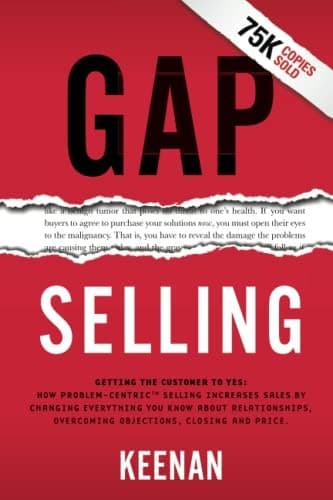
Gap Selling
On this pageWhat I like
What I like about this book
It makes a clear, uncomfortable point: buyers do not care about your product until they see a problem worth solving. I like that it gives you a way to work out the size of that problem, so a price can be set against something real. It is firm, sometimes harsh on salespeople, and all the more useful for it.
Why read it
It shows you how to sell by finding and sizing the gap between where the buyer is and where they want to be.
The problem it solves
Many salespeople lead with the product. They explain what it does, show a demo and wait for the buyer to be impressed. Keenan argues that this treats a sale as a presentation, when it is closer to a diagnosis. If you cannot describe the buyer's problem better than the buyer can, you have not earned the right to propose a fix. Gap Selling is a systematic way to learn the problem before you talk about the solution.
What changes in how you sell
Discovery becomes the main event. You ask questions to understand the buyer's current state, the causes behind it and its effects on the business and on the person. You then describe the future state and measure the difference. Your proposals refer to the buyer's own numbers, and you lose less time on deals that were never going anywhere because you identify them earlier.
Why it matters for a growing business
A company that sells on a clear problem finds it easier to justify price and shorter to close. That is because the buyer has already seen the cost of doing nothing. The method also helps you decide whom to sell to: customers with a large, well-understood gap are better prospects than those who are curious. For a founder, it is a way to learn what customers truly struggle with, and that feeds back into the product.
When to read it, and when to skip it
Read it if you sell something where the buyer must be persuaded to change, and where deals involve several conversations. It is especially good for software, services and other considered purchases. Skip it if you sell a simple, low-priced product, where a long diagnosis would be excessive. The tone is forceful and some of the framework is heavy for small deals, so take the principles and scale the effort to the size of the sale.
Turning discovery into a playbook
The idea that I would take from it is to treat discovery as a repeatable set of questions. Write down the questions that expose the current state, the causes and the impact, record the answers in a consistent format and review them after each call. Patterns will show which problems are common among your best customers, and which questions are most effective. That record is the raw material for training new reps and for building tools that help prepare calls.
Who it's for
Key take-aways
Book summary
Jim Keenan argues that selling is the work of understanding a buyer's problem and showing how your offer closes the gap between where they are and where they want to be. He rejects the idea that sales is an art driven by charm, and presents it as a discipline that can be taught. The book was published in 2018 by A Sales Guy Publishing, and it is aimed at salespeople who want to move from describing products to diagnosing problems.
Sales as problem solving
Keenan starts from the claim that people buy because they have a problem. A product is of interest only when it relates to something the buyer wants to fix. He contrasts this with the common approach of starting with features, which assumes the buyer already sees the need. In his view the seller's first job is to understand and, where necessary, to help the buyer understand their own situation.
Current state, future state and the gap
The central model is simple. The current state is how things are for the buyer today, including the problems they face. The future state is where they want to be. The gap between them is what a purchase is meant to close. Keenan teaches sellers to map both states in detail, because a buyer who sees a large gap has a reason to act and a buyer who sees a small one does not. If you cannot find a gap, you are probably talking to the wrong person.
Problem knowledge over product knowledge
A notable argument is that sellers should know their buyers' problems more deeply than their own products. Product knowledge helps once you have found a fit, but problem knowledge is what lets you ask good questions and recognise patterns. A seller who has seen the same problem many times can spot it quickly and explain it in terms the buyer recognises. Keenan encourages reps to study the problems of their market before the features of their offer.
Finding root causes
Buyers often describe symptoms and not causes. Keenan teaches sellers to ask follow-up questions that move from what the buyer says is wrong to why it is happening. The solution must address the cause or it will not last. This also changes the relationship, since a seller who finds a cause the buyer had missed becomes an adviser and not a vendor.
Quantifying the impact
Keenan stresses that problems must be measured. He wants the seller to establish what the gap costs the buyer, in money, time or risk, and to look at the effect on the individual as well as the business. When the impact is quantified, the buyer can weigh it against the cost of your solution and decide. This also helps buyers build a case internally, because they can show colleagues the size of the problem in numbers.
The seller as diagnostician
Keenan compares the best salespeople to doctors. A doctor does not prescribe before asking questions and running tests, and a seller who proposes a solution before understanding the problem loses credibility. The comparison also explains why the method asks for patience. Time spent on discovery is time not spent on presenting, and the book argues that the first is worth far more than the second. It places the burden of preparation on the seller, who is expected to arrive at each call with a view of the likely problems.
Sales is a process you can measure
Keenan insists that selling is a science, not an art, and that results come from a method applied consistently. That means the questions, the stages and the outcomes can be defined, tracked and improved. For sales managers this has practical consequences: a shared model of the gap makes coaching easier, because everyone is using the same language. For a small company it means the process can be written down and taught instead of living in one person's head.
Qualifying out
The final theme is honesty about fit. If discovery shows that there is no gap, or that your product cannot close it, Keenan advises you to say so and move on. This saves time and builds credibility, and it keeps your pipeline free of deals that were never real. He treats this as a sign of a professional seller and not of a failed one.
What to do with it
- Write down the current state, the future state and the gap for each open deal, and mark what you are guessing.
- Prepare a list of discovery questions that move from symptoms to root causes, and use the same list on every call.
- Put a number on the impact of the problem for every active prospect and check it with them.
- Study the three most common problems among your best customers before you refine your demo.
- Drop or pause any deal where you cannot find a real gap.