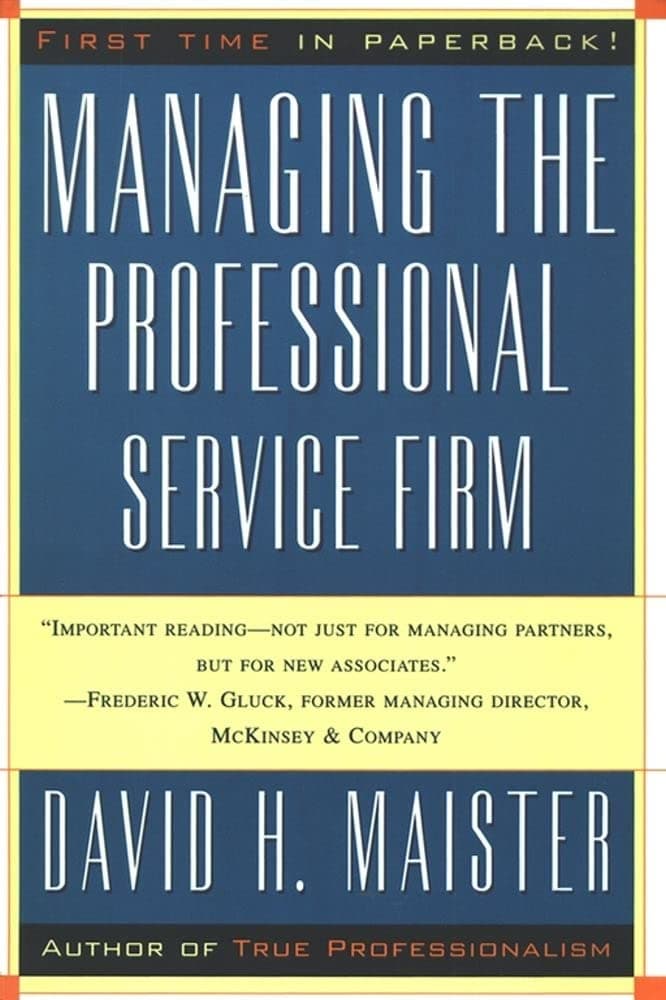
Managing the Professional Service Firm
On this pageWhat I like
What I like about this book
It made me respect the economics of services. It’s dry but deeply useful.
Why read it
It explains how to run a consultancy or service firm without burning out.
Managing the Professional Service Firm by David H. Maister is on our shelf for the people side of a business, on the productivity line. We only recommend a book when it gives you something you can put to work, not just something to agree with.
It is one of the books behind our playbook Managing clients solo, so its ideas already have a place to land in your week.
Who it's for
Key take-aways
Book summary
Introduction
David H. Maister’s Managing the Professional Service Firm is a comprehensive guide to addressing the unique challenges of managing organisations whose primary asset is intellectual capital. Drawing from his experience consulting across diverse industries, Maister provides insights into balancing client service, employee satisfaction, and financial performance. The book is structured around practical frameworks and actionable advice, addressing the lifecycle, structure, and dynamics of professional service firms (PSFs).
Key Themes and Concepts
The three goals of professional firms
Maister identifies three interdependent goals for PSFs:
- Outstanding client service: Delivering customised solutions to complex problems.
- Employee satisfaction: Creating fulfilling and rewarding careers.
- Economic success: Achieving financial growth and sustainability.
Balancing these goals requires careful management of leverage (the ratio of juniors, mid-level staff, and seniors) to match the demands of client work and internal career development.
Project types and leverage
Maister categorises PSF projects into three types:
- Brains projects: High innovation and complexity, requiring senior expertise and creativity.
- Grey hair projects: Problems solved through experience and judgement rather than cutting-edge innovation.
- Procedure projects: Standardised work requiring efficiency and scalability.
Each project type dictates a different organisational structure and staff composition. For example, brains projects are less leveraged, requiring a high proportion of senior involvement, while procedure projects allow for greater use of junior staff.
The professional lifecycle
Maister outlines the stages of a professional’s career apprenticeship, mastery, and partnership. Career development within PSFs hinges on mentorship and the promotion of top talent. Firms must balance growth with retention to ensure a sustainable flow of opportunities for juniors while maintaining profitability.
Managing Client and Employee Relationships
Client-centric strategies
Maister stresses the importance of building long-term client relationships through exceptional service and consistent delivery. Key tactics include:
- Listening to client needs and adapting services accordingly.
- Maintaining high standards of quality in both technical work and service delivery.
- Developing expertise in solving recurring client problems efficiently.
Building human capital
Employee development is crucial for PSFs, as their value lies in intellectual resources. Maister advocates:
- Clear career paths with opportunities for advancement.
- Training and mentorship programmes that prepare juniors for leadership roles.
- Maintaining high morale through meaningful work and transparent promotion criteria.
Financial and Organisational Strategies
Profitability and growth
Maister warns against unchecked growth, which can dilute profitability and strain resources. He argues that sustainable growth stems from:
- Pursuing work that aligns with the firm’s capabilities and structure.
- Balancing staffing levels to match client needs while preserving profitability.
- Avoiding reliance on vanity metrics like headcount or revenue without considering per-partner profits.
Governance and culture
Effective governance in PSFs depends on aligning decision-making structures with organisational goals. Maister emphasises a collegial culture, where leadership inspires rather than dictates, and collaboration drives success.
Conclusion
Maister concludes that the unique dynamics of PSFs require tailored management practices. Success lies in balancing the demands of clients, staff, and financial performance while fostering a culture of collaboration and continuous improvement.
Key Takeaways
- Align structure with client needs: Tailor organisational leverage to project types.
- Invest in people: Prioritise employee development to sustain long-term success.
- Balance growth and profitability: Focus on sustainable growth rather than rapid expansion.
- Foster collaboration: Build a collegial culture that aligns individual and organisational goals.
Managing the Professional Service Firm is a vital resource for leaders and managers seeking to navigate the complexities of professional service organisations effectively.