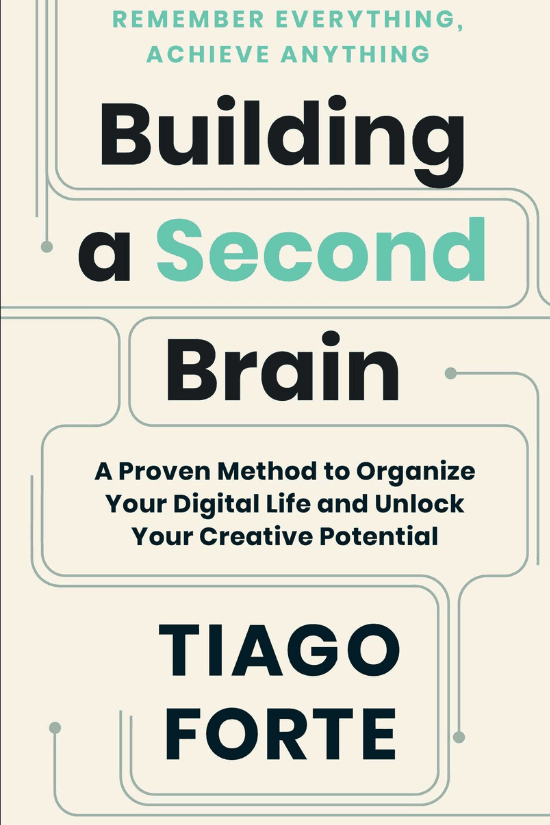
Building a Second Brain
On this pageWhat I like
What I like about this book
It’s the best modern system for storing and resurfacing your thinking. Notion and Evernote finally made sense after this.
Why read it
If your knowledge system is a mess, this helps you rebuild it into something useful and trusted.
Building a Second Brain by Tiago Forte is on our shelf for the people side of a business, on the productivity line. We only recommend a book when it gives you something you can put to work, not just something to agree with.
It is one of the books behind our playbook Get the chaos out of your head, so its ideas already have a place to land in your week.
Who it's for
Key take-aways
Book summary
Introduction
Building a Second Brain presents a revolutionary approach to managing the overwhelming flow of information in the modern world. Tiago Forte outlines a method for creating a “Second Brain,” a digital system to capture, organise, distill, and express knowledge. This system aims to free up mental space, enhance creativity, and allow individuals to focus on what truly matters. By using tools like note-taking apps and frameworks for organising information, the book teaches readers how to transform fleeting ideas into actionable insights and long-term value.
Part I: The Foundation
Chapter 1: Where it all started
Forte introduces the concept of a Second Brain through his personal journey of overcoming cognitive challenges. Drawing on systems of personal knowledge management (PKM), he explains how keeping notes and organising information outside his mind allowed him to focus on creativity and productivity. He emphasises that the human brain is for having ideas, not holding them.
Chapter 2: What is a Second Brain?
A Second Brain is described as a digital extension of our memory. It stores valuable insights, ideas, and knowledge in a way that is searchable, reusable, and actionable. By leveraging technology, individuals can manage the increasing complexity of modern life while reducing mental strain. Forte draws parallels with historical tools like commonplace books, which intellectuals used to organise their thoughts.
Chapter 3: How a Second Brain works
Forte outlines the four "superpowers" of a Second Brain:
- Making ideas concrete: Turning abstract thoughts into tangible, actionable insights.
- Revealing associations: Connecting diverse ideas to spark creativity.
- Incubating ideas: Allowing thoughts to mature over time for deeper insights.
- Sharpening perspectives: Using organised information to support clear, confident thinking.
Part II: The Method
Chapter 4: Capture – Keep what resonates
The first step of the system is capturing information that feels meaningful or inspiring. Forte encourages readers to act as curators, collecting only what truly resonates with them. This reduces information overload and focuses attention on ideas with long-term value.
Chapter 5: Organise – Save for actionability
The book introduces a system called PARA (Projects, Areas, Resources, and Archives) to organise captured information. This structure aligns notes with actionable goals and ongoing responsibilities, ensuring that they remain relevant and accessible.
Chapter 6: Distill – Find the essence
Forte encourages readers to distill their notes into concise, actionable insights. By focusing on the main takeaways or key ideas, individuals can quickly recall important information without wading through unnecessary details.
Chapter 7: Express – Show your work
The ultimate goal of a Second Brain is to turn knowledge into creative output. Forte explains how to use the organised information to write reports, give presentations, or create content that benefits others. Sharing knowledge not only reinforces learning but also amplifies its impact.
Part III: The Shift
Chapter 8: The art of creative execution
Forte explains how a Second Brain empowers individuals to take meaningful action. By having a trusted system to manage ideas, they can focus on execution rather than struggling with organisation or memory.
Chapter 9: The essential habits of digital organisers
This chapter outlines practical habits for maintaining a Second Brain, such as regular reviews, prioritising tasks, and updating information. Forte compares this process to tending a garden, requiring consistent but minimal effort to ensure growth and utility.
Chapter 10: The path of self-expression
The book concludes by emphasising the transformative potential of the Second Brain. Beyond productivity, it fosters personal growth, self-expression, and a deeper connection with one’s creativity.
Key Takeaways
- Offload your brain: Use technology to manage information so your mind can focus on creativity and problem-solving.
- Organise for action: Align knowledge with your goals and priorities using the PARA method.
- Turn knowledge into output: Use your Second Brain to create meaningful work and share valuable insights with others.
- Make information timeless: Capture and refine knowledge in a way that remains useful over time.
Building a Second Brain is a guide to thriving in the Information Age, offering tools and mindsets to harness knowledge and unlock creative potential.