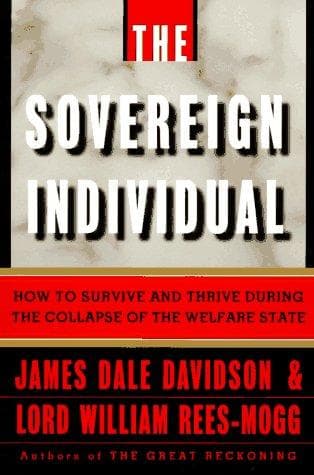
The Sovereign Individual
On this pageWhat I like
What I like about this book
It is provocative, and it makes you ask who holds power over your income, which most business books never do. Some of its specific forecasts did not arrive as written, and Peter Thiel's own preface says the authors missed the rise of China. I'd read it as an argument that stretches your thinking about technology, money and work that is not tied to a place, not as a plan.
Why read it
It argues that information technology moves power from institutions to individuals and asks what that means for your money, work and business.
The problem it solves
Most business reading looks at the next year or two. Davidson and Rees-Mogg look at the next few decades and ask how the move from an industrial economy to an information economy could change what governments can do, how people earn and how money works. For someone who sells knowledge or software, the question is practical: who captures the value you create, and who stands between you and your customers?
Their answer is blunt and political, and it is more argument than evidence. That is why it is worth reading with a pen: it gives you a set of claims to test.
What changes in how you think
After reading it you ask where your income depends on a gatekeeper. A single employer, a platform, one large client or one jurisdiction may hold more power over your business than you have noticed. The authors draw on Ronald Coase's question of why firms exist, and argue that falling information and transaction costs weaken the advantages of large, long-lived firms. Whether or not they are right about the pace, it is a useful lens for a small company: which tasks need to sit inside the business, and which could be bought?
It also trains a long-run habit. Ask what a technology does to the cost of controlling, taxing or copying something, and who gains when that cost falls.
When to read it, and when not to
Read it when you want a bigger frame for decisions about where to live, where your customers are and how to spread your income. It works as a prompt for a long walk, not as a manual.
Be careful. It is polemical and takes a strong political position, it was written in the late 1990s and its early chapters lean on the Year 2000 computer bug, and some passages, such as those on nationalism and genetics, are speculative. Thiel's own preface says the authors missed the rise of China. The closing pages also promote the authors' own investment newsletters and an offshore wealth guide, which is a good reason to check every financial or legal idea independently. Do not make a money or tax decision from this book.
How it connects to running and growing a business
Their underlying question, who captures the value, is a good test for any business model. Write it down as a decision: which parts of our value do we control, and which do we rent from somebody else? Revisit it each year.
Their argument about earnings is also worth testing against your own business. They expect rewards to concentrate on the best people in each field as markets become global, which affects how you price, hire and decide what to keep in-house. And work that can be described precisely and delivered from anywhere is exactly the kind of work that can be written into a playbook and handed to people or software.
Who it's for
Key take-aways
Book summary
Davidson and Rees-Mogg argue that the industrial age and its nation-states are ending, and that the information age will liberate individuals with valuable skills at the expense of mass institutions. Their method is megapolitics, the idea that the logic of violence, meaning who can use force and at what cost, shapes politics and economics more than ideology does. The book was first published in 1997 and uses the coming year 2000 as its frame. A preface by Peter Thiel, dated 2020, says the authors got some things wrong, above all the rise of China, and calls AI and cryptography the two poles of the contest over the future.
The Transition of the Year 2000: The Fourth Stage of Human Society
The opening chapter treats the millennium as an inflection point. The authors use the Year 2000 computer bug, caused by two-digit dates, as an example of how fragile centralised industrial systems are. History, they say, has had three stages of economic life (hunting and gathering, agriculture and industry), and a fourth, the information society, is arriving. Because it transcends place, it will cut the returns to violence, and the revolution will happen within a lifetime and almost everywhere at once. For those who can educate and motivate themselves, ideas become wealth and merit is rewarded. The same shift brings more individual responsibility and a painful transition.
Megapolitical Transformations in Historic Perspective
The second chapter sets out the factors that change the economics of force. They group them as topography, climate, microbes and technology. The first three change slowly, while technology changes fastest and now matters most. Early states arose on river floodplains where whoever controlled the water had power, and Greek geography favoured farmers and democracy. The point is that political forms follow the cost of force.
East of Eden
Farming created something to steal, so violence became a specialised activity and property emerged. Rulers, god-kings and local lords built monopolies of protection. The chapter calls this the sophistication of violence, and treats government as the organisation of that monopoly, with a long history of its own.
The Last Days of Politics
The authors compare the fading nation-state with the medieval Church of the late fifteenth century. Both were dominant institutions whose officials were held in contempt even while the office was thought sacred. They argue that politics, as the preoccupation with controlling the power of the state, is a modern invention that will end with the modern world. The printing press undermined the Church, and they say microtechnology will do something similar to the state.
The Life and Death of the Nation-State
The nation-state, they say, is a two-hundred-year episode that began with the French Revolution in 1789 and ended with the fall of the Berlin Wall in 1989. Democracy and nationalism worked as ways of raising resources for mass armies. They challenge the idea that voters are customers in control: only a small share of government spending goes on protection, and the people who pay the bills do not set its priorities.
The Megapolitics of the Information Age: The Triumph of Efficiency over Power
Drawing on the historian Frederic Lane's work on the economics of violence, they argue that the cost of protection explains the rise of both governments and unions, whose hold over capital came from the power to extort. They say microprocessing removes much of that hold. Because no government can monopolise cyberspace, it works like the open sea or a medieval frontier, a place where competition among protectors replaces plunder.
Transcending Locality: The Emergence of the Cybereconomy
For all of history, economies were tied to a local area. The authors say the information superhighway is the wrong metaphor, because cyberspace is a destination, not a road. They point to the collapse in the cost of long-distance communication and argue that tax and inflation, which work as protection rackets on a place, will be uncompetitive in an economy that can move online. They also forecast cybermoney: encrypted, denationalised digital cash that would end inflation as a source of government revenue.
The End of Egalitarian Economics: The Revolution in Earnings Capacity in a World Without Jobs
Inequality will rise beyond the old 80-20 split described by Pareto. They illustrate this with Ammon's turnip, a dice-based picture of how ability is distributed, to argue that a small rise in the skill needed for work leaves many people outside the economy and few qualified for the top. Locational advantages shift as governments lose power to tax. Falling transaction costs shrink the advantage of large firms, which they expect to give way to what they call the virtual corporation. They also cite Mancur Olson's view that poor countries are held back by bad government, not by a shortage of capital.
Nationalism, Reaction, and the New Luddites
As the nation-state wobbles, the authors expect most political agendas to become reactionary, with environmentalists, socialists and nationalists all defending the state. They treat nationalism and language as artefacts of power, and they speculate about nationalism's roots in inclusive fitness and genetics. They argue that citizenship will matter less as individuals gain choice, and they compare the transition with the early modern period, when real incomes for much of the population fell for generations.
The Twilight of Democracy
Democracy, they say, has depended on military conditions that favoured the masses: cheap weapons, weapons that amateurs could use and an advantage for large infantry armies. Those conditions have gone. They also argue that representation by geography is an artefact of power. What they expect to replace politics is commercialised sovereignty, a market for governance in which the individual picks services the way he picks a pair of jeans.
Morality and Crime in the Natural Economy of the Information Age
As the nation-state decays, they predict that criminal organisations and corrupt officials will gain real power, and that military power will count for less. They stress that strong societies rest on a moral order, citing the trust that built Quaker business, and that people will need to judge true from false more carefully when media can be made to order.
Afterword: Devolution and the Law of Diminishing Marginal Returns
Citing Joseph Tainter on the collapse of complex societies, they argue that big, centralised states face diminishing returns on control, and point to taxes rising from 27.8 per cent of US median income in 1957 to 37.6 per cent in 1997. Devolution of power, they say, has historically looked like collapse. The book ends with a resources appendix that includes promotion of the authors' own services.
What to do with it
- List your income sources and note, for each, which single employer, platform, client or jurisdiction could end it.
- Write down which of your skills could be sold to customers anywhere, and which depend on a local relationship.
- Pick one claim from the book, such as digital money or the shrinking of firms, and write what evidence would convince you it is true or false.
- Treat the closing resources section as marketing and check any investment or legal idea independently.
- Record your decision about where to diversify, with the reasons, and review it every year.