The Science of Selling
On this pageWhat I like
What I like about this book
This book combines behavioural science with sales tactics. It’s research-backed and highly applicable.
Why read it
It sharpens both your sales conversations and your copy.
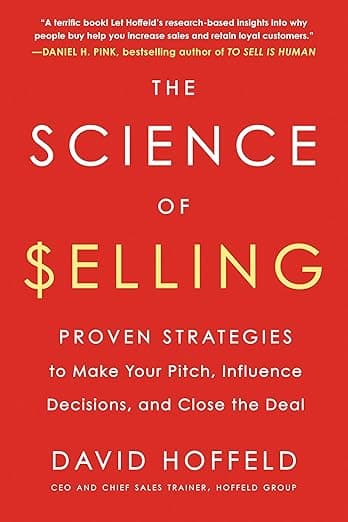
The Science of Selling by David Hoffeld is on our shelf. We only recommend a book when it gives you something you can put to work, not just something to agree with.
Below: who it is for, what it says in short, and how to turn it into a change in how your business runs. Two minutes, and you will know if it belongs on your desk.
Who it's for
Key take-aways
Book summary
Introduction David Hoffeld’s The Science of Selling integrates cutting-edge research from psychology, neuroscience, and behavioural economics to transform the art of sales into a science. Hoffeld argues that understanding how people make buying decisions enables salespeople to influence behaviour predictably and ethically. The book provides actionable strategies grounded in research to help sales professionals improve every stage of the sales process.
Part I: Foundations of Selling with Science
Why salespeople underperform
Hoffeld highlights that traditional sales methods often fail because they rely on anecdotal techniques rather than proven principles. A major issue is the misalignment between how salespeople sell and how buyers make decisions. He stresses the importance of adopting a scientific approach to influence effectively.
The two methods of sales influence
Influence occurs through two primary routes:
- The central route: Engages logical reasoning and critical thinking.
- The peripheral route: Relies on heuristics, or mental shortcuts, that shape quick decisions.
Hoffeld explains how leveraging both methods enhances the likelihood of success. For instance, presenting information in a logical sequence while building trust creates a powerful synergy.
Selling the way people buy
Hoffeld introduces the Six Whys, a framework representing the mental questions buyers subconsciously ask before making a purchase:
- Why change?
- Why now?
- Why your industry?
- Why you?
- Why your product/service?
- Why spend the money?
Addressing these questions ensures the sales process aligns with the buyer’s decision-making journey.
Part II: The Salesperson’s Toolkit
The science of asking questions
Hoffeld explains that well-crafted questions uncover buyer motivations, needs, and objections. He advises avoiding closed or leading questions, which can inhibit meaningful dialogue. Instead, focus on open-ended questions that encourage buyers to share insights and priorities.
Creating value and overcoming objections
Buyers perceive value when solutions address their primary motivations. Hoffeld shares strategies to:
- Create tailored solutions.
- Frame objections as opportunities to provide clarity.
- Neutralise competitors by emphasising unique value propositions.
Closing redefined
Hoffeld challenges traditional “hard closing” techniques, which often create resistance. He advocates for a methodical approach to gaining incremental commitments throughout the sales process, reducing pressure during the final close.
Presentation strategies
Hoffeld highlights five scientific principles for effective presentations:
- Primacy and recency effects: Position key points at the beginning and end for maximum retention.
- Storytelling: Use narratives to engage emotions and simplify complex ideas.
- Visual aids: Enhance understanding through images and diagrams.
- Personalisation: Tailor content to the audience’s preferences.
- Interactive dialogue: Involve buyers to maintain engagement and reinforce understanding.
Part III: Merging Science and Selling
The future of selling
Hoffeld predicts that sales will increasingly integrate scientific insights, transforming it into a more predictable and respected profession. He identifies five core qualities for successful salespeople:
- Growth mindset.
- Emotional intelligence.
- Ethical integrity.
- Adaptability.
- Mastery of evidence-based techniques.
Hoffeld concludes with a call to action for sales professionals to embrace continuous learning and adopt science-backed methods to thrive in a competitive marketplace.
Key Takeaways
- Focus on the buyer’s decision-making process: Align sales strategies with how people naturally make decisions.
- Leverage science-based tools: Use research to guide questioning, objection handling, and presentations.
- Adopt a growth mindset: View failures as learning opportunities to refine skills.
- Build trust and relationships: Prioritise ethical and transparent interactions.
The Science of Selling provides a framework for sales success, bridging the gap between theoretical research and practical application. It is a valuable resource for salespeople, managers, and anyone seeking to influence effectively.