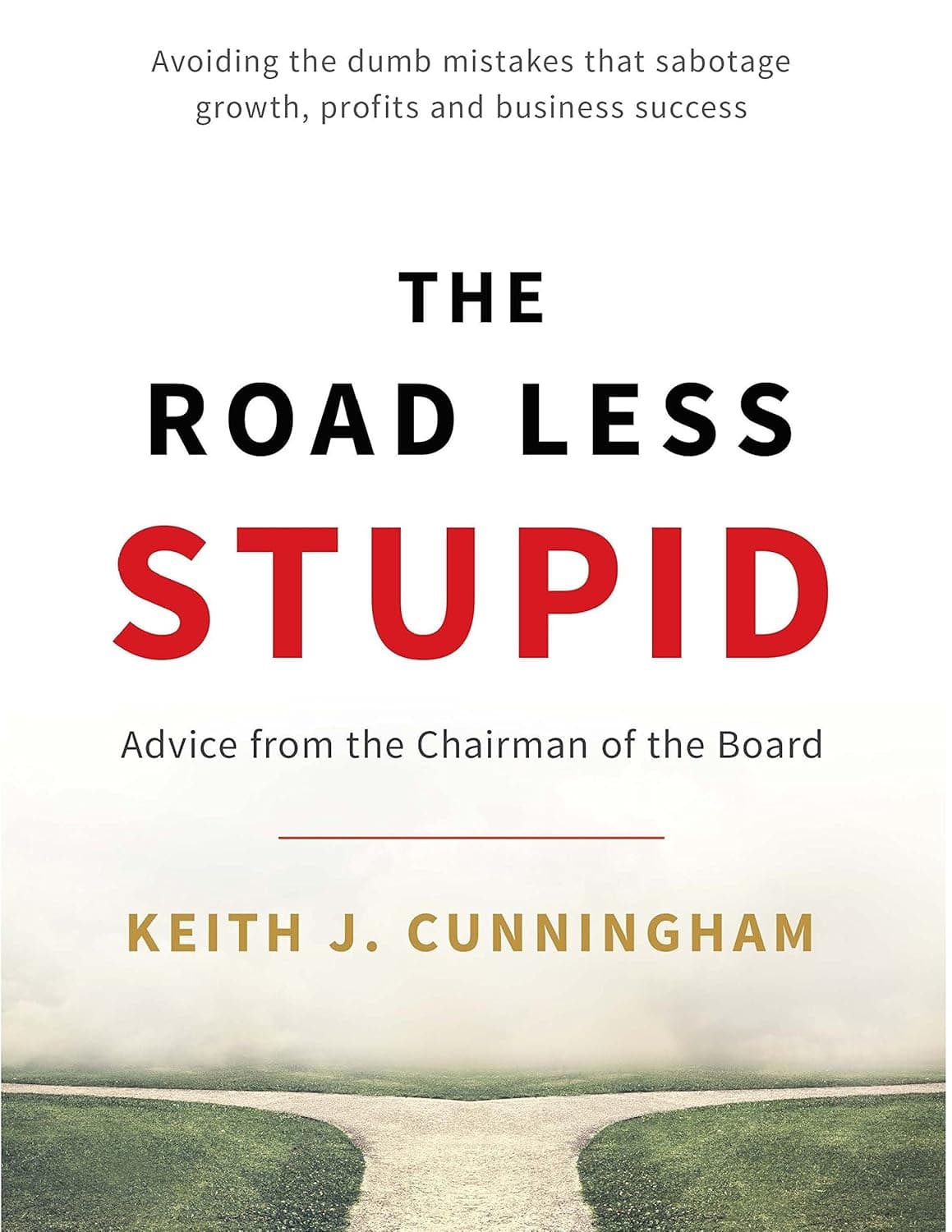
The road less stupid
On this pageWhat I like
What I like about this book
This book taught me that most business problems are thinking problems. It’s full of brutal wisdom and strategic prompts.
Why read it
It helps you think like a long-term business owner, not just a busy operator.
The road less stupid by Keith J. Cunningham is on our shelf. We only recommend a book when it gives you something you can put to work, not just something to agree with.
Below: who it is for, what it says in short, and how to turn it into a change in how your business runs. Two minutes, and you will know if it belongs on your desk.
Who it's for
Key take-aways
Book summary
Introduction
"The Road Less Stupid" is a practical guide for business leaders and entrepreneurs seeking to minimise mistakes and optimise decision-making. Keith J. Cunningham, a successful businessman and mentor, emphasises the importance of avoiding the "dumb tax" avoidable financial and business mistakes caused by impulsive, poorly thought-out decisions. Through structured thinking time, actionable insights, and a disciplined approach to leadership, the book offers a framework to enhance clarity, improve business outcomes, and create sustainable success.
The Concept of the Dumb Tax
Cunningham introduces the idea of the "dumb tax," which refers to the cost of poor decisions made due to a lack of thoughtful analysis. He argues that avoiding mistakes is often more valuable than pursuing additional opportunities. Success, according to Cunningham, comes not from doing more smart things but from doing fewer stupid things. By identifying and mitigating risks through deliberate thinking, leaders can preserve wealth, reputation, and growth potential.
Thinking Time and the Power of Questions
Cunningham advocates for "thinking time," a structured practice designed to improve clarity and decision-making. This involves dedicating uninterrupted time to deeply consider business challenges, opportunities, and strategies. The foundation of this process lies in asking better questions. Cunningham provides examples of high-quality questions that uncover root problems, challenge assumptions, and stimulate innovative solutions. He encourages leaders to adopt a disciplined, unemotional approach to thinking, which allows for rational analysis over reactive decision-making.
The Five Core Disciplines of Thinking
Cunningham outlines five key disciplines to guide thinking time:
- Find the Unasked Question: Identify the questions that, if answered, could unlock clarity and progress.
- Separate the Problem from the Symptom: Focus on the underlying issue rather than its surface manifestations.
- Challenge Assumptions: Differentiate between facts and the stories we tell ourselves.
- Consider Second-Order Consequences: Anticipate the ripple effects of decisions to evaluate risks and benefits.
- Build the Right Machine: Develop systems and structures that support execution and efficiency.
By mastering these disciplines, leaders can improve their ability to diagnose challenges, craft solutions, and achieve sustainable results.
The Four Hats of Leadership
Cunningham explains the four roles every leader must play to build a successful business:
- Artist: The creative visionary who generates ideas and solutions.
- Operator: The executor who ensures tasks get done efficiently.
- Owner: The strategist who builds systems, measures performance, and ensures alignment with goals.
- Board Member: The critical thinker who evaluates risks and considers long-term sustainability.
Balancing these roles allows leaders to shift their perspective and approach challenges with a well-rounded mindset.
Building a Culture of Excellence
Culture plays a central role in business success, according to Cunningham. He argues that culture is not about perks or superficial benefits but about accountability, trust, and high standards. Leaders are encouraged to establish clear expectations, address mediocrity, and foster a results-driven environment. By creating a culture where excellence is the norm, businesses can achieve extraordinary outcomes.
Avoiding Common Business Mistakes
Cunningham identifies several common pitfalls that entrepreneurs face, including:
- Over-optimism: Ignoring potential risks or underestimating challenges.
- Poor Delegation: Failing to empower team members or effectively allocate responsibilities.
- Neglecting Metrics: Making decisions without adequate data or tracking progress.
- Shortcut Thinking: Pursuing quick wins at the expense of long-term value.
He offers practical strategies to overcome these challenges, such as implementing clear dashboards, leveraging expertise, and focusing on fundamentals.
Execution and Systems Thinking
Execution is highlighted as a critical component of success. Cunningham stresses the importance of creating systems that enable consistent performance and scalability. By measuring results, identifying inefficiencies, and refining processes, leaders can drive progress while minimising waste. The "machine" of a business should be designed to operate independently of the owner, allowing for sustainable growth and flexibility.
Key Takeaways
- Think Before You Act: Structured thinking time prevents costly mistakes.
- Ask Better Questions: Quality questions lead to clarity and innovation.
- Focus on the Fundamentals: Avoid distractions and stick to proven principles.
- Build Systems for Sustainability: Develop processes that enable growth without constant oversight.
- Learn from Mistakes: Use failures as opportunities for reflection and improvement.
"The Road Less Stupid" is a pragmatic guide for leaders who want to achieve success by avoiding avoidable mistakes. Cunningham’s insights are grounded in real-world experience, making this a valuable resource for entrepreneurs, executives, and anyone looking to improve their decision-making.