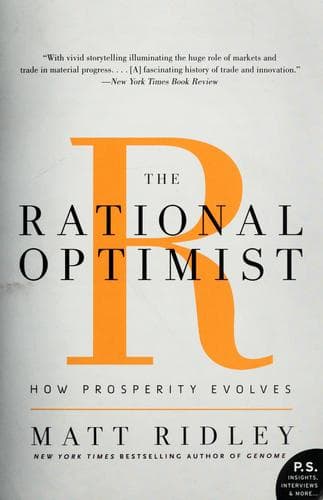
The Rational Optimist
On this pageWhat I like
What I like about this book
It gives you a long view that is rare in business reading. Ridley asks why people became richer and answers with exchange and specialisation, using concrete cases from stone hand axes to Hong Kong. He argues strongly and sometimes one-sidedly on policy, so I'd read the chapters on Africa and climate as his case and check them elsewhere.
Why read it
It argues that exchange and specialisation drove human progress, which gives you a hopeful, evidence-based reason to specialise, trade and plan for growth.
The problem it solves
Business decisions get made in the mood of the moment, and the mood is set by headlines. A year of bad news makes hiring, investing or trying something new feel reckless. Ridley offers a long counterweight. Since 1800, he says, the world's population has multiplied six times while average life expectancy has more than doubled and real income has risen more than ninefold, and he measures prices in hours of work to show how much cheaper everyday things have become. An hour of work buys far more light than it did in 1800.
What makes it more than a mood is that he offers a mechanism. His answer is exchange: when people specialise and trade, ideas combine and output rises.
What changes in how you think
You start to see a business as one node in a large network. Nobody knows how to make a computer mouse, Ridley points out, because it contains the work of hundreds of people or more. So you do not need to make everything yourself, and you should not try. Your suppliers, tools, partners and freelancers each hold skills you can reach by trading for them.
It also changes how you think about ideas. If invention comes from recombining what others have made, the best way to improve is to meet more people, work across more fields and build things that others can build on. Ridley puts it in one line: prosperity is simply time saved.
When to read it, and when not to
Read it for perspective, when the quarter's numbers are crowding out everything else, or when you need a reason to specialise. It is a long sweep from early humans to 2100, so it suits a slow period better than a deadline.
Be careful with the policy chapters. Ridley wrote in the middle of the 2008 banking crisis, and he is open about distrusting markets in assets while backing markets in goods and services. He is strongly in favour of free exchange, sceptical of regulation and confident about energy, climate and Africa. He says he is testing his optimism against the facts, but it is still one side of a debate, so I'd read those chapters and then read an opposing source before they change any decision. If you want a method for a specific problem this month, a more practical book will help faster.
How it connects to running and growing a business
Specialisation is a decision you can log. What do we do ourselves, what do we buy and what do we leave to others? Writing down why you chose each, and checking the choice once a year, stops you drifting into doing everything.
Ridley's point about ideas also fits repeatable work. An idea shared is not used up, so a process you have written down can serve many people at once. Once a task is well understood and documented, it can be traded for, whether to a specialist, a tool or an automated process, and that frees people to work where they add the most.
Who it's for
Key take-aways
Book summary
Ridley argues that human progress is a kind of cultural evolution driven by exchange and specialisation, that it has made most people far better off, and that it can go on. He is a biologist, and the book applies the logic of evolution to economics: what accumulates is ideas, not genes. He calls himself a rational optimist because he reached optimism through evidence rather than temperament. The book runs from early humans to a forecast for 2100, and it is organised as a prologue, eleven chapters and notes. First published in 2010, it was written during the financial crisis, and he expects humanity to be much better off a century later.
Prologue When Ideas have Sex
Ridley compares a stone hand axe made by one person with a computer mouse made by hundreds of people. Human nature has not changed, but culture has, and the question is why. Big brains and language are not enough, because Neanderthals had big brains and did not experience this change. His answer is that the change happened between brains, not inside them. Exchange is to cultural evolution what sex is to biological evolution, because it lets ideas meet and combine. Specialisation then saves time, and he says prosperity is simply time saved. He also says he is chiefly in disagreement with reactionaries of every colour, those who dislike cultural, economic or technological change.
Chapter One A better today: the unprecedented present
He starts by attacking nostalgia, with a fictional family in 1800 coping with disease, hunger and a short life. He backs it with numbers on income, life expectancy and the falling cost of light, food and cars in hours of work. The average person today, he says, has access to more than past kings did. The central story of humanity is that specialists accumulate knowledge so that each of us can consume more and more different things while producing fewer and fewer.
Chapter Two The collective brain: exchange and specialisation after 200,000 years ago
Half a million years ago each toolmaker made their own hand axe, and the design hardly changed for a million years. Later signs of trade, such as shell beads carried far from the coast, mark a change. His main claim is that technology depends on the size and connection of the population, not the size of anyone's brain. Small, isolated groups such as Tasmanians lost technologies, while dense, connected populations gained them. The book's term for this is a collective brain.
Chapter Three The manufacture of virtue: barter, trust and rules after 50,000 years ago
Why do strangers trust each other? Ridley uses the Ultimatum Game, in which people usually offer close to half, and finds that societies that trade more are more generous and fair. Trade rewards behaviour that benefits both sides. But markets need rules: he lists the rule of law, property rights, credit and impartial courts, and argues that tools and rules co-evolve, with specialisation behind both.
Chapter Four The feeding of the nine billion: farming after 10,000 years ago
Farming, he says, is exchange with other species: crops and animals specialise in work for people. A man preserved in the Alps carried the knowledge of many people in his kit. Ridley's case is that intensive farming, helped by fertiliser made with fossil fuels, has spared land on a vast scale, and he says organic farming would need more of it. He backs plant breeding and genetic modification to feed more people and improve nutrition, and he concedes that modern farming may have cost some nutritional quality. This is one of the book's more contested stretches.
Chapter Five The triumph of cities: trade after 5,000 years ago
Cities exist for trade. They grow when trade expands and shrink when it dries up, and the world passed the point where most people live in cities in around 2008, from 15 per cent in 1900. The first cities arose in Mesopotamia as farmers swapped grain and wool for timber and stone. He argues that dense cities are better for the planet, because city dwellers use less land and energy, and he ends by raising the old fear of overpopulation.
Chapter Six Escaping Malthus's trap: population after 1200
Specialisation rises and falls with the food supply. When food is tight, people retreat into self-sufficiency, and the division of labour shrinks. Ridley says the way out of the Malthusian trap is prosperity itself: as people become richer and healthier, birth rates fall, and he claims that the population explosion is petering out. He notes that economists now worry as much about shrinking, ageing populations.
Chapter Seven The release of slaves: energy after 1700
Energy has moved from human muscle to animals, water, wind and then coal and other fossil fuels, and each step let one person do more work for others. Ridley links the first big coal-powered factories with the abolition of the slave trade. He describes watts as the modern equivalent of slaves and cites the Jevons paradox, which says that efficiency tends to increase total consumption. He is sceptical of wind and wave power and favours nuclear power.
Chapter Eight The invention of invention: increasing returns after 1800
Things suffer diminishing returns, but ideas do not: telling someone how to make a bicycle does not use up the idea. So the more people prosper, the more they can invent, and since 1800 the growth in knowledge has outrun population growth. He draws on Paul Romer's work, which treats new knowledge as a product people invest in. He also looks at intellectual property, and says copyright law in particular has become a thicket that makes sharing and building on ideas harder.
Chapter Nine Turning points: pessimism after 1900
Doom attracts prizes and praise, while optimists are called naïve. Ridley lists decades of predicted disasters, each replaced by a new one: population, resource exhaustion, acid rain and pandemics. He argues that many scares passed or were managed, and he defends Julian Simon and Bjørn Lomborg against their critics. He also objects to calls for economic retreat, which he says look like the feudal past.
Chapter Ten The two great pessimisms of today: Africa and climate after 2010
The pessimist's two best cards are Africa and climate. For Africa he argues that it can prosper through trade, free cities, mobile phones, simpler business law and the end of rich-world farm subsidies and tariffs. On climate he accepts that warming is real and partly human-caused, but argues that rapid, severe change and net harm are unlikely, and he criticises the Stern report's low discount rate. This chapter is the most disputed in the book, and it is worth reading with an opposing source beside it.
Chapter Eleven The catallaxy: rational optimism about 2100
The last chapter retells history as the story of a Species that began to exchange, specialise and accumulate habits. Parasites and bureaucracies have often slowed it, but never stopped it. The real threat is a retreat from exchange, as China made for centuries, and he thinks a global retreat is unlikely while somewhere keeps exchange alive. His closing instruction is short: "Dare to be an optimist."
What to do with it
- List what your business does in-house and what it buys, and write one line on why each sits where it does.
- Pick one task you do yourself that a specialist, tool or partner could do faster, and test handing it off.
- Write one process down well enough that someone else could run it.
- Before a big decision, name the pessimistic story you are reacting to and ask what evidence supports it.
- Read the chapters on Africa and climate for the argument, then read one opposing source before they change any decision.