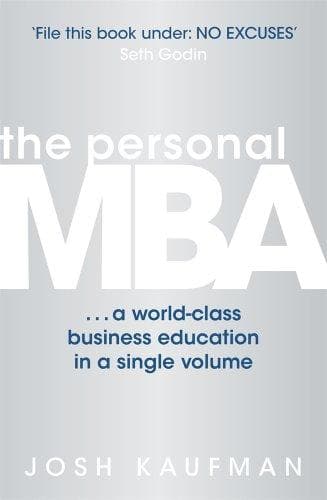
The Personal MBA
On this pageWhat I like
What I like about this book
It is a reference book, and that is its strength. Kaufman breaks business into a few parts and then into short, named ideas you can look up when a problem appears. I'd dip into it where I have a gap, instead of reading it straight through.
Why read it
It gives you a map of how a business works, from value to sales to finance, in short named ideas.
The problem it solves
Many owners learn business by doing it. That works until you meet something you never studied: pricing an offer, reading a cash flow, designing a sales process or deciding whether to borrow. You can patch each hole with a separate book, but you will not see how the pieces connect. Kaufman's answer is a single volume that names the core ideas of business and shows how they link, written for people who did not take the course.
His starting position is blunt. He tells readers to skip business school and educate themselves, and he spends several short chapters making the case before he gets to the ideas.
What changes in how you work
The first change is vocabulary. When you can say that a problem sits in marketing and not in sales, you can fix the right thing. Falling revenue could be a market problem, an attention problem, a sales problem or a delivery problem, and each needs a different fix.
You also get tools for specific moments: ten factors for judging a market before you commit, a way to test an offer by selling a minimal version of it, four ways to support a price, and a plain list of the ways to raise revenue. And you start asking where the real constraint is before you add effort anywhere.
When to read it, and when not to
Read it when you have run a business for a year or two and can feel the holes in what you know. It also works as a first book for someone about to start. Use it as a reference: skim the contents, read the idea that matches today's problem and try it for a few days, which is exactly the advice Kaufman gives.
Do not expect depth on any single topic. He says himself that deep finance, accounting and quantitative analysis are beyond the scope of the book, and he points to other titles for them. The examples come from around 2010. And a long reading list is not experience, so treat the book as a map and test its ideas on real decisions.
How it connects to running and growing a business
The five parts give you a way to review your own company. For each one, write down what you know, what you are guessing and what you decided without thinking. Those answers are decisions you can record, and over time they become the reasons the business works the way it does.
The book also treats a business as a repeatable process, and that is where it meets playbooks. Kaufman covers standard operating procedures, checklists and automation, and he is careful about the order: automation suits well-defined, repetitive tasks, and it multiplies mistakes as fast as it multiplies output. A task you can describe as a procedure is a task you can hand to a person, a tool or an agent, so writing it down first is the useful step.
Who it's for
Key take-aways
Book summary
Kaufman argues that the essentials of business can be learned from a clear structure and a good reading list, without an expensive degree. The book organises that knowledge into twelve chapters and more than two hundred short concepts, which he calls mental models. The first chapters explain why to teach yourself, then the five parts that every business has. The later ones cover people and systems. He suggests you browse, pick a concept that grabs you, apply it for a few days and come back later.
Why Read This Book?
Kaufman describes his own route: a corporate job at Procter & Gamble, thousands of business books, and a decision to skip business school and educate himself instead. He admires Charlie Munger's habit of building a lattice of core mental models, and the book is his attempt to distil the fundamentals into one place. He then argues against an MBA on three grounds: it costs so much that you effectively mortgage your life, it teaches outdated material, and it does not guarantee a good job. He cites a study that found no link between an MBA, or the grades earned, and career success. The one benefit he concedes is access to big recruiters, which fades after a few years.
Value Creation
A business, he says, is a repeatable process that creates and delivers something people want, at a price they will pay, in a way that satisfies them, and with enough profit to carry on. Take any part away and you have something else: a hobby, a flop, a charity, a scam or a closure. For the first part he starts with the market. The Iron Law of the Market says that if too few people really want what you offer, no team or product will rescue you, and the Segway is his example. He gives ten ways to rate a market from zero to ten, including urgency, size, pricing potential and the cost of acquiring and serving a customer, then twelve standard forms of value. He ends with testing: build a prototype, find the assumptions that matter most and sell the smallest offer that someone will actually pay for.
Marketing
Marketing is the work of earning attention and building demand. The concepts run from attention, receptivity and remarkability to identifying the probable purchaser, describing the end result they want, and the point at which they enter the market. Later ones cover framing, permission, a hook, a call to action, narrative, controversy and reputation. The chapter reads as a toolbox for explaining your offer in terms the buyer cares about.
Sales
Sales turns attention into a transaction, and it rests on trust and common ground. Kaufman's Pricing Uncertainty Principle says that any price can be set at any level, so you need a reason why the price is worth paying. He offers four ways to support a price: replacement cost, comparison with the market, discounted cash flow and comparison of value. The chapter goes on to value-based and education-based selling, negotiation (the other side's best alternative, the three currencies you can trade, concessions and reciprocation) and ways to remove barriers to purchase, such as reversing risk and reactivating old customers.
Value Delivery
Delivering what you promised is where many small businesses win or lose. The chapter follows the value stream and the distribution channel, then the expectations you set and the predictability customers expect. It moves to throughput, duplication and multiplication, and how a business scales, and ends with barriers to competition, force multipliers and systemisation, which means turning how you work into a process.
Finance
Finance is the part that keeps score. Kaufman covers profit margin, the difference between revenue and profit, and the four ways to increase revenue: more customers, larger transactions, more frequent transactions or higher prices. He explains lifetime value, how much you can afford to spend to acquire a customer, fixed and variable costs, breakeven and cash flow cycles. He also covers opportunity cost, the time value of money, compounding, borrowing (which amplifies gains and losses), the order in which to seek funding, bootstrapping, return on investment and sunk cost. He says plainly that deep accounting is outside the book.
The Human Mind
Every business is made by people and survives by serving people. This chapter explains behaviour with a thermostat model, perceptual control, and sets it against the older carrot and stick view. It then goes through ideas such as willpower depletion, loss aversion, scarcity, novelty, contrast and the limits of attention. The aim is to understand why customers and colleagues act as they do.
Working with Yourself
Here the owner is the first resource. The ideas cover focusing on one thing at a time, the cost of switching tasks, choosing two or three Most Important Tasks each day, setting goals, building habits, energy cycles, and stress and recovery. Parkinson's Law, which says work expands to fill the time available, turns into a question: how would you finish this on a much shorter deadline? He also covers confirmation bias, locus of control and a growth mind-set.
Working with Others
Comparative advantage, from Ricardo's example of England and Portugal, explains why working with other people pays even if you are better at everything. The chapter covers communication overhead, explaining the reason why behind a request, setting out your intent clearly, referrals, social proof, authority, and commitment and consistency. Management, he says, is a skill best learned through experience, and his first principle is to recruit the smallest group of people who can do the job quickly and well.
Understanding Systems
Gall's Law says that every complex system that works evolved from a simpler system that worked, so start simple. Other concepts include flow, stock and slack, feedback loops, uncertainty, interdependence, counterparty risk and second-order effects. The Theory of Constraints, from Goldratt, says every system is limited by at least one constraint, and that improving anything else is wasted effort.
Analysing Systems
This chapter is about measuring honestly. Deconstruct a system into parts, measure only the few numbers that matter (the Key Performance Indicators), watch for bad inputs, and be honest about what the data can and cannot show. It covers sampling, confidence intervals, ratios, the difference between correlation and causation, proxies and segmentation.
Improving Systems
The last chapter turns analysis into change. It covers the critical few, diminishing returns, friction and automation, which works best for well-defined, repetitive tasks. The Paradox of Automation shows how a faulty automated line can ruin goods at huge speed, so you need oversight. Standard operating procedures and checklists reduce friction, and resilience, fail-safes, stress tests and scenario planning prepare you for failure. He closes with an experimental mind-set: you learn most from what does not go well.
Not the End
Kaufman finishes by saying self-education never ends, using Warren Buffett's wish to read faster as an example. The appendices list recommended reading by topic and forty-nine questions to ask yourself about what you want and what holds you back.
What to do with it
- Describe your business in the five parts, one sentence each, and mark the weakest one.
- Rate your current market from zero to ten on the ten factors, and be conservative where you are unsure.
- Pick one concept that matches today's problem, such as constraint, pricing or Most Important Tasks, apply it for a few days and note what changed.
- Choose three to five numbers to track and drop the rest.
- Write a procedure or checklist for one repetitive task before you think about automating it.