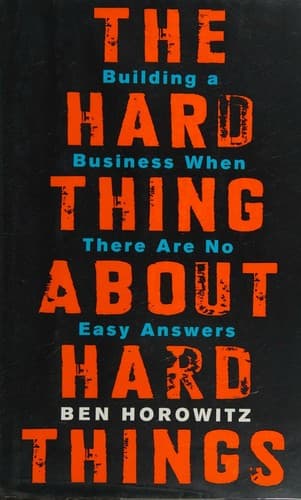
The Hard Thing About Hard Things
On this pageWhat I like
What I like about this book
It is the least tidy management book I know, and that is why it works. Horowitz writes about the weeks when nothing goes right: the layoff, the missed quarter, the executive who is not up to the job. He offers no formula, only how he thought and what he did, and I find that more useful than another framework.
Why read it
It shows what running a company feels like when the decisions have no clean answer, and how to make them anyway.
The problem it solves
Most business books describe how things work when they go well. This one describes the weeks when they do not. Horowitz co-founded Loudcloud, which became Opsware and was later sold to HP, and he went on to co-found the venture firm Andreessen Horowitz. The book draws on those years, when the company came close to running out of money more than once.
The problem it solves is loneliness at the top. Nobody tells a new CEO that the hard decisions have no right answer, only less bad ones. This book says so plainly, and that alone is a relief.
What changes after you read it
You stop looking for the formula. You become calmer about the fact that some problems cannot be fixed with a process, and you treat them as a matter of nerve, honesty and speed.
I would also take a more direct approach to people problems. Tell people the truth early. Do not let a bad situation drag on because the conversation is uncomfortable. Most of the damage in a company comes from the months of avoiding it.
When to read it, and when not to
Read it when you are a few years in and the company is big enough for your decisions to affect other people's livelihoods. Before that, parts of it will feel abstract. After a bad quarter or a tough hiring mistake, it will read like a conversation with someone who has been there.
Skip it if you want a step-by-step guide. There is not one, and the author says so. Note also that it is written from the world of venture-backed technology companies. Advice on boards, funding rounds and selling the company matters less if you run a small, self-funded business. The sections on people, honesty and decision making apply to any company.
How it connects to running and growing a business
Hard decisions are where a decision log earns its keep. When there is no clean answer, the best you can do is write down the options, what you knew at the time and why you chose as you did. Later you can see whether the reasoning was sound even when the result was bad. That separates bad luck from bad judgement, and it is how you improve.
The people problems in the book also repeat: hiring, firing, reorganising, cutting. The first time you do them, you rely on gut feel. The second time, a written playbook from the first time is faster and fairer. That is a good example of work you can turn into a repeatable process without removing the human judgement at the centre of it.
Who it's for
Key take-aways
Book summary
Horowitz argues that the real job of a CEO is not applying best practice but making decisions when no best practice exists. The book is a collection of lessons from his time running Loudcloud and Opsware, mixed with advice on hiring, managing and steering a company through bad times. It is organised around stories rather than a method, and each lesson is meant to be borrowed, not copied.
There is no formula for the hardest problems
The title makes the central claim. Setting a vision is not the hard part. The hard part is what to do when the money is almost gone, a key person leaves or the market turns against you. Horowitz says this is the stuff management books skip, because there is no recipe and the answer depends on the situation. What you can do is prepare your mind: expect hard moments, and decide how you will behave in them.
The struggle
Horowitz describes a stretch every founder goes through, which he calls the struggle. It is the period when everything feels like it is going wrong, you doubt yourself and every option looks bad. His advice is practical rather than inspirational. Do not hide from it, do not expect it to go away and do not pretend it is not happening. Keep making the next decision. Talk to the people who have been through it, because the isolation is part of what makes it hard.
Be honest with your people about the company
Early on, Horowitz shows how he told employees the truth about the company's position, including the parts that were frightening. His reasoning is that people will find out anyway, and when you hide bad news you lose their trust at the moment you need it most. Being open also lets the team help with the problem. This is a recurring theme: say the difficult thing, say it early and say it clearly.
Peacetime and wartime leadership
One of the best-known ideas in the book is the difference between a peacetime CEO and a wartime CEO. In peacetime the company has a strong market position and the job is to expand, so the CEO can focus on culture, process and broad thinking. In wartime the company faces an existential threat, and the CEO has to act with speed, narrow focus and less consensus. Horowitz points out that the two modes need different behaviour, and that many leaders are better at one than the other. The skill is recognising which one you are in.
Look after people, then product, then profit
The book is firm about the order of priorities. If you take care of the people, they produce good products. If the products are good, profit follows. Horowitz uses this to argue that how you treat employees is a business matter, not a soft one. It also shapes how he handles training, management and communication: building a company people want to work for is what lets you ask for the extra effort in a crisis.
Hiring and replacing executives
Horowitz is open about how often he got executive hiring wrong. He warns against hiring people for a lack of weaknesses and argues you should hire for strength in the areas that matter most. He also says that a company that outgrows an executive has to face it, and that the right way to handle it is respectfully but without delay. The same applies to promoting from within: a good performer is not automatically ready for a bigger job, and training is part of the answer.
Layoffs and firing
He gives a plain account of how to lay people off if you must. Tell the company what is happening and why, make the decisions quickly, treat the people leaving with respect and speak to those who stay. His point is that a badly handled layoff damages the whole company, not only the people who leave. The same applies to firing individuals: delay hurts everybody, including the person who is struggling.
Culture is what you do
Horowitz draws on historical examples, from historical leaders to a former prisoner turned writer, to argue that culture is not a list of values on a wall. It shows in the behaviour you reward and the behaviour you tolerate, especially when it is uncomfortable. Culture is how people act when you are not in the room.
What to do with it
- Write down the three hardest decisions you are avoiding, and decide on a date by which you will make each one.
- Decide whether your company is in peacetime or wartime right now, and check whether your behaviour matches.
- Share one piece of difficult news with your team this week, plainly and without spin.
- Write a short playbook for how you handle hiring, firing and layoffs, so the next time you are not starting from scratch.
- Keep a log of your big calls with the options you considered, and review it after a quarter.