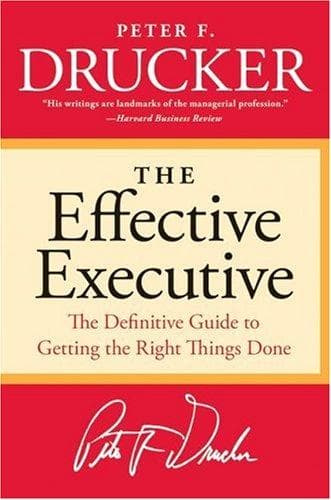
The Effective Executive
On this pageWhat I like
What I like about this book
Drucker is short on theory and long on habits you can start this week, beginning with a written record of where your time goes. The problems he describes, too many meetings, too many demands and too little time for real work, have not changed. It is plain and serious, and it treats effectiveness as something anyone can learn.
Why read it
It teaches five practices of effective people: know your time, focus on contribution, build on strengths, put first things first and decide well.
The problem it deals with
Drucker says that intelligence, imagination and knowledge are common and still tell you little about whether a person gets results. Brilliant people are often strikingly ineffectual. Effectiveness is a separate skill, and without it, as he puts it, there is no performance, however many hours go into the work. The book is about managing yourself first, because someone who cannot manage their own work is a poor example for the people they manage.
What changes after you read it
You begin with your time and not with a plan. Drucker's finding is that plans stay on paper, while people who first learn where their days go can cut and group their work. A time record is uncomfortable, because it shows how much of a day belongs to other people. It then points to the practical moves: stop what need not be done, hand over what others can do and protect large blocks of time for work that needs thought.
Why it suits a business owner
An owner has nobody to set priorities. The questions in the book are the ones an owner must answer alone: what contribution is needed from me, where can good work produce outstanding results, and what should I stop doing? Drucker also warns that senior people tend to keep operating in the work they came from, and that the real results sit outside the organisation, with customers, so you have to go and look.
The chapters on decisions
The last two chapters give the most reusable material. Drucker separates decisions that need a rule from truly one-off events, and says most problems that look unique are the first sign of a generic one. A rule, once made, lets you handle the later cases quickly. He also insists that a decision has not been made until it has turned into work with a named owner.
When to read it, and when to skip it
Read it when your calendar is full and your results are thin, or when your role has changed and old habits no longer work. It is short enough to read in a few sittings. Skip it if you want current tools or research, because the examples come from large organisations of the 1960s, the language is dated and its computers are room-sized. This edition adds a foreword by Jim Collins and a short introduction that lists eight practices, which are worth reading first.
How it connects to decisions you can log
Drucker's account of decisions is close to a decision log. He wants the problem classified, the conditions stated, the right answer worked out before the compromise, the action built in and the result checked against what you expected. Writing those steps down makes a decision reviewable, and he notes that a regular review also shows your own strengths and blind spots. A decision that keeps recurring can then become a standing rule or a playbook for someone else.
Who it's for
Key take-aways
Book summary
Drucker argues that effectiveness is the job of anyone paid for judgement and knowledge, whom he calls knowledge workers or executives, and that it can be learned by practice. The book is organised around five habits: knowing your time, focusing on contribution, making strength productive, putting first things first and making effective decisions. The edition used here adds a foreword by Jim Collins, an introduction and an afterword for the 50th anniversary.
Foreword and Introduction: What Makes an Effective Executive?
Collins gives ten lessons he took from Drucker, among them manage yourself first, do what you are made for and be useful. The introduction says effective executives differ widely in temperament, but follow the same eight practices: asking what needs to be done, asking what is right for the enterprise, writing action plans, taking responsibility for decisions and for communicating, focusing on opportunities, running productive meetings and saying we before I. It stresses that effectiveness does not require charisma.
Chapter 1: Effectiveness Can Be Learned
Executives are paid to get the right things done, and intelligence alone does not do it. Drucker found no natural among the many executives he studied, only people who learned the habits. He explains why knowledge workers need this: their output is thought and cannot be supervised like manual work. He also describes four realities that make it hard: your time belongs to others, you keep operating unless you change things, you work inside an organisation, and results are outside it.
Chapter 2: Know Thy Time
Effective executives start with time, not tasks. The three steps are recording time, managing time and consolidating time. Time is the scarcest resource and cannot be bought or stored. You record where it goes, ask which activities need not be done at all, which others can do and which waste other people's time, then prune the wasters that come from poor systems, too many staff, too many meetings and gaps in information. Finally, you gather the remaining discretionary time into large blocks, since small fragments do not allow serious work.
Chapter 3: What Can I Contribute?
The effective executive looks upward and outward and asks what contribution to results he or she can make. Every organisation needs three kinds of performance: direct results, building and reaffirming values and developing people for tomorrow. Drucker says experts have to make themselves understood, since the person who uses the knowledge cannot be expected to learn the jargon. Focusing on contribution also supplies the four needs of good human relations: communication, teamwork, self-development and developing others.
Chapter 4: Making Strength Productive
You cannot build on weakness. Staffing should maximise what people can do, not minimise what they cannot, and Drucker offers Lincoln's choice of Grant as the model. His rules are to design jobs that are doable, make them demanding and big, start from what a person can do, and refuse to treat anyone as indispensable. He thinks formal appraisals that look for faults destroy trust, and suggests asking what the person has done well and what he or she is likely to do well. He applies the same method to your own boss and to yourself.
Chapter 5: First Things First
If effectiveness has a secret, Drucker says, it is concentration: do first things first and one thing at a time. The first rule is to slough off yesterday by asking of each activity, "If we did not already do this, would we go into it now?" Priorities matter less than posteriorities, the decisions about what not to do, and what you postpone you effectively abandon. Pressure should not set the agenda, and you should aim at opportunities and not at solving yesterday's problems.
Chapter 6: The Elements of Decision-Making
Effective executives make few decisions and make them as a systematic process. Drucker uses the Bell System under Theodore Vail and General Motors under Alfred Sloan as cases. The elements are classifying the problem as generic or unique, defining the boundary conditions the answer must meet, deciding what is right before deciding what is acceptable, building action into the decision and testing it against feedback. Feedback means going out and looking, and also needs a plan for who has to know and who has to act.
Chapter 7: Effective Decisions
Here he turns to the decision itself. "A decision is a judgment," he writes, and you start from opinions, not facts, which you test against relevant measurements. He argues for organised disagreement, because it protects you from special pleaders, supplies alternatives and stimulates imagination. You decide only when the condition would otherwise get worse or the opportunity would vanish, and you listen to unease for a short while before acting. A closing section says the computer will force managers to decide in principle.
Conclusion: Effectiveness Must Be Learned
The book rests on two premises: the job is to be effective, and effectiveness can be learned. The first step is the time record, and each step builds self-development, organisational performance and the health of a society of organisations. Drucker calls the goal modest, since the large organisation needs "common people achieving uncommon performance."
Afterword
The 50th-anniversary afterword, by Zachary First, defines effectiveness as doing the right things well. It says the book asks you to be yourself, aim beyond yourself and work with courage, and it describes how Drucker told a client to adapt his ideas to the firm and not copy them.
What to do with it
- Keep a time log for two weeks and mark each item you could stop, hand over or batch.
- Book two or three blocks of undisturbed time each week and treat them as fixed.
- Write down what contribution is expected of you in the next year and check it with your team.
- Review each regular activity with the question of whether you would start it today, and drop those that fail.
- Before the next big decision, state the conditions it must meet and ask one person to argue the opposite.