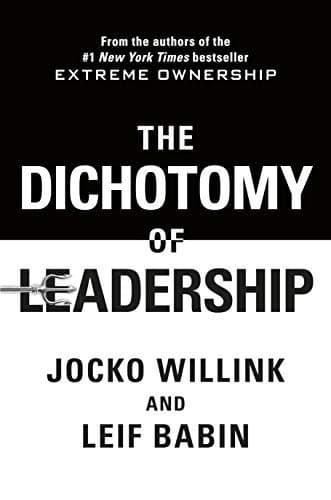
The Dichotomy of Leadership
On this pageWhat I like
What I like about this book
It takes the one-sided advice of Extreme Ownership and tests it against the opposite pole, so each chapter asks where a good trait stops helping. I like that every chapter pairs a combat story with a business case, and that the business cases are about ordinary problems such as meetings, software roll-outs and sales scripts. The military framing will not suit everyone.
Why read it
It shows that most leadership failures come from pushing a good trait too far, and gives twelve pairs of opposites to check yourself against.
The problem it deals with
Leadership advice usually arrives as single slogans: take ownership, be aggressive, hold people accountable. Each is sound, and each does damage when taken too far. Willink and Babin say they met this problem often after Extreme Ownership came out, when leaders applied its lessons so hard that they ended up taking over, over-planning or controlling everything. This book is their follow-up, and the preface says it can be read without the first.
What changes after you read it
You stop looking for the right setting and start looking for signs of imbalance. The authors give symptoms. A team that waits to be told what to do and shows no initiative suggests micromanagement. A team that drifts in different directions suggests too little direction. Once you can see the symptom, you know which way to correct.
Why it suits someone running a business
Owners move between many roles in a single day, and most of them have a dominant habit: pushing hard, checking everything, or avoiding conflict. The chapter on holding people accountable without holding their hands is a good example. It shows how piling on checks and bonuses failed to make field technicians record useful notes, and how explaining the reason did what the controls could not. That is a lesson any owner who has tried to fix behaviour with rules will recognise.
The part I find most useful
The afterword gives the method in a few lines. Know that the pairs exist. Watch for signs that you are out of balance. Move back with small corrections and do not overshoot. Expect the balance to shift again as people and markets change. That is a repeatable habit you can apply to any decision, not only to leadership.
When to read it, and when to skip it
Read it when your team has grown, when a new manager is struggling, or when you notice you are stuck in one mode. Skip it if war stories put you off or if you want research evidence. The stories come from the authors and the business cases come from their consulting firm, with details changed, so treat them as illustrations. Expect a long book with plenty of repetition.
How it connects to decisions you can log
Several chapters turn into questions you can write down: should I step in or hold back on this, who is accountable, what are the three or four likely contingencies and the worst case? Logging the answer and the result shows over time where your own judgement leans. The chapter on discipline also argues that standard procedures give a team freedom. That is a useful idea for anyone who wants to turn repeated work into a written playbook without making it rigid.
Who it's for
Key take-aways
Book summary
Willink and Babin, both former US Navy SEAL officers who led Task Unit Bruiser in the Battle of Ramadi in 2006 and later founded the consulting firm Echelon Front, argue that leadership always sits between opposing forces. Pushed too far, almost any strength becomes a weakness. Each of the twelve chapters takes one pair, opens with a story from combat, states the principle and then gives an Application to Business from the authors' consulting work. The authors alternate as narrators. Names and details in the business stories have been changed.
Introduction: Finding the Balance
Babin opens in a gunfight in Ramadi and uses it to introduce the idea that a leader must keep balancing opposing forces. The authors say the principles are simple, but not easy, and that most failures come from going too far in one direction. They explain that Extreme Ownership told leaders to own everything, and that this book deals with the limits of that advice.
Chapter 1: The Ultimate Dichotomy
The hardest pair is caring deeply for each person while accepting the risks needed to finish the mission. Willink opens with a badly wounded SEAL. In the business case, a regional manager of mines kept staff from a closed mine on the payroll because he cared about them, and by doing so put five mines and hundreds of other jobs at risk. After a blunt conversation he cut about eighty posts and the mines returned to profit.
Chapter 2: "Own It All, but Empower Others"
Micromanagement and a hands-off style are opposites, and both fail. The micromanaged team stops taking initiative, and the neglected team follows its own ideas in different directions. The chapter lists warning signs of each. In the business story, a CEO who took extreme ownership by holding daily meetings on every detail stalled a product launch. He pulled back gradually and his leaders began to lead.
Chapter 3: Resolute, but Not Overbearing
Leaders must set high standards but save their firmness for what matters. The authors use the term leadership capital, a finite store built through trust, and warn against spending it on trivial points. They also stress explaining why. In the business case, an executive who admired Patton banned phones from every meeting, and the lesson was to allow them for urgent matters so that his authority held where it counted.
Chapter 4: When to Mentor, When to Fire
Most underperformers need guidance, not dismissal, and a leader should coach, mentor and counsel first. But once those efforts have failed, a leader owes it to the team to remove someone who drags it down. The chapter sets loyalty to the individual against loyalty to the team and says that ownership of a weak performer includes the hard decision. A construction project manager who kept a failing superintendent is the business example.
Chapter 5: Train Hard, but Train Smart
Training should push people out of their comfort zone, but not so far that it crushes them. The authors name three elements, realism, fundamentals and repetition, and say you train as you fight. In the business case, a company with no training programme for its junior leaders built one, and a harsh instructor was replaced when the training demoralised participants.
Chapter 6: Aggressive, Not Reckless
The default setting should be aggressive, which means proactive and aimed at problems, not at people. But aggression must be balanced with careful analysis of the risks. A new owner of a small business planned to hire and move to larger premises ahead of expected growth. After a review of the cash position she aimed her aggression at cutting costs instead.
Chapter 7: Disciplined, Not Rigid
Discipline gives freedom, because standard procedures free a team from building each plan from scratch. But too many procedures stop people thinking and adapting. A sales VP responded to falling sales by tightening scripts, pricing and call quotas, and sales fell further. She loosened the scripts, changed the metric to time on calls and loosened pricing, and numbers recovered.
Chapter 8: Hold People Accountable, but Don't Hold Their Hands
Accountability is a tool and should not be the main one. A leader who inspects everything cannot look up and out or do anything else, and the team does less when he is absent. Leaders should explain why, give ownership and show how each task supports the mission. Bonuses and penalties failed to get technicians to log useful notes, and explaining the benefit to them worked better.
Chapter 9: A Leader and a Follower
Good leaders also follow. They take good ideas from juniors, share the credit, support their own boss and carry out decisions as if they were their own, unless an order is illegal, immoral or dangerous. A sales leader who had blown up at his boss over a poor review was told to rebuild trust and become a better follower.
Chapter 10: Plan, but Don't Overplan
Plan carefully, but you cannot plan for every contingency. The authors suggest choosing the three or four most likely contingencies for each phase of a plan, plus the worst case. They also warn against complacency after a string of wins. A COO feared that a company launching two subsidiaries and expanding its offices at once was exposing itself to a downturn.
Chapter 11: Humble, Not Passive
Humility is the most important quality in a leader, and most SEAL leaders who were removed lost their posts through ego and not through lack of skill. Yet a humble leader must not be passive, and has to push back when the team is at risk. A CEO who blamed his team for not adopting new software learned that he had not listened to their concerns, and that they had not spoken up.
Chapter 12: Focused, but Detached
Leaders must know the details but not drown in them. The image is high port, keeping the weapon pointed up so that you can see the whole scene instead of a narrow sight picture. A manager found the answer to a profit problem only after leaving his daily firefighting to attend a leadership class. The balance is to stay close enough to the front line to understand it.
Afterword
The authors say the list of dichotomies is endless: metrics against people, direct against diplomatic speech, work against family, serious against light. Leaders should learn that these pairs exist, watch for signs of imbalance, make small corrections without overcorrecting and keep monitoring, because balance does not last.
What to do with it
- Choose the pair that worries you most and write down two signs your team would show if you had gone too far.
- Ask two people on your team which way you lean, towards control or towards distance.
- Pick one decision to hand over fully, state the reason behind it and check in only at agreed points.
- Write the three or four likeliest problems for your next project, plus the worst case, and stop there.
- Review your standing rules and keep the ones that protect something important.