The 12 Week Year
On this pageWhat I like
What I like about this book
It deals with the gap between knowing what to do and doing it, and it does so with a small set of working tools: a short plan, a weekly score and a weekly meeting. I like that you score the actions you finished, not the results, because that tells you whether the plan or the effort is the problem. You can start your first cycle the week you finish it.
Why read it
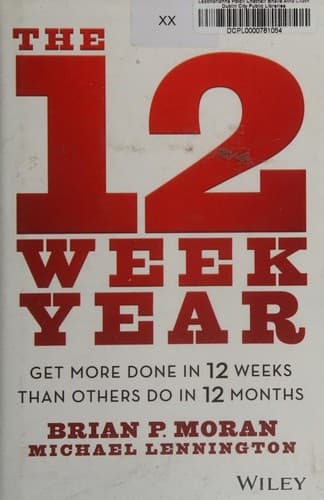
It replaces the annual plan with twelve-week cycles, each with a short plan, a weekly execution score and a regular review.
The problem it deals with
Most teams and owners do not run short of ideas. They run short of follow-through. Moran and Lennington say the plan is usually fine and the doing is the weak point, and that the annual calendar makes it worse. In January the end of the year feels far away, so a slow start seems harmless, and urgency only shows up in the last weeks of the year.
What changes after you read it
You start planning in twelve-week blocks and judging each week by what you did. The book separates two questions that most people blur: did I carry out the plan, and did the plan produce results? If your execution score is low, you fix your habits. If it is high and the results are poor, you change the plan. That one distinction saves a lot of time otherwise spent rewriting plans nobody followed.
Why it suits someone running a business
An owner's week fills up with interruptions, and the work that is important but not urgent is the first to go. The authors answer with fixed time blocks, a short written weekly plan and a weekly accountability meeting with peers. For a small team this gives everyone the same rhythm and the same score, so conversations about progress are about facts and not impressions.
The honest limits
The book is written in an upbeat, motivational tone and repeats its main points. Many examples come from sales and financial advice, where activity is easy to count: calls made, referrals asked for, meetings held. If your results depend on long cycles or on other people, choosing the weekly actions takes more thought. The chapters on vision and emotion will also feel soft to some readers.
When to read it
Read it a few weeks before a quarter starts, so you can write your first plan with a real start date. It is also worth reading when you keep ending the year with the same unfinished list. Skip it if you already run a tight weekly cycle with clear goals and a regular review.
How it connects to decisions you can log
The plan, the weekly scorecard and the review at the end of each cycle leave a written record of what you chose to do, what you did and what happened. Over several cycles you can see which actions moved the numbers and which did not. The actions that keep proving themselves are the ones to turn into a written playbook that someone else, or an agent, can run on your behalf.
Who it's for
Key take-aways
Book summary
Moran, with Lennington, argues that the annual planning cycle limits performance, because a year feels long enough to postpone effort. Their answer is to treat twelve weeks as a year: a vision, one short plan, a weekly routine, a weekly score and a review at the end. The book has two parts. Part I, Things You Think You Know, makes the case and covers the ideas. Part II, Putting It All Together, covers the system and how to start it. Most examples come from clients, many of them financial advisers and sales teams.
Chapter 1: The Challenge
The authors open with the gap between the life most people live and the life they are capable of. Their claim is that what holds people back is not knowledge, talent or luck but execution, meaning the habit of doing the important things consistently. They tell of an adviser who raised her production sharply by doing the same work more steadily, not by changing clients or hours. The book promises a system for closing that gap, one that works for individuals and for teams.
Chapter 2: Redefining the Year
Annualised thinking is the belief that there is plenty of time. Targets slip in January and March, and nobody worries until the final weeks, when urgency finally arrives. The authors would like that urgency every week. They borrow periodization from athletic training, where one skill is trained at a time for a short period. A twelve-week year gives a deadline always near enough to feel real, a fresh start four times a year and a pause to celebrate and reset between cycles.
Chapter 3: The Emotional Connection
Execution means doing uncomfortable things, so you need a vision you want more than you want comfort. The authors draw on brain research. The amygdala resists uncertainty and change, while the prefrontal cortex responds when you picture a compelling future, and they say you can train your brain by thinking about that future repeatedly. They start with a personal vision and then ask what the business must look like to support it.
Chapter 4: Throw Out the Annual Plan
A plan reduces mistakes, saves time and gives focus. Twelve-week planning adds three things. It is more predictable, because you can name what you will do each week for twelve weeks but not for twelve months. It is more focused, because annual plans carry too many objectives. And it is based on actions, not just targets, so the link between today's work and the result is clear.
Chapter 5: One Week at a Time
Results come from daily actions, and you control actions more than outcomes. The weekly plan turns the twelve-week plan into the tactics due that week. It is not a glorified to-do list. It holds the few critical actions that move you toward the goal, so a week in which they are done is a good week and a week in which they are not is a lost one.
Chapter 6: Confronting the Truth
Keeping score is how you find out whether you are effective, and the authors say it builds confidence. They separate lag indicators, such as revenue or weight, from lead indicators, such as calls made. The weekly scorecard measures execution, the share of planned tactics you completed, and about 85 percent is the target. They say that most of the time the breakdown is in execution, not in the plan, and that changing a plan you have not carried out only produces guesses.
Chapter 7: Intentionality
Time cannot be stretched, and many people let the day decide for them. The remedy is to say yes and no on purpose and to block time in advance. The chapter introduces Performance Time, built from strategic blocks, buffer blocks and breakout blocks, and the idea of an ideal week drawn up on paper before you try to live it.
Chapter 8: Accountability as Ownership
The authors reject the idea that you can hold someone else accountable. As they put it, "Accountability is not consequences; it's ownership." It rests on freedom of choice: there are no have-to's, only choices with consequences. Taking ownership means looking at your own part in a result and asking what more you can do.
Chapter 9: Interest versus Commitment
A commitment is a personal promise that you act on whatever you feel like on the day. The chapter uses stories from the authors' own lives to show that keeping promises to others builds trust and keeping them to yourself builds character. Twelve-week commitments are easier to hold than a lifelong or annual promise, and you reassess them at the end of each cycle.
Chapter 10: Greatness in the Moment
Greatness is decided in the moment of choice, when you do the planned action or take something easier. The chapter argues against constant multitasking and for being fully present in what you are doing. Results then confirm the choice made earlier.
Chapter 11: Intentional Imbalance
Balance does not mean equal time in every part of life. It means choosing on purpose where to put effort in each season. The authors suggest using a twelve-week cycle on a few areas at a time, such as health or a relationship, either with a short plan or with one keystone action.
Chapter 12: The Execution System
Here the eight elements are grouped into three principles, accountability, commitment and greatness in the moment, and five disciplines: vision, planning, process control, measurement and time use. The authors describe the emotional cycle of change, from uninformed optimism through a valley of despair to success, and argue that the twelve-week year works as a closed system that shows where it breaks down. It is meant to become the way you do everything else, not a layer on top.
Chapter 13: Establish Your Vision
The vision should balance personal and professional life and make you slightly uncomfortable. The chapter moves from impossible to possible by asking what if, then to probable by asking how, then to given as results appear. It includes advice for managers on helping their team own a vision and warns against small, vague or disconnected visions.
Chapter 14: Develop Your 12 Week Plan
A twelve-week goal bridges the vision and the plan, and it should be a realistic stretch. The plan lists tactics against goals, and the authors give criteria for well-written ones: specific, measurable, a stretch, owned by someone and tied to a date. Fewer goals and fewer tactics work better, and a plan you will not execute is worth nothing.
Chapter 15: Installing Process Control
Process control gives structure that does not depend on willpower. Its parts are the weekly plan, built from the tactics due that week, and the weekly routine, which includes a weekly accountability meeting. The agenda has each person report results, execution score and intentions, share techniques that work and encourage the group. Leaders are asked to model the routine themselves.
Chapter 16: Keeping Score
The chapter shows how to use lead and lag measures together and how to calculate the weekly score. A score under 85 percent is not a disaster, and a rising score is a good sign. The common failure is to stop scoring after a bad week, so the authors advise a short weekly slot for scoring and planning and a buddy or group to review it with.
Chapter 17: Take Back Control of Your Day
The lack of time is often a lack of allocation. The strategic block is three hours of uninterrupted work on planned tasks, buffer blocks group email and other low-value tasks, and breakout blocks are time away from work to prevent burnout. The chapter walks through designing a model week, warns that multitasking slows you down and says to work from your strengths and unique capability.
Chapter 18: Taking Ownership
A victim mind-set puts your results in other people's hands. The authors give four steps: stop being the victim, stop feeling sorry for yourself, be willing to take different actions and spend time with people who take ownership. Failures are treated as feedback.
Chapter 19: 12 Week Commitments
Using an iceberg metaphor, the authors show that hidden intentions below the surface often defeat stated ones, as when you say you want to lose weight but also want comfort. A good commitment has a burning desire, clear actions, counted costs and action regardless of feeling. The chapter also covers promises to other people.
Chapter 20: Your First 12 Weeks
This is a guide to the first cycle. It names the resistance you will meet, such as the pull of immediate comfort, trying to change too much at once and old habits, and then walks through the first four weeks, the second four and the last four. The thirteenth week is for review, celebration and planning the next cycle, and the chapter ends with weekly coaching notes.
Chapter 21: Final Thoughts and the 13th Week
The closing chapter acts as the thirteenth week of the book. It restates that the system works only through application and invites readers to start now.
What to do with it
- Choose a twelve-week period with a fixed start and end date and write one or two goals for it.
- List the tactics for each goal, make each one specific enough to tick off, and assign them to weeks.
- Fill in the weekly plan and score yourself as a percentage at the same time every week.
- Set up a weekly meeting with a peer or small group, using the report-out agenda from the book.
- Put a three-hour strategic block and two short buffer blocks into your calendar as recurring items.
- Use the thirteenth week to review the score, decide what to change and write the next plan.