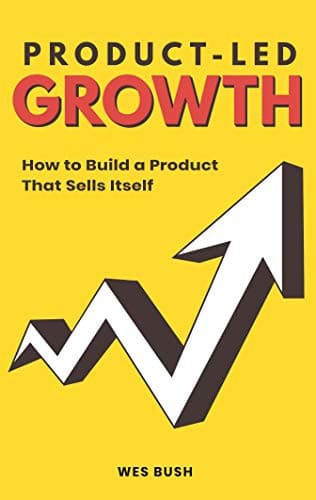
Product-Led Growth
On this pageWhat I like
What I like about this book
It is organised around decisions you can make this week: which model to offer, what to charge, which onboarding steps to cut and which metric to work on next. The Bowling Alley chapter, with its green, yellow and red steps and its list of onboarding emails, is the part I would copy first. Bush writes for software companies and says plainly when a sales-led approach is the better fit.
Why read it
Shows software companies how to pick a free trial, freemium or demo model and then build onboarding, pricing and emails around it.
The problem it solves
Many software companies run a sales-led model where every prospect fills in a form, waits for a call and sits through a demo. Bush argues that this adds friction and raises acquisition costs, and he lists three pressures behind it: customer acquisition is getting dearer, most business buyers prefer to educate themselves, and the product experience has become part of the buying process. The book is a working guide for moving from that model to one where the product does the selling.
What changes in how you work
You stop asking how many leads you generated and start asking how quickly a new user reaches a result they care about. Onboarding becomes a set of steps you can count, label and cut. Pricing becomes a question about what a customer values, not what a competitor charges. Marketing, sales, customer success and engineering each get a product question to answer, so growth stops being the job of one team.
Which model you should pick
The most useful part is the decision framework in the early chapters. It makes you answer four questions before you build anything: how you compete, whether the market is crowded, who buys and how fast the value shows. The book is also honest that freemium needs a big market and a product people can use alone. Bush even advises starting with a free trial and moving to freemium only once the trial is proven to convert.
When to read it and when not to
Read it before you launch a trial or a free plan, or when one already exists and converts badly. It is less help if you sell a complex product to a small number of large buyers. Bush says sales-led can be the right choice for a hyper-niche market, for a new category and for enterprise deals with long procurement.
A caution about the format
The book is written for SaaS and for one author's methods. Some tactics, such as the email templates and the Triple A sprint, are his own frameworks, and several statistics come from other companies' blog posts listed in the references. Treat the numbers as prompts to measure your own, and keep the structure.
Decisions and playbooks
Almost every chapter ends in a choice you can record: the model, the value metric, the price range, the steps you cut, the metric you pick for the next sprint. Write down what you expected and check it a month later. The onboarding tracks and the monthly sprint are repeatable work, so they suit a written playbook that a team member, or later an agent, can run the same way each time.
Who it's for
Key take-aways
Book summary
Product-Led Growth, by Wes Bush, argues that software companies should let the product acquire, activate and retain customers, and it gives frameworks for choosing a model, building the foundation and growing from there. The book has three parts: Design Your Strategy, Build Your Foundation and Ignite Your Growth Engine.
Introduction
Bush opens with his own experience as a marketer who spent heavily on content and lead capture, then helped launch a freemium product that passed 100,000 users in under a year. That showed him a flaw in the old playbook. His claim is that people expect to try a product before buying it, and that SaaS will split into sales-led and product-led companies. As he puts it, "Truly great software companies are built to be product-led."
Chapter 1: Why Is Product-Led Growth of Rising Importance?
The chapter defines the term as a go-to-market strategy that uses the product as the main vehicle to acquire, activate and retain customers. It names three pressures on subscription businesses: rising cost of acquiring customers, buyers who prefer to self-educate, and the product experience becoming part of buying. It then weighs sales-led against product-led, including when sales-led still makes sense, and warns that going product-led is hard. Quoting Rob Walling, "Freemium is like a Samurai sword: unless you're a master at using it, you can cut your arm off."
Chapter 2: Choose Your Weapon, Free Trial, Freemium or Demo?
This chapter introduces the MOAT framework: Market strategy, Ocean conditions, Audience and Time-to-value. A free trial gives a limited-time product, while freemium gives a part of the product with no time limit. Bush sorts growth strategies into dominant, differentiated and disruptive, and says freemium fits dominant and disruptive strategies while free trials and demos fit differentiated ones. Each strategy comes with questions to ask yourself.
Chapter 3: Ocean Conditions: Are You in a Red- or Blue-Ocean Business?
Red-ocean companies fight over existing demand, and blue-ocean companies create new demand. Bush says that in a blue ocean a complex product usually needs a sales-led start to educate the market, while in a red ocean the buyer already understands the need and a product-led model can widen the funnel and cut acquisition cost. He notes that different segments of one market can sit in different oceans.
Chapter 4: Audience: Do You Have a Top-Down or Bottom-Up Selling Strategy?
Top-down selling targets executives and tends to bring large contracts, long sales cycles and uneven revenue. Bottom-up selling lets individual users adopt the product and bring in their managers, which gives a wider funnel, lower acquisition cost and more predictable numbers, but smaller deals. Bush says freemium rarely suits top-down selling and that a free trial in a company built around demo requests often fails for internal reasons.
Chapter 5: Time-to-Value: How Fast Can You Showcase Value?
New users must reach a key outcome fast and without help. Bush cites a claim that 40 to 60 per cent of new users never come back, and sorts users by motivation and ease into four types: mission impossible, rookie, veteran and spoiled. The last, with high motivation and an easy product, is the one to optimise for. Unlike your market, you control this number.
Chapter 6: Choose Your Product-Led Growth Model with the MOAT Framework
Bush points to an online quiz that turns the MOAT questions into a recommendation, and notes that the answer can change as the business matures. He describes three hybrids: launching a new product-led product beside an existing business, a freemium product with trials of paid features, and a free trial that falls back to a free tool.
Chapter 7: Build a Product-Led Foundation
Part II starts with the UCD framework: understand your value, communicate it and deliver on it. It applies to a new launch, a product-led arm, a move from sales-led, or a relaunch of an underperforming model. Skipping a step, Bush says, risks a mediocre experience.
Chapter 8: Understand Your Value
Customers buy for functional, emotional and social outcomes, so you need customer research and not just a feature list. The chapter introduces value metrics, the unit by which your product exchanges value, such as videos uploaded or messages sent. A good one is easy to understand, matches the value users receive and grows with their use. Bush calls per-user pricing a common trap and shows how to test candidate metrics against data about your best and worst customers.
Chapter 9: Communicate Your Value
In a product-led company, pricing and customer acquisition are tied together, so the pricing page matters. Bush covers four approaches (best judgement, cost-plus, competitor-based and value-based), favours value-based pricing, and shows two ways to find a price: an economic value analysis with a 10x rule, and a Van Westendorp survey of what people consider too cheap, a bargain, expensive and too expensive. He also warns against a free plan that gives away so much nobody upgrades.
Chapter 10: Deliver on Your Value
The gap between perceived value and experienced value is what he calls the value gap, and he names three causes: ability debt, not knowing why people buy, and poor communication. He explains how to win over leaders who resist, and how to launch a free trial in 24 hours by renaming a demo request and holding a recorded onboarding call where you watch the user struggle.
Chapter 11: The Most Common Mistake that New Product-Led Businesses Make
The mistake is launching and never updating, because nobody owns it. Bush compares it to a plant that no one waters and suggests training a small cross-functional team of seven roles instead of trial and error or hiring a new team.
Chapter 12: Develop an Optimisation Process
Part III begins with the monthly Triple A sprint. The first step, "Analyze", reviews outputs such as sign-ups, upgrades, ARPU, churn, ARR and MRR. The second, "Ask", sets a goal, picks a lever and chooses inputs, scored with the ICE method of impact, confidence and ease. The third, "Act", ships one or two ideas. The levers rank in this order: churn, then ARPU, then number of customers.
Chapter 13: The Bowling Alley Framework
This is the longest chapter. You map every onboarding step, label each green, yellow or red, and build a straight line to the first real outcome. Two kinds of bumper keep users on it. Product bumpers include welcome messages, product tours of three to five steps, progress bars, checklists, tooltips and empty states. Conversational bumpers are nine kinds of email, such as welcome, usage tips, sales touch, expiry warning and post-trial survey, organised into three tracks that fire on signals like a quick win.
Chapter 14: Increase Your Average Revenue Per User (ARPU)
ARPU is total MRR divided by total users, and Bush warns that the word user needs a clear definition in your company. Ways to raise it include value metrics, fewer pricing tiers, higher prices, special treatment for best-fit users, and upselling and cross-selling.
Chapter 15: Slay Your Churn Beast
Churn is measured three ways: customer churn, revenue churn and activity churn. The chapter walks through a five-step engagement score and then a list of actions: own the metric, welcome customers properly, remove friction, send usage reviews, restate value at invoicing, run a cancellation survey, recover failed cards, invest in customer success and fix pricing.
Chapter 16: Why Truly Great Companies Are Built to Be Product-Led
The short closing chapter repeats the introduction's argument: buyers want to start using a product and ask for help when stuck, and the choice is to be product-led or be disrupted.
What to do with it
- Walk through your own sign-up and label every step to the first result green, yellow or red, then cut the red ones.
- Run the MOAT questions with your team and write down which model they point to and why.
- Draft two or three candidate value metrics and test each against the three conditions before you change a price.
- Name one owner for the product-led model and start a monthly "Analyze", "Ask", "Act" sprint.
- Track customer churn, revenue churn and a simple engagement score, and compare them with your own past figures.