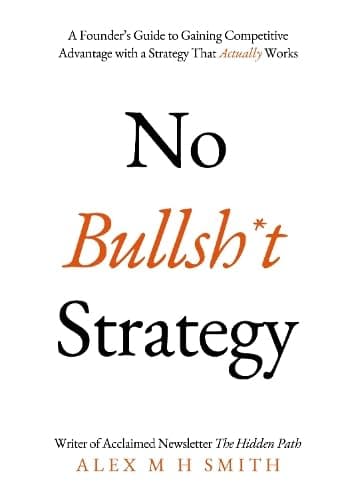
No Bullsh*t Strategy
On this pageWhat I like
What I like about this book
It is plain-spoken and gives you tests you can run on your own strategy the same afternoon. I like that the author says up front that a strategy is only worth what it makes people do, and then shows how to check for that. The big-brand examples are quick, and he admits himself that they may not be historically exact, so take them as illustrations.
Why read it
A plain-spoken guide to finding one unique value your business can own, and writing it so a whole team acts on it.
The problem it solves
Most business owners have either no strategy or a document nobody uses. The book names three kinds of bad strategy: a goal dressed up as a strategy, a generic approach every rival shares, and corporate waffle you cannot act on. It then gives you a way to replace all three with one clear choice about the value you bring to customers.
What changes in how you work
You stop asking how to beat the competitor who looks like you. The author argues that rivals who chase the same offer drift together until customers cannot tell them apart and margins suffer. After reading, you ask where the open space is, what you would have to stop doing to take it, and who you are prepared to put off. A strategy nobody could disagree with is, by his test, not yet a strategy.
Start from the business you have
I like that it does not ask you to reinvent the company. The book says to look at what the market already favours in your business, including your accidental strengths and your weaknesses, and to push that further. That is a more realistic starting point for an owner with a live company than a blank-page exercise.
When to read it, and when not to
Read it before you write or rewrite a strategy, or when growth has stalled and your offer looks like everyone else's. It is less use as a source of numbers, since the author says you cannot research your way to a strategy. Treat it as a thinking tool, and bring your own customer and margin data to check each idea against.
How it connects to decisions and playbooks
The one-page strategy the author recommends is a decision with its reasoning attached: the situation, your reading of it, the choice and the actions that follow. That is exactly the kind of thing worth logging with a date, so you can later see whether a result came from the choice or from the execution. The delivery list at the end is the start of a playbook your team can repeat.
Who it's for
Key take-aways
Book summary
The book argues that most strategy is empty talk and that a real strategy is one clear choice: the unique value your business gives the market, written plainly enough that people change what they do on Monday. Alex M H Smith, a strategy consultant, offers a set of small ideas and tests instead of one framework, and illustrates them with well-known brands.
Introduction
The author opens by saying most strategy is bullshit in the technical sense, fancy words that mean nothing. He sorts bad strategy into three kinds: goals presented as strategy, generic strategies every competitor shares, and vague corporate language you cannot act on. The only job of a strategy, he says, is to provoke specific action, so a wrong but actionable strategy beats a right but unusable one. He promises lots of little ideas instead of one big theory, and writes as if you already run a company.
What is strategy really?
The textbook definition, a plan to reach a goal, is too broad to help, so the book uses a narrower one: the unique value a business provides to the market. Value is the benefit customers get, not the product you make. Unique means customers cannot get it elsewhere, which rules out claims like impeccable service or being the best. As Srinivas Rao puts it, "Only is better than best." The value must also be wanted by many people, and it should not be mistaken for a product quirk. The author then sets out a strategic hierarchy: the strategy at the top, the delivery through products and services below it, and the brand that communicates it at the bottom.
Coming up with an idea
A strategy is bounded by market conditions and by the nature of your business. The book treats the market as space: rivals who offer the same thing cluster together and fight over margin, while a brand that sits alone is left in peace. The aim is to decluster, and to treat competitors as part of an ecosystem rather than enemies. Companies either weird the normal, by twisting a familiar category, or normalise the weird, by tying a new product to a category people understand.
The author then says to find the strategy already hidden in your company. His guide is a line from Dolly Parton: "Find out who you are and do it on purpose." The market reinterprets what you launch, so you follow what it favours, and you avoid being a self-loathing business that fights its own pull. He rejects heavy research and prefers observation and intuition.
Three methods follow. Context shift frames the same product against a different category or a different true competitor. Unexpected value brings a benefit to a category that nobody thought relevant. Contrarian value is the strongest: you deliberately neglect something the whole category cares about, which rivals cannot copy without damaging their own offer. It means giving up market share and cultivating weaknesses. The chapter ends by recommending informal one-to-one chats as the best tool for working this out.
Turning an idea into a strategy
A strategy is only as good as it is usable, and the author says bad thinking made usable beats good thinking that is not. He then offers a series of tests. First, a strategy must force you to change in an obvious way, and an outsider should be able to see it in the business. Second, the subjectivity test: strip out words like good, great and best and see what is left. Third, the opposites game: if the opposite of your strategy would also make sense, and someone would reject yours, it is a real choice. Fourth, the how cascade: keep asking how until the answer is a solution rather than an aspiration. The last two are content checks. The toilet paper rule says low-interest categories need blunt, simple offers. The challenger trap warns against copying yesterday's challenger brands, whose values are now the norm.
Actually writing the strategy
The book says to ditch the deck and write the strategy as prose on a single page, the way you would explain it in a pub. Prose lets you make an argument, helps people retell it in their own words and exposes weak thinking. His usual structure has four parts: background, strategy argument, a one-sentence strategy summary (plain, perhaps with a short name), and delivery, a list of two or three key actions. He demonstrates it with an invented write-up for Tesla and says it is not Tesla's real one.
Executing a strategy
Execution is where most brands fall down, the author says, because it comes on top of the day job, takes months to internalise and is easy to rationalise away. He suggests an outside observer to keep you honest. His concepts follow.
Minimum viable strategy is the smallest set of actions that makes you actually follow the strategy, doable in roughly six to twelve months and visible to customers without marketing. Cross-category copying borrows the visual codes of a brand in another category with a similar offer, to look familiar yet different. The creative canvas extends the creativity most firms keep for advertising to the whole business, making an interesting company rather than interesting adverts. For packaged goods with little canvas, he suggests format, process, ritual or brand proxies.
He also gives a why a modest role: a motivational tool for leadership, not a substitute for strategy. Finally, strategy should hold for decades, but execution must keep changing. In his words, "You must keep moving in order to stand still." Multi-layer pacing says the strategy never changes, the brand changes slowly, and tactics change often.
What now?
The closing pages say the book gives the need-to-knows and that knowledge alone is not enough. The author points to his newsletter and consultancy, and ends by saying that the amount of bad strategy around is what makes good strategy so valuable.
What to do with it
- Write your current strategy in one sentence, then run the subjectivity test, the opposites game and the how cascade on it until it survives.
- List the people your strategy would put off, and the things you would stop doing. If both lists are empty, you do not have a choice yet.
- Ask what your true competitors are, meaning anything a customer might buy instead of you, and where a different frame would favour you.
- Write the one-page version with background, argument, summary and delivery, and give it to someone outside the business to see whether they get it.
- Pick the two or three actions that make up your minimum viable strategy, set a date within twelve months, and ask an outsider to check the result.