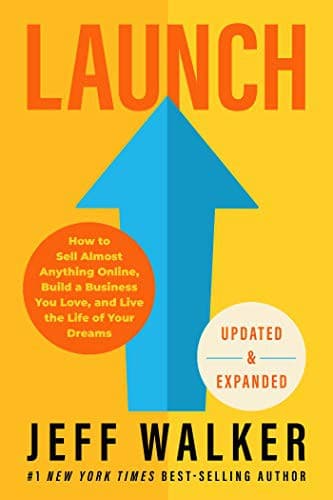
Launch
On this pageWhat I like
What I like about this book
It treats a launch as a sequence of events you can plan and repeat, not a single day you hope goes well. Giving real content before asking for money is easy to apply and easy to test. I would read it as a playbook for selling something new to an audience, and keep in mind that most of the success stories are chosen by the author.
Why read it
A step-by-step method for warming up an audience with useful content, then opening and closing a short sales window for a new offer.
The problem it solves
Many owners launch a product the same way. They finish building it, announce it, and wait. A few sales come in, then nothing. Walker calls this hope marketing, and his argument is that the announcement is the wrong unit of work. Selling can be a sequence with a build-up, a window and a follow-up, and you can plan each part. For anyone with an audience and something to teach or offer, that is a useful change in how you think.
What changes after you read it
You stop selling to people who have never heard from you. You plan a short series of useful content before any offer, you decide in advance when selling opens and closes, and you treat the result as data for the next round. The offer stops being a surprise. That takes some of the pressure off, because you have already spent days giving people reasons to care. You also start to see your email list as the thing you are building, and a launch as the way to move people from the prospect list to the buyer list.
Where the method fits
The formula was built around information products, online courses and coaching, and the examples lean that way. The author says the seed launch does not work for physical products, although the full formula has been used for them, including a yarn business in the book. It works best when you have an expert offer, an audience you can reach by email and a product people buy at one moment. If you sell complex B2B software with long buying cycles, take the ideas, such as content before pitch and a deadline for a decision, but expect to adapt the mechanics.
Read the success stories with care
The book is full of student results, and Walker is open that the big numbers are not typical, and he discloses that he also sells a paid coaching programme alongside the book. I would take the stories as proof that the method can work and not as a forecast for your first launch. The advice I trust most is the small, testable parts: a few questions to your list, three useful pieces of content, a five-day cart and a close you stick to.
Use the pressure honestly
The book is open about using scarcity and deadlines, and it spends a chapter on mental triggers with a warning that they can be misused. I would use a real deadline, such as a cohort start date or a limit on places you can serve, and never an invented one. Used honestly, a closing date helps people who want the offer to stop putting off the decision.
Test small before you build big
The seed launch is the most useful part for a business owner. You sell a small version of the idea to a micro-list, with the product still to be made, and you shape it using the questions your first customers ask. That is a cheap way to find out whether anybody will pay, and it fits the habit of testing demand before spending months on a build.
How it connects to decisions and playbooks
A launch has many decisions in it: the audience, the price, the content, the dates, the offer. Writing each one down with the result gives you a record to compare launch against launch. The sequence itself, from the pre-prelaunch question to the open cart emails and the post-launch follow-up, is the kind of repeatable work you can turn into a checklist and then hand to someone else.
Who it's for
Key take-aways
Book summary
Jeff Walker argues that marketing a new product by hoping people notice it is a poor plan, and that you can instead turn a launch into an event. His Product Launch Formula combines sequences, stories and mental triggers, and he built it over many years of selling his own products and teaching students. The updated and expanded edition keeps the core formula and adds chapters on live launches, social media and paid traffic.
From Stay-at-Home Dad to Six Figures in Seven Days (chapter 1)
The opening chapter is Walker's own story. He left a corporate operations job, spent years as a stay-at-home dad, and launched his first product from his basement when his family needed income. He says he had no sales or marketing experience, and that the formula came from trial and error. He also tells readers up front that it is hard work and not a get-rich-quick scheme.
The Product Launch Formula Explained (chapter 2)
This chapter explains why a launch works. Communication has become faster, cheaper and more interactive, so small businesses can create the buzz that Apple or a film studio builds with big budgets. Walker contrasts this with hope marketing. The formula uses sequences, because one message is lost in the communication fog, stories, because that is how people take in ideas, and mental triggers. The sequences are the pre-prelaunch, prelaunch, open cart and post-launch.
Income on Demand: Your List (chapter 3)
Walker's first rule of business is to build an email list. He explains why email beats social media for reach and control, and why a combination of the two works best. A buyer list is worth about 10 to 15 times a prospect list in his experience, so a launch is a way to move people from one to the other. He covers how to get people to join with a free resource on a simple opt-in page, and why the best moment to start a list is now.
The Sideways Sales Letter (chapter 4)
A long sales letter holds the reader's attention with pages. Walker swaps pages for days: a sequence of useful content delivered over several days, ending in a sales message. He calls the content PLC, for prelaunch content, and says it must be valuable and not a pitch stretched thin. The case is a juggler who stopped trading hours for dollars after using it.
Tools of Mass Influence: The Mental Triggers (chapter 5)
The chapter describes nine triggers: authority, reciprocity, trust, anticipation, likability, events and ritual, community, scarcity and social proof. Walker says they work best when layered, for example scarcity with social proof, and he warns that they can be used for harm. His ask is to use them to create real value.
The Shot across the Bow: Your Pre-Prelaunch (chapter 6)
The pre-prelaunch is a simple early step, often one or two emails, that signals something is coming without selling anything. Its jobs are to tease interest, test demand, surface objections and shape the offer. Walker's favourite version is a short email asking for help with a few questions, and the answers become material for the prelaunch.
Sell Them What They Want: The Power of Prelaunch (chapter 7)
The prelaunch is three pieces of content shaped like a three-act story. The first covers the opportunity and why the viewer should care, the second the transformation and gives something useful to try, and the third the ownership experience, where the viewer pictures the change. Walker suggests 7 to 10 days from the first piece to the cart opening, and says the most important thing is real value.
Open Cart (chapter 8)
Open cart is when people can buy. The message shifts to enrollment, and Walker advises a cart open for four to seven days, five for your first launch. He says to expect around a quarter of orders on the first day and around half on the last. A definitive close with a real consequence is the cardinal rule, and the three ways to create it are a price rise, bonuses removed or the offer going away. The chapter also covers a minimum email sequence, what to check if no one buys and what to do after the cart closes.
How to Start from Scratch: The Seed Launch (chapter 9)
For people without a list or a product, the seed launch sells to a micro-list of roughly 100 to 300 people, who are often more responsive. You ask them for their questions, make an offer for a series of live classes, and use their questions to build the product as you deliver it. Walker's point is that the aim is to get into the market and learn from it, and not to make a million dollars.
The JV Launch and Going Live (chapters 10 and 11)
In a joint venture launch, partners with their own lists promote your offer for a commission. Walker says to run an internal launch first, because partners put their reputation at risk and will not repeat a poor experience. Live launches deliver some or all of the content through broadcasts, which creates a stronger sense of an event and speeds up the work, with gotchas he lists.
Using Social Media and Paid Traffic (chapters 12 and 13)
Social media helps you find and research your market, build authority and feed your email list, but the book warns that you are building on a bed of sand because platforms come and go. Paid traffic can add cold leads and warm up existing ones, though costs tend to rise as you reach beyond your most responsive audience.
Creating a Business from the Ether (chapter 14)
The business launch formula extends the method beyond products. Walker lists six keys: deliver high-value prelaunch content, always build the list, make more than one offer, run the cycle he calls the Circle of Awesome from seed to internal to joint venture, use relaunches and evergreen launches, and take care of clients and launch to them again.
Creating a Business You Love, A Recipe for a Big Life and It's Your Time to Launch (chapters 15 to 17)
The last chapters turn personal, covering your big why, the clients you want, mastermind groups, working in your genius zone and a life well lived. The book ends with a reminder that tactics change while strategy lasts, and an invitation to run your first launch.
What to do with it
- Write down the single outcome your offer delivers and the audience that wants it.
- Send your list a short message asking for help with two or three questions about the offer.
- Plan three pieces of useful content for the opportunity, the transformation and the ownership experience.
- Pick a real opening and closing date for the cart, and a genuine consequence for missing it.
- After the launch, log what you did, the numbers and what you will change next time.