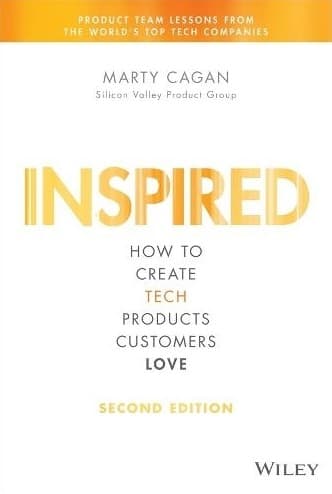
Inspired
On this pageWhat I like
What I like about this book
It separates a product team that ships a list from a product team that solves problems, and it is specific about who has to be in the room. The second edition tightens the split between discovery and delivery. I'd keep it as the reference for what a product role should actually own.
Why read it
Shows how strong product teams find out what is worth building before they build it, and which roles that takes.
The problem it solves
Plenty of software companies run on a list. Sales or management asks for features, the team builds them, a release goes out, and the product gets bigger without getting better. Cagan calls this a feature team: a group that is told what to build and judged on delivery. Inspired describes the alternative, a product team that is given a problem and a target and works out the solution itself.
What changes after you read it
You stop treating "what to build" as the outcome of a meeting. For each idea you ask four questions. Will customers want it? Can they work out how to use it? Can the engineers build it? Does it work for the business, including sales, support, legal and cost? Cagan names these the four risks, and that list alone is worth the price. Most roadmap items I see fail on the first one, and nobody tested it.
Who it points at
Part of the book is aimed at leaders, and that is the uncomfortable part. A product team has no real say if the people above it keep handing down solutions. If you run the company, read the chapters on leadership and culture twice. Hiring a product manager and then telling them what to build wastes the hire.
When to read it, and when not to
Read it before you hire your first product manager, or when releases keep going out and the numbers do not move. It is written around technology companies with several teams, so a company of five will not need every role in it. Take the principles, not the org chart. If you do not build a product yourself, it is a poor fit.
How it connects to decisions and playbooks
Each discovery test ends in a decision: build it, change it or drop it. Written down with the evidence, those decisions become a record the team can learn from, and the repeatable parts (how you run a customer test, how you assess an opportunity) can be turned into a playbook that the next hire, or an agent, can follow.
Who it's for
Key take-aways
Book summary
Inspired argues that most product failure comes from how teams are run, not from lack of effort or talent. Companies hire capable people, give them a list of features and measure them on shipping. The book sets out what the best technology companies do instead: they form small cross-functional teams, give each one a problem to solve, and let the team find the solution through constant testing with customers. The rest of the book describes the people, the process and the culture that make this possible.
Feature teams and product teams
The starting point is a distinction. A feature team gets a roadmap from stakeholders and builds it. A product team gets a goal, such as raising the share of new users who finish setup, and is trusted to decide how. Cagan's claim is that the second kind produces better results and keeps better people. The first kind often produces output without value, because nobody checked that the requested features solve anything.
Four risks to test
Every product idea is a bet, and the book splits the bet into four risks. Value: will customers choose it and use it? Usability: can they work out how to use it? Feasibility: can the team build it with the time and skills it has? Business viability: does it work for the whole company, including how it is sold, funded, supported and regulated? A team that only checks feasibility is a delivery team. A strong team deals with all four before committing engineering time.
Discovery and delivery
Cagan separates discovery, where you work out what to build, from delivery, where you build it well. He treats discovery as ongoing work done in parallel with delivery, not a phase before it. The aim of discovery is to find a solution that is valuable, usable, feasible and viable, and to learn quickly which ideas to throw away. Most ideas will not survive contact with customers, and that is the point of testing them cheaply.
The people on the team
The book spends real time on roles. The product manager owns the problem and the questions about value and viability, and needs knowledge of the customer, the data, the business and the market. The product designer owns usability and the experience. The engineers own feasibility, and Cagan wants them in discovery from the start because they know what is possible and often suggest better solutions. The three work as a close trio, and a team that skips one of them has a gap that shows up later.
Ways to find out
Discovery in the book is hands-on. Teams build prototypes of different fidelity, from a sketch to something that behaves like a working product, and put them in front of real users. They run small live tests, look at usage data and talk to customers regularly. The key habit is speed: test the idea in days, not months, and with the least work that gives a real answer. The book describes the techniques without making them a rigid method.
Vision, strategy and goals
Teams need direction or they pull in different ways. A product vision describes where the product is heading and why it matters. A product strategy picks the order of the problems to attack. Objectives then give each team its problem. Cagan is sceptical of roadmaps that list features and dates, because a date on an unproven idea is a promise nobody can keep. He prefers a list of problems with the outcomes wanted.
Leaders and coaching
The book gives leaders a job beyond approving plans. They set the vision and the objectives, hire people strong enough to solve the problems, and coach them rather than direct them. Cagan is blunt that weak product management is usually a leadership failure. If the people you hired are not good enough, coach or replace them. If they are good and held back by instructions, change how you lead.
What good delivery looks like
Delivery still matters. Once discovery has produced something worth building, the team needs to ship it reliably and in small steps, so that it can learn from real use. The book treats frequent, low-risk releases as part of the same loop: you learn from what you ship, and that feeds the next round of discovery.
Culture
The final theme is culture. Cagan describes companies where people are trusted to solve problems, where learning from failed tests is normal and where teams are expected to deliver results rather than follow orders. He uses the contrast between missionaries, who care about the customer and the mission, and mercenaries, who build what they are told. His view is that you cannot copy the process without the trust behind it.
What to do with it
- List the features your team is building now and write down the problem each one is meant to solve. Drop any item where you cannot name the problem.
- Take one open idea and test it against the four risks. Write down what you know and what you only believe.
- Run one prototype test with five real customers before the next build starts.
- Put the engineer who will build the work into the next discovery conversation.
- Replace one dated feature on your roadmap with a problem and a target outcome.