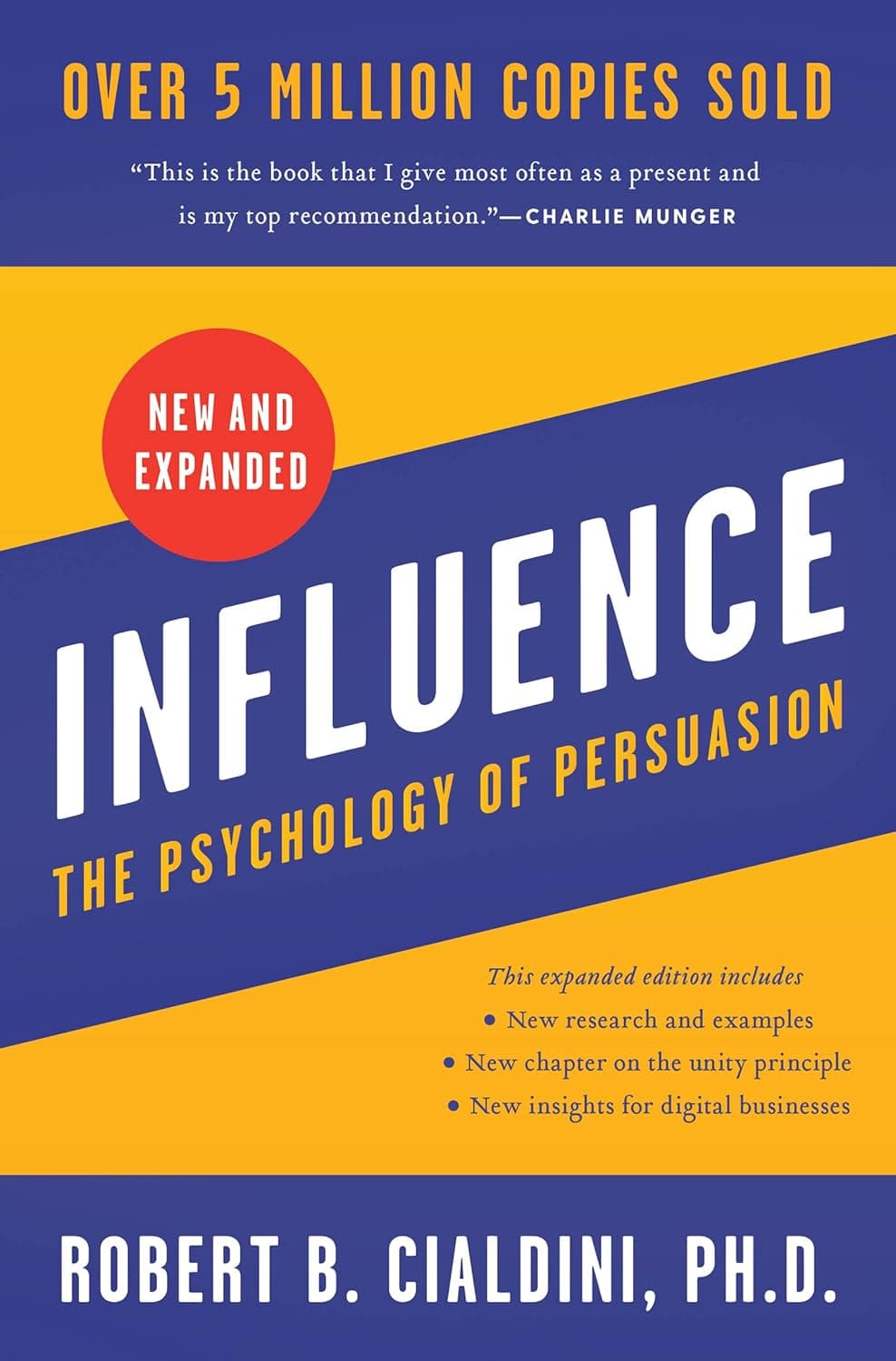
Influence
On this pageWhat I like
What I like about this book
A psychology classic that every marketer should read. It made me see persuasion everywhere.
Why read it
It’s the foundation for modern marketing psychology.
Influence by Robert Cialdini is on our shelf. We only recommend a book when it gives you something you can put to work, not just something to agree with.
Below: who it is for, what it says in short, and how to turn it into a change in how your business runs. Two minutes, and you will know if it belongs on your desk.
Who it's for
Key take-aways
Book summary
Introduction Robert B. Cialdini’s Influence: The Psychology of Persuasion explores the science behind why people say “yes” and how to apply these principles ethically. Cialdini, a social psychologist, investigates how persuasion works by combining experimental research with real-world observations of “compliance professionals” such as salespeople and advertisers. The book identifies six universal principles of influence that guide human behaviour and decision-making.
The Six Principles of Influence
Reciprocation
The rule of reciprocation compels individuals to return favours or concessions, creating a sense of obligation. For example, receiving a gift or favour even unsolicited often prompts reciprocation. This principle is leveraged in marketing through free samples and “gifts.” Cialdini illustrates this through an experiment where subjects who received a small, unsolicited favour were significantly more likely to comply with a subsequent request.
Commitment and Consistency
Once individuals commit to an idea or action, they are driven to act consistently with it, especially if their commitment is public. This principle explains tactics like the "foot-in-the-door" technique, where small initial agreements pave the way for larger commitments. Cialdini cites examples of political campaigns and customer loyalty programs that harness this need for consistency.
Social Proof
People tend to look to others for guidance when unsure about how to act, particularly in ambiguous situations. Social proof is most effective when the reference group is similar to the individual. Testimonials, online reviews, and crowd behaviours often capitalise on this principle. Cialdini recounts how this phenomenon helps explain phenomena like groupthink and viral marketing.
Liking
Individuals are more likely to be persuaded by those they find attractive, friendly, or relatable. This principle operates through shared similarities, compliments, and physical attractiveness. Cialdini reveals how brands use likeable spokespeople and how interpersonal techniques like genuine flattery can build rapport and influence.
Authority
People tend to follow the lead of credible, knowledgeable experts, especially when the authority figure is perceived as legitimate. Uniforms, titles, or affiliations lend weight to a message, as shown in experiments where subjects obeyed instructions from someone in a lab coat even when it conflicted with their own judgment.
Scarcity
The perception of limited availability enhances an item's value. Scarcity drives urgency and desire, a concept evident in limited-time offers and exclusive products. Cialdini highlights how framing opportunities as rare or fleeting compels people to act quickly.
Practical Application and Ethical Implications
Cialdini emphasises that understanding these principles allows individuals to resist manipulation while leveraging them ethically in fields like marketing, negotiation, and leadership. He warns against exploitative use, as it can erode trust and harm relationships in the long term.
Key Takeaways
- Leverage reciprocation: Offer value first to build goodwill.
- Encourage commitment: Seek small initial agreements to pave the way for larger ones.
- Use social proof: Highlight endorsements, testimonials, or popular behaviours.
- Build likability: Foster connections through genuine compliments and relatability.
- Establish authority: Use credible endorsements or expertise to support claims.
- Create urgency: Frame offers as time-sensitive or exclusive.
Cialdini’s Influence is a cornerstone for anyone looking to understand the psychology of persuasion and use these insights to create meaningful, positive change.