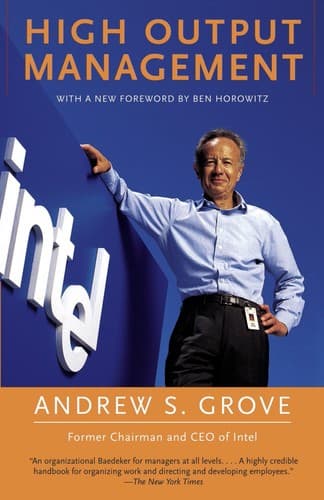
High Output Management
On this pageWhat I like
What I like about this book
It treats management as a job with output you can measure, and it says so without jargon. Grove wrote it from running Intel, and it is full of concrete devices, such as how to run a one-on-one, how to design a meeting and how to pick indicators in pairs. It is old and still one of the most practical management books I know.
Why read it
It teaches you to judge a manager by the output of their team, and gives concrete tools for indicators, one-on-ones, meetings and planning.
The problem it solves
Many people become managers because they were good at the work, and then no one tells them what the new job is. They fill their days with meetings and requests and feel busy without being sure they are effective. Andy Grove, who helped found Intel and later ran it, gives management a definition: a manager's output is the output of their own organisation plus the organisations they influence. That one idea makes it easier to judge what to do with your time.
What changes after you read it
You start looking at your role in terms of results. You ask which activities increase your team's output and which are only motion. You set up regular one-on-ones, you choose indicators for your area and you vary how closely you supervise each person according to how experienced they are at the task. Meetings stop being a default. You decide what each one is for and whether it should happen at all.
Why it matters for a growing company
A small company can run on goodwill and shared context. Once the team grows beyond a handful, that stops working, and the founder has to build management practices. The book follows a single breakfast restaurant as it grows into a national chain, so it deals with exactly this: how to run a process, how to measure it, how to run a team and how to handle the tension between local control and central standards. It also gives you one of the clearest explanations of objectives and key results that I know of, in a chapter on planning.
Management as a system you can log
Grove treats management as a production process with inputs, outputs and indicators. I find that a good way to think about decisions. Write down what you decided, which indicator it was meant to move and when you will check. If you also record the routine parts of managing, such as how you run a one-on-one or a weekly review, you get playbooks that others can follow, and parts of the reporting can be automated.
When to read it, and when to skip it
Read it when you manage your first people, when your team has grown and you have become the bottleneck, or when you are redesigning how the company is organised. It is dense and worth reading slowly with a pen. The closing section gives assignments with points, which is a good way to turn it into action. Skip it if you want stories about culture, since Grove writes like an engineer. Many examples come from a large semiconductor firm in the 1980s, so adapt them to a small team and do not copy them.
Who it's for
Key take-aways
Book summary
Andrew Grove argues that management is a job with output, and that applying the discipline of production to managerial work gives you a systematic way to improve it. The book has three ideas: that all work can be seen as production, that managers are leaders of teams who must deliver the team's output, and that the means of managing, such as indicators, meetings and feedback, can be improved with practice. He wrote it in 1983 from twenty years of managing, and added a new introduction in 1995 on globalisation and e-mail, with the motto "Let chaos reign, then rein in chaos."
The Basics of Production: Delivering a Breakfast (chapter 1)
Grove uses a breakfast of a three-minute egg, toast and coffee to explain production. You plan the flow backwards from delivery time around the limiting step, which is the slowest or most sensitive part, here the egg. He describes the three kinds of production operations, which are process, assembly and test, and says value rises as material moves through the flow. The rule that follows is to find and fix problems at the lowest-value stage, such as rejecting a bad egg on delivery and not after cooking.
Managing the Breakfast Factory (chapter 2)
The restaurant grows into a factory, and with it comes the need for indicators. Grove proposes a small daily set covering the forecast, raw materials, equipment, manpower and quality. Indicators steer your attention, so he recommends pairing them, such as inventory levels with shortages. He explains build-to-order against build-to-forecast, inspection points, and two ways to raise productivity: do the same work faster, or change the work to raise its output. The chapter ends with the formula that defines a manager's output.
"Managerial Leverage" (chapter 3)
This chapter says a manager's output is the sum of the output produced by each of their activities, and that activities differ hugely in what they produce. High-impact activities reach many people, shape behaviour over a long time, or supply a key piece of knowledge. Some activities have negative effects, including meddling, waffling and arriving at a meeting unprepared. Grove also covers delegation, the right number of reports (about six to eight), how to gather information in many ways, and how to protect your time from interruptions. He includes a worked day from his own calendar.
Meetings: The Medium of Managerial Work (chapter 4)
Grove argues that meetings are the way managers share information and make decisions, so the aim is to use them well. Process-oriented meetings are regular and exchange knowledge: one-on-ones, staff meetings and operation reviews. A one-on-one is the report's meeting, prepared with an outline and lasting at least an hour. Mission-oriented meetings are ad hoc and aim at a decision, and the chairman owns the result, mostly through what they do before the meeting starts.
Decisions, Decisions (chapter 5)
In fast-changing businesses the people with the knowledge are often not the people with the position, so Grove sets out a model for deciding. The first stage is free discussion, the second is a clear decision, and the third is full support from everyone, including those who disagreed. If no consensus forms, the senior person decides, but not too early. He also warns of the peer-group syndrome, where peers circle without resolving, and recommends a "peer-plus-one" who steps in to help.
Planning: Today's Actions for Tomorrow's Output (chapter 6)
Planning, to Grove, is an ordinary activity: check what your environment will demand, check where you will be if you change nothing, and decide what to do about the gap. The chapter separates strategy from tactics, and presents the objectives and key results system. An objective answers where you want to go, key results are the milestones that show you are getting there, and each must be specific enough that there is no doubt whether it was met. He also warns that hitting every key result does not guarantee the objective.
The Breakfast Factory Goes National and Hybrid Organisations (chapters 7 and 8)
Once the restaurant becomes a chain, a local manager knows the neighbourhood while headquarters can buy and market at scale. Grove explains mission-oriented and functional organisations as two extremes, and says most real companies are hybrids that need a balance between responsiveness and scale. The chapter treats that balance as a permanent managerial task and not a problem to solve once.
Dual Reporting (chapter 9)
In a hybrid, a person may need to answer to both a functional expert and a local business manager. Grove uses a plant security example from Intel to show how dual reporting arose, and describes matrix management, the approach that came from large projects such as the moon landing. He argues it works when each of the two bosses has a clear role, and it needs peers who work well together.
Modes of Control (chapter 10)
Work is controlled in three ways: free-market forces, contractual obligations and cultural values. Free markets suit things with a clear price, contracts suit work whose value cannot be priced piece by piece, and shared values suit work where neither will do. Which mode fits depends on how self-interested or group-minded people are and on how complex, uncertain and ambiguous the environment is. Grove says managers build a culture by spelling out values and, more importantly, by setting an example.
The Sports Analogy and Task-Relevant Maturity (chapters 11 and 12)
Grove says a person who is underperforming either cannot or will not do the job, so the manager has two tools: training and motivation. Using Maslow's hierarchy, he suggests that self-actualisation drives the strongest motivation, and that competition against a score or a record can bring it into the workplace through good indicators. He then introduces task-relevant maturity: the right style varies from structured direction for someone new to the task, to two-way support for someone in the middle, to light-touch monitoring for an expert.
Performance Appraisal, Two Difficult Tasks and Compensation (chapters 13 to 15)
Grove calls the review the most important form of task-relevant feedback a manager gives, and says it should be specific, honest and about performance and not potential. He explains how to prepare, how to deliver the assessment, and how to deal with the poor performer and the star. The "two difficult tasks" are interviewing, where the candidate should do most of the talking, and talking a valued employee out of quitting. Compensation is treated as another form of feedback on performance.
Why Training Is the Boss's Job (chapter 16)
The last chapter argues that managers should train their teams themselves and not hand it to specialists. Training is a high-impact activity because it multiplies the output of many people, and the manager is the person who knows the work and the company's values best. Grove ends with "One More Thing", a set of assignments with points for you to complete.
What to do with it
- List the indicators for your area and pair each quantity measure with a quality measure.
- Classify last week's calendar into high, medium and low impact, and plan to do more of the first.
- Start a weekly or fortnightly one-on-one with each direct report, and let them set the agenda.
- Note how experienced each person is at their current task and adjust how closely you supervise.
- Write one objective and two or three dated key results for the next quarter, and review them weekly.