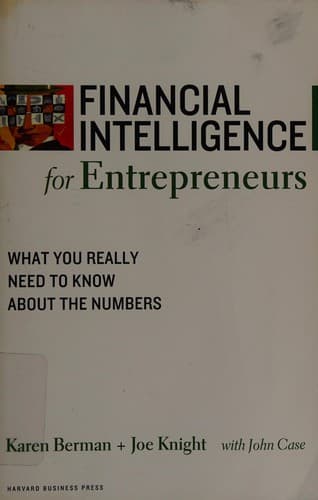
Financial Intelligence for Entrepreneurs
On this pageWhat I like
What I like about this book
It takes the financial statements that many owners avoid and explains them in plain language without talking down. I like that it keeps telling you the numbers rest on estimates and judgement, so you read them with questions and not with blind trust. It is the book I would hand to anyone who runs a business and cannot yet read their own accounts.
Why read it
It teaches you to read the three financial statements, spot where the numbers are soft, and manage cash and working capital with confidence.
The problem it solves
Many owners run a business by feel until something goes wrong with the money. The book opens with a story of two entrepreneurs whose sales were doubling every year and whose reports showed a profit. A friend who read the statements told them they would run out of cash in about eighteen months, and they did. The authors, Karen Berman and Joe Knight, wrote this edition for owners who know their product and customers but cannot yet read the documents that describe how the business is doing.
What changes after you read it
You can open an income statement and a balance sheet and know what to look at first. You understand why the bank balance can fall while profit rises. You can ask your accountant useful questions and tell when an answer does not add up. Meetings change too. A conversation about a hire or a discount can include its effect on margin and cash, not only on whether the idea feels right. The book also gives you the words to talk to a banker, an investor or the owner of a company you might buy.
Why it matters for growth
Growth uses cash before it produces it. You pay for people, stock or advertising first and collect from customers later, and the faster you grow the larger that gap becomes. The authors devote a whole part to working capital and the cash conversion cycle, and they make a point I find useful: you can improve cash and profitability by managing the balance sheet, with no change in sales or costs. Many healthy-looking businesses get into trouble through growth they cannot fund, and this book shows you how to see it coming.
The art of finance
The idea I would take from it is that accounting is a reflection of reality and not reality itself. Many figures depend on estimates, such as when revenue is recognised, how long equipment lasts or whether a cost counts as an expense or an investment. That does not mean the numbers are dishonest. It means you should know which are hard and which are soft before you rely on them, because your bankers, investors and suppliers will be reading the same figures.
When to read it, and when to skip it
Read it early, before you have a payroll and a large cost base, or whenever you realise you are guessing. It assumes no accounting background and it never uses debits and credits. Skip it if you already work comfortably with financial statements, or if you want advice on tax, raising money or accounting software, because the authors say outright that they leave tax and software out and say little on how to raise money beyond the basics. The examples are US based, so you will need your own accountant for local rules.
Finance and decisions
Financial statements are the record of decisions you have already made: what you charged, what you spent, whom you hired. If you also write down why you made each decision, you can look back and see how a choice moved the numbers. The authors push the same idea inside the company, through weekly meetings on a few key numbers and shared scoreboards. That is a repeatable routine, and it is the sort of work that can be written down as a playbook.
Who it's for
Key take-aways
Book summary
Karen Berman and Joe Knight argue that finance is a skill any owner can learn, and that the numbers matter most when you know where they come from and what they leave out. This is the entrepreneur edition of their earlier Financial Intelligence, built around the three financial statements, ratios, return on investment and working capital. A running theme is their "finance is as much art as it is science". The book does not teach bookkeeping, and it leaves tax and accounting software to other guides.
What Is Financial Intelligence? (chapter 1)
The authors define financial intelligence as three skill sets. The first is understanding the foundation, which means being able to read the income statement, the balance sheet and the cash flow statement. The second is understanding the art of finance, meaning how estimates and assumptions shape the numbers. The third is understanding financial analysis, which uses ratios and return on investment to make decisions. They also list the roadblocks: fear of maths, a feeling that profit is not your real goal, and the belief that finance is for accountants.
A Primer on the Art of Finance (chapter 2)
This chapter explains why accounting is partly judgement. Revenue is one example, because you must decide when a sale is recorded. Another is whether a cost is an operating expense that reduces profit now or a capital expenditure whose cost is spread over time. The authors use the WorldCom case to show how capitalising ordinary costs can inflate profit. They also cover depreciation choices and the many methods of valuing a company, and finish with the main sources of financing and the staff you add as you grow.
Profit Is an Estimate and Cracking the Code of the Income Statement (chapters 3 and 4)
Part Two takes the income statement apart. The matching principle says costs are recorded in the period of the sales they helped produce, which is why a truck is depreciated over its life and not charged in the month you buy it. The authors give one big rule for reading any income statement: many numbers reflect estimates and assumptions. They also show how to read the label, the period, the big numbers, the comparative data and the footnotes.
Revenue, Costs and Expenses, and The Many Forms of Profit (chapters 5 to 7)
Here the book looks at recognition of revenue, the gap between cost of goods sold and operating expenses, and non-cash items such as depreciation and amortisation. It treats one-time charges as a yellow flag. It then separates gross profit, operating profit (EBIT) and net profit, and explains what each one tells you about the health of the business.
Understanding Balance Sheet Basics, Assets and On the Other Side (chapters 8 to 10)
Part Three explains that the balance sheet is a snapshot on a given day of what the company owns, owes and is worth. Assets must equal liabilities plus owners' equity. The authors walk through cash, receivables, inventory, equipment and intangibles such as goodwill, then liabilities and equity, and point out where estimates creep in, such as how much of your receivables will really be collected.
Why the Balance Sheet Balances and The Income Statement Affects the Balance Sheet (chapters 11 and 12)
These two chapters show that the statements are linked. Profit increases retained earnings, and almost every income statement item has a counterpart on the balance sheet. A good deal of the book's value is in seeing that connection, because it lets you trace a decision through all the statements.
Cash Is King (chapters 13 to 17)
Part Four makes the case that cash is the number least affected by the art of finance, which is why Warren Buffett watches it. Profit and cash differ for three reasons: revenue is booked at the sale, expenses are matched to revenue and not to payment, and capital expenditures do not count against profit. A bakery example shows a company that is profitable on paper and out of cash within months. The authors explain the three sections of the cash flow statement, show how to reconcile profit to cash, and introduce free cash flow and owner earnings.
The Power of Ratios (chapters 18 to 22)
Ratios turn statements into comparisons. The profitability group includes gross, operating and net margin, return on assets and return on equity. Debt ratios, such as debt to equity and interest coverage, show how much you rely on borrowing. Liquidity ratios, the current and quick ratio, test whether you can pay your bills. Efficiency ratios cover inventory days, days sales outstanding, days payable outstanding and asset turnover. The authors add percent of sales and the sustainable growth rate, which estimates how fast you can grow without outside equity.
How to Calculate Return on Investment (chapters 23 and 24)
This part covers the time value of money, future and present value, required rate of return, opportunity cost and cost of capital. It then compares three methods for judging a big purchase: payback, net present value and internal rate of return. The methods can give different answers, and the authors recommend net present value when they conflict. A step-by-step guide shows what to put in a proposal to your banker.
Working Capital Management (chapters 25 to 27)
Part Seven is about managing the balance sheet. Working capital is current assets minus current liabilities. Collecting faster, holding less stock and managing what you owe suppliers all release cash. The cash conversion cycle ties these together, and the authors add practical advice on working with a banker and on ageing your receivables, since an average collection time can hide a few very late payers.
Creating a Financially Intelligent Company (chapters 28 to 30)
The final part argues that businesses perform better when managers and staff understand the numbers. The authors suggest short regular training sessions, weekly numbers meetings, scoreboards and visual aids, and they describe open-book management. They also set out four routes to growth: more of the same, branching out, new products and services, and acquisition. They close with going public and a short guide to Sarbanes-Oxley.
What to do with it
- Ask for the income statement, balance sheet and cash flow statement each month, and read them in that order.
- Write down, for the last three months, the difference between profit and the change in your bank balance, and find the reasons.
- Track gross margin, operating margin and days sales outstanding every month, and watch the trend and not just the figure.
- Before a major purchase, work out payback and net present value, and use the second if they disagree.
- Pick two or three numbers, share them with the team each week and post them where everyone can see.