Fanatical Prospecting
On this pageWhat I like
What I like about this book
It is blunt about the one habit most salespeople dodge: starting conversations with people who did not ask to hear from you. I like that it covers the phone, email, text, social media and in-person visits in one book, with a short structure for each, and that it spends real pages on the time and the mindset that make you do it. It repeats itself and shouts a lot, which is tiring, but it suits a book about a habit.
Why read it
It makes one case, that an empty pipeline comes from not prospecting, and gives you the daily routine to fix it.
The problem it solves
Most small businesses sell in bursts. They work hard to close what is in the pipeline, look up and find nothing behind it, and then blame the market, the leads or the product. Blount's answer is that this is predictable. He names a cause, which is that you stopped starting conversations while you were busy, and he gives a timescale: the damage turns up weeks later, which is why it feels like bad luck. The book does not offer a trick. It offers a routine and the reasons to keep to it.
What changes in how you work
After reading it, prospecting is scheduled work with a place in the calendar, a target and a count of what you did. You stop checking email first thing in the morning and start with the hardest task. You stop treating your list as a flat pile and rank it by how close each prospect is to buying. You also stop relying on the channel you like best. Blount argues that a mix of phone, email, text, social and visits beats any one of them, and he gives a short structure for each.
Why it matters for a growing business
Outbound activity is the part of growth you steer directly. Referrals, content and word of mouth are slower and harder to control. An owner who can start a conversation with a stranger, handle the first brush-off and ask for a meeting has an advantage that does not depend on budget. The book also puts weight on the database: a clean record of every account and every contact is what lets you build lists, time your approach and hand work to someone else later.
When to read it, and when to skip it
Read it when you are starting to sell, when revenue is lumpy or when you are about to hire your first salespeople. The style is loud, and it assumes that more activity is the answer. If you are reaching the wrong people, or your offer is unclear, volume will not fix that, and you should sort out who you sell to first. Parts of it also date: the social media and tooling chapters describe the platforms of 2015, so use the principles and check the current tactics. The book is written for people who sell for a living, so an owner has to translate some of it.
Turning it into a playbook
The idea I would take from it is the repeatable sequence. Who do you contact, through which channel, in what order, with what reason to talk, and what counts as a result? Blount's frameworks for calls, voicemail, email and text are already written as short steps. If you write down your own version and record the outcomes, you can see which step loses people, and that is a decision you can log and revisit. Once the steps are clear, much of the research and list building can go to a colleague or to software, and your own time goes to the conversations that need a person.
Who it's for
Key take-aways
Book summary
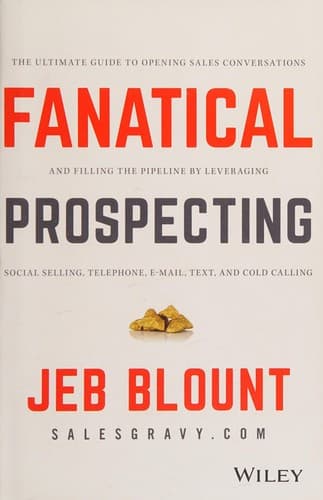
Jeb Blount argues that most sales failure comes down to one cause: an empty pipeline, and the root of that is a failure to prospect. The book combines a case for the habit, a set of laws and numbers that explain why it matters, a method for managing your time and your list, and a framework for each channel. It is written in a blunt, motivational voice for people who sell for a living.
The Case for Prospecting
Blount opens with the top 20 percent of salespeople who produce most of the sales and asks what separates them from capable people who underperform. His answer is fanatical prospecting: they keep the pipeline full all the time, in good months and bad, and they do not wait for a good mood. He rejects the search for an easy button. Prospecting is hard, rejection-heavy work, and the book promises to make you better at it, not to make it pleasant. He states that the number one reason for failure in sales is an empty pipe.
Seven Mindsets of Fanatical Prospectors
The second chapter lists seven traits he has seen in top prospectors: optimistic and enthusiastic, competitive, confident, relentless, thirsty for knowledge, systematic and efficient, and adaptive and flexible. He treats mindset as the part you fully control, and he presents the traits as patterns to copy.
To Cold Call or Not to Cold Call?
Blount attacks the debate about whether cold calling is dead. In his view the real issue is that a salesperson has to interrupt people who are not expecting them, whatever you call the call. Fear of interrupting is the problem, not the temperature of the lead. Social and inbound methods are useful, but he sees the people who say you never need to call as having something to sell.
Adopt a Balanced Prospecting Methodology
The fourth chapter argues against the excuse of being better at one channel. He compares it to putting your whole retirement into one stock. The right mix of phone, in person, email, social, text, referrals, networking, inbound leads and trade shows depends on your industry, product, territory and goals, and there is no single formula.
The More You Prospect, the Luckier You Get
This is the core of the book. Blount sets out three laws. The Universal Law of Need says that the more desperately you need a deal, the less likely you are to win it. The 30-Day Rule says that activity today becomes results about a month later, so a gap in December shows up in March. The Law of Replacement uses a worked example: with thirty prospects and a one in ten close rate, closing one deal really removes ten from the pipeline, because the other nine are statistically gone. He then lays out how a slump builds, from stopped prospecting to lost confidence to desperation, and gives the first rule of slumps: start prospecting.
Know Your Numbers: Managing Your Ratios
Sales is a numbers game, he says, and the numbers are the science of it. Elite performers track calls, contacts, emails, appointments and sales. He defines efficiency as activity within a time block and effectiveness as the ratio between activity and outcome, and adds them up as the basis of performance. His example is a rep who believed he had made fifty calls and had made twelve.
The Three Ps That Are Holding You Back
Procrastination, perfectionism and paralysis from analysis are the three habits he sees keeping people from the phone. Over-researching and polishing a script feel like work but produce few conversations. His fix is to make one call, then the next.
"Time: The Great Equalizer of Sales"
Every salesperson has the same 24 hours, and only some are Golden Hours, when prospects can be reached. Blount tells you to guard them from administration, to delegate what others can do, to block time for a single activity with a count as the goal, and to treat the block like an appointment. He warns against multitasking and notifications, advises against opening email first thing, and gives the admin work a separate slot he calls the Platinum Hours.
The Four Objectives of Prospecting
Each touch should aim at one of four things: set an appointment, gather information and qualify, close the sale, or build familiarity. An appointment means a time in both calendars, not a vague promise to call back. For qualifying he uses a strike zone, a written profile of the prospect most likely to become a good customer.
"Leveraging the Prospecting Pyramid"
He asks how you choose whom to contact first, and treats the database as a pyramid rather than a flat square. At the base are prospects you know little about, and the work is to correct and fill in data. Higher up come identified buying windows, a short list of conquest accounts, hot inbound leads and referrals, and at the top those about to buy. The top gets called first. He also lists the filters for building lists: objective, channel, qualification level and more.
Own Your Database: Why the CRM Is Your Most Important Sales Tool
Blount says he finds the subject dull and insists on it anyway. The prospect database is what makes a living now and later, so you own it like a chief executive: log calls, keep notes and put every new lead in the system.
The Law of Familiarity
The more familiar a prospect is with you, the more likely they are to answer, reply and meet. His data suggests a cold prospect can take twenty to fifty touches to engage, and a familiar one far fewer. He describes a familiarity threshold, and five levers: persistent and consistent prospecting, referrals and introductions, networking, company and brand, and personal branding.
Social Selling
Social media is, for him, useful and oversold. It is good for building familiarity, research, nurturing and noticing trigger events, and poor as a place to pitch. He gives five objectives of social prospecting, advice on a profile that supports your reputation, and the Five Cs: connecting, content creation, content curation, conversion and consistency. He expects social to work best alongside outbound calls and email.
Message Matters
Prospects give their time for their reasons, so the message must be quick, simple, direct and relevant. He teaches the because: a short reason why they should spend time with you, built on emotion first, with a targeted bridge for groups and a strategic one for key accounts. The most important element is the ask. His own call data show assertive requests succeed far more often than hesitant ones, and after asking you stop talking.
Telephone Prospecting Excellence
The phone, he says, is the most effective tool you have. His five-step call structure runs through using their name, identifying yourself, giving a because, asking for what you want and then staying quiet. Skip the small talk: no asking how they are. There is also a five-step voicemail structure, a daily call block of one to two hours, and advice not to hunt for the best time to call.
Turning Around RBOs: Reflex Responses, Brush-Offs, and Objections
RBOs are the reflex answers prospects give to interruptions. He lists the common ones, such as not interested, send information and too busy, and says to plan a response in advance. Rather than overcome them by arguing, you anchor, disrupt the expected pattern and ask again.
The Secret Lives of Gatekeepers
Gatekeepers protect someone's time, so he lists seven keys that begin with being likeable, transparent and polite, then offers hacks for finding names through other extensions and through other salespeople.
In-Person Prospecting
Visits suit some roles only. He recommends pairing them with preset appointments in a hub-and-spoke route, and gives a five-step process that mirrors the phone call at a slower pace.
E-Mail Prospecting
Email must get delivered, get opened and convert. He plans each message with AMMO (audience, method, message, outcome) and writes it in four elements: hook, relate, bridge and ask. He notes that email response is many times that of social.
Text Messaging
Texting is risky because it feels personal, so familiarity matters most here. He cites a study in which a text sent after a phone contact converted far better than a text alone, and gives seven rules for writing one, starting with identifying yourself and keeping it short.
Developing Mental Toughness
The last chapters turn to the person. He names four pillars: desire, mental resilience, physical resilience and attitude. The two short closing chapters repeat the daily habit of one more call and ask how much you want it.
What to do with it
- Block a fixed slot every working day for outreach, switch off notifications and count what you do.
- Write your strike zone, then rank your list so the prospects closest to buying are contacted first.
- Pick two channels and write a short sequence for each, with one objective per touch.
- Each week, count how many prospects left your pipeline and how many entered, and aim to add more than you lose.
- Write down your five most common brush-offs and a calm anchor, disrupt and ask reply for each.