Enlightenment Now
On this pageWhat I like
What I like about this book
It replaces a vague feeling that everything is getting worse with charts you can check. Pinker is confident and sometimes sweeping, but he shows his data and invites you to argue with it. I find it a useful corrective whenever I catch myself judging a decision by the day's headlines.
Why read it
It gives you long-run data on health, wealth, safety and knowledge, so you can plan for the long term when the news is gloomy.
The problem it addresses
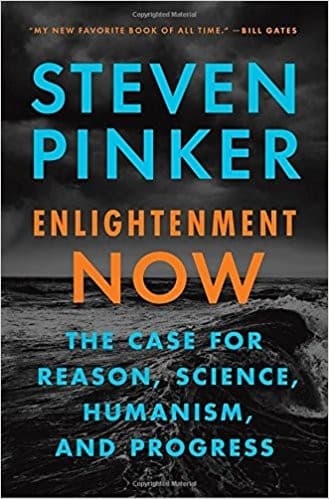
Business owners make long-term bets: hire this person, build this product, enter this market. Those bets are shaped by mood, and mood is shaped by the news. A steady diet of bad headlines makes the future look worse than the data suggests, and that leads to caution at the wrong moments. Enlightenment Now is Steven Pinker's case that on a long list of measures life has improved a great deal, and that you should look at the numbers before you decide how worried to be.
How it changes your thinking
The main change is a habit of asking for the trend. When someone tells you a market is collapsing or a technology is ruining everything, you ask how it compares with ten years ago and how it was measured. Pinker explains why our minds overweight vivid bad events and underweight slow improvement. His point is that good news is a process and bad news is an event, so they never line up with the news cycle. Once you see that bias, you notice it in meetings, in board discussions and in your own reasoning.
Progress as a method
Pinker says progress comes from applying knowledge and sympathy to problems, and that each solution produces new problems. He quotes Isaiah Berlin on this: the children get what their parents longed for, and then face problems created by those solutions. That is a fair description of a company. A business is a set of problems being solved one after another, and you improve it by measuring, trying something, checking what happened and adjusting. The book is a long defence of that loop at the scale of a civilisation.
Where I would push back
Read it as an argument and not as a verdict. The inequality and environment chapters are where people disagree most, and Pinker's answers there lean on his preferred measures. I would read at least one serious critique alongside it. The book itself asks you to do this, since it says to hold your beliefs to objective standards.
When to read it, and when to skip it
Read it when you want a broad, data-heavy view and have the patience for a long book. It suits a quiet month better than a week when you need a tool you can use by Friday. Skip it if you want direct advice on running a company, because it gives none. Chapters 4, 9, 10 and 20 are the ones I would start with if you only have an evening.
How it connects to decisions
The book is about reasoning from evidence, and that is how I think decisions should be made in a business. Write down what you believe, what data supports it and what would change your mind. Over time you can look back and see where your instincts followed the facts and where they followed the mood of the moment. Pinker's habit of asking what the numbers say is the habit a decision log builds.
Who it's for
Key take-aways
Book summary
Steven Pinker argues that the ideals of the Enlightenment, which he names as reason, science, humanism and progress, have made human life much better, and that they need defending now. He opens with a framework for understanding the human condition, spends the bulk of the book on data across health, wealth, safety, freedom and knowledge, and ends by defending the ideas behind those gains. He says he restates the case "in the language and concepts of the 21st century", and the language he chooses is charts.
Dare to Understand (chapter 1)
Pinker starts with Kant's 1784 essay on what enlightenment is, and uses it to define four themes: reason, science, humanism and progress. Reason is the one he treats as non-negotiable, because as soon as you argue that an answer is justified you have committed yourself to it. Science is the method for understanding the world, humanism puts the flourishing of people first, and progress follows when you apply the first three. He presents this as a project that is never finished.
Entro, Evo, Info (chapter 2)
This chapter gives the book its framework. The Second Law of Thermodynamics says order tends to dissipate, because there are far more disorderly arrangements than orderly ones. Living things and societies hold off disorder by spending energy and using information. Pinker adds evolution, which explains why we want to survive and flourish, and information and feedback, which explain how goals can be pursued. One consequence he stresses is that misfortune may be no one's fault, which is why progress takes effort.
Counter-Enlightenments (chapter 3)
Pinker asks who could be against these ideals, and answers that many people are. He traces opposition from the Romantic movement through to modern populism and to parts of elite intellectual culture. He also rejects the claim that the Enlightenment is a purely Western idea, arguing that an idea's birthplace says nothing about its merit.
Progressophobia (chapter 4)
Here he explains why so few people see progress. Intellectuals have long preferred the idea of decline, and ordinary people judge likelihood by how easily examples come to mind. News adds to the distortion because it covers events that happened since the last edition, so slow improvements are invisible. Pinker also recalls how audiences reacted to his earlier work on violence by questioning whether progress is even possible.
Life, Health, Sustenance and Wealth (chapters 5 to 8)
These four chapters are the core of the evidence. Pinker shows life expectancy rising worldwide, child and maternal deaths falling, deadly diseases in retreat, famine becoming rare and the share of people in extreme poverty shrinking sharply. He ties the improvements to science, trade, markets and technology, and to the energy that the Industrial Revolution made available.
Inequality (chapter 9)
Pinker accepts that inequality has risen in many rich countries, then argues that it is the wrong thing to focus on. He calls it a fallacy to treat wealth as a fixed lump that the rich take from everyone else, and says relative position matters less than whether people are better off in absolute terms. He suggests measuring consumption as well as income, and prefers targeting specific problems such as growth, education and health over inequality itself. This is the chapter I expect readers to argue with most.
The Environment (chapter 10)
He treats environmental problems as real and solvable. His case rests on decoupling, which means getting more human benefit from less matter and energy, and on carbon pricing and nuclear power as parts of deep decarbonisation. He argues that resources have so far not run out as predicted, and that the green movement should be more open to technology.
Peace, Safety and Terrorism (chapters 11 to 13)
Violence between and within countries has fallen over the long run, and Pinker argues that the post-1945 decline in war can continue. He also shows that deaths from accidents, fires, drowning and road crashes have dropped a great deal. In the terrorism chapter he argues that attacks kill few people compared with other causes, but that fear of them is out of proportion.
Democracy and Equal Rights (chapters 14 and 15)
Democracy has spread over the long run, though Pinker admits it has had setbacks. He then covers the rights revolutions: race, women, sexual orientation and children. He presents these as moral gains that reached many countries, and also points to places where they are still contested.
Knowledge, Quality of Life and Happiness (chapters 16 to 18)
These chapters ask whether progress reaches ordinary lives. Pinker covers education and the spread of knowledge, then leisure, travel and access to books, music and film that once belonged to the rich. On happiness he asks whether we are happier than people used to be, and argues that wealthier, healthier, freer societies tend to report more satisfaction.
Existential Threats and The Future of Progress (chapters 19 and 20)
Pinker then takes on the strongest objection: that we are courting disaster. He argues that most catastrophic forecasts, from Y2K to runaway artificial intelligence, depend on stacking up unlikely events, but he takes nuclear weapons seriously and sets out a path to reduce the risk. In chapter 20 he looks at populism, including its causes and what might slow it, and offers the label "possibilism" for his stance, quoting Hans Rosling: "I am not an optimist. I'm a very serious possibilist."
Reason, Science and Humanism (chapters 21 to 23)
The last part defends the ideas behind the progress. Reason is attacked by those who say it is a pretext for power, and Pinker points out that this argument refutes itself. He describes how motivated reasoning and tribal loyalty lead people astray, and why institutions such as open debate and peer review help. On science he rejects political interference from both left and right. On humanism he argues that a morality based on human flourishing needs no supernatural basis, and he is openly critical of religion as a source of morals.
What to do with it
- Pick three claims you often hear about your market and look up the long-term trend before you accept them.
- Replace some mood-driven news with annual data from reliable sources.
- When you feel pessimistic about a decision, write down whether the evidence is a trend or a single event, because as Pinker puts it, "an anecdote is not a trend."
- Treat each problem in your business as solvable and name the next step you can measure.
- Read one serious critique of the book so that you test Pinker's evidence as well as accept it.