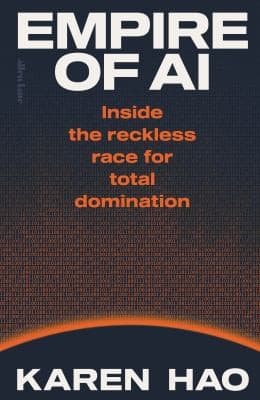
Empire of AI
On this pageWhat I like
What I like about this book
It is reported journalism built on more than 300 interviews, not a hot take, and it shows how choices made by a few people shaped the AI tools your business now uses. I like that it keeps asking who pays: the data workers, the communities that host data centres, the people whose work trained the models. It is a good prompt to look harder at the vendors you build on.
Why read it
A reported history of OpenAI that shows the choices, labour and resources behind the AI tools your business now relies on.
The problem it addresses
If your business uses AI, you are now a customer of a handful of very large companies. Most coverage tells you what the tools can do. Very little tells you who controls them, how they are funded and what pressures shape their decisions.
Empire of AI fills that gap. Karen Hao reports that the book rests on more than 300 interviews with around 260 people, plus documents and correspondence, and that every scene and technical detail is corroborated by at least two sources. That gives it more weight than commentary written from the outside.
What changes in how you work
You start treating an AI vendor as a critical supplier. You ask what happens to your workflow if its pricing, terms or priorities change, and who inside the company decides. The book shows how fast OpenAI's stated mission shifted, from open nonprofit research to a capped-profit structure to a paid product, so a promise on a website is not a safeguard.
You also stop assuming the current shape of the technology is fixed. Hao stresses that large language models are one narrow path, and that smaller, task-specific systems exist, such as the community-run one in her closing chapter.
When to read it, and when not
Read it when you are choosing a vendor, building a product that depends on one, or sitting on a board that must decide how much risk that is. It is also a good read if you want the human side of the story: the founders, the researchers and the workers.
Do not read it as a guide to using AI tools. It is a long narrative with many characters, and it has a thesis. If you want a technical or how-to book, pick another.
What to be careful about
This is a journalist's argument and the empire metaphor is hers. Conversations are reconstructed from interviewees' memories, notes and some recordings, as the author's note explains, and OpenAI was approached for comment. The book was finished in January 2025, so company details date quickly.
You can accept the facts she reports and still weigh the framing yourself. I would keep a clear line between what she documents and what she concludes.
Connecting it to a repeatable system
Record vendor decisions the way you record any big decision: which model you chose, why, what it costs, and what would make you switch. Keep prompts, playbooks and test cases in a form that works with more than one model, so work you have written down can move to another provider. The book's story of rapid change is the case for that discipline.
Who it's for
Key take-aways
Book summary
Hao argues that the biggest AI companies, led by OpenAI, behave like empires. They take resources that are not theirs, from the work of artists and writers to land, energy and water, they rely on cheap labour across the world, and they justify it with a story about benefiting humanity. The book follows OpenAI from its founding to the 2023 crisis at the top and asks who gains and who pays. It has four parts and an epilogue.
Prologue: A Run for the Throne
The book opens on 17 November 2023, when OpenAI's board fired its chief executive, Sam Altman, saying he had not been consistently candid. Within a day, more than 700 of roughly 770 employees had signed a letter threatening to quit, and he returned. Hao says the episode showed how a few people decide the future of AI. Her thesis follows: the current form of AI was not fixed in advance. In her words, "Nothing about this form of AI coming to the fore or even existing at all was inevitable."
Divine Right
In the summer of 2015, Altman convened a dinner with Elon Musk and others to discuss AI and humanity. Musk had been alarmed by conversations about superintelligence and by Demis Hassabis of DeepMind. OpenAI was set up as a nonprofit with a $1 billion pledge, to share research and to build artificial general intelligence for everyone.
A Civilizing Mission
Greg Brockman was the first to commit, and Altman picked Ilya Sutskever as the scientist. Brockman had been chief technology officer at Stripe, and Sutskever had studied under Geoffrey Hinton. The chapter introduces the founding team and their belief that they were building something for humankind.
Nerve Center
Hao first visited the San Francisco offices in August 2019. By then the experiment in open, idealistic governance was already unravelling, and OpenAI had become competitive, secretive and insular, with a stated aim of being first to artificial general intelligence.
Dreams of Modernity
This chapter places AI in history. The phrase artificial intelligence was coined as a marketing term, and the field split between symbolic and connectionist approaches, with funding for neural networks drying up after a 1969 book. Hao draws on two economists who argue that technologies do not default to broad prosperity, because the visions that win belong to those with the power to rally resources.
Scale of Ambition
Sutskever's faith in deep learning, after the 2012 ImageNet result, led OpenAI to scale. Dario Amodei's team found scaling laws: smooth curves linking a model's performance to its data, compute and parameters. GPT-2 could write coherent prose, and also showed the risks that came with its training data.
Ascension
Altman refounded Y Combinator and brought a winner-takes-all mindset to OpenAI. He did not want it to be one of the top AI organisations, but the only one, and he cited Peter Thiel's rule of aiming for a technology ten times better than the next.
Science in Captivity
The GPT-3 interface released in June 2020 started a race. Google, DeepMind and Meta reacted, and Google's leaders waited until ChatGPT scared them before pooling resources. Researchers such as Timnit Gebru raised concerns about the scaling trend, while independent research shrank as companies took over.
Dawn of Commerce
In 2021 OpenAI wrote a road map to scale GPT-3 another ten times on a new Microsoft supercomputer, improve compute efficiency and use human feedback to train. The departure of the people who founded Anthropic, which the book calls The Divorce, weakened internal resistance to commercialising.
Disaster Capitalism
To clean up its models' outputs, OpenAI needed people to review sexual and violent text. It signed four contracts worth $230,000 with the outsourcing firm Sama, and dozens of workers in Kenya did the work. Hao, drawing on research into so-called ghost work, reports lasting harm to some of them and compares the conditions to servitude.
Gods and Demons
Hao describes two camps: Doomers, who fear catastrophic risk, and Boomers, who think progress is a moral imperative. OpenAI became a battleground between them, and Anthropic, which split off over safety, ended up varying from OpenAI in style more than in substance, she says.
Apex
ChatGPT launched on 30 November 2022 as a low-key research preview. Staff guessed it would draw thousands of users, and the team provisioned servers for 100,000. It crashed under demand, surprised Microsoft and firmly turned the company towards paid products, which put OpenAI and Microsoft in competition for customers.
Plundered Earth
In Chile, Hao describes communities near Santiago facing Google data centres in a country where water is privatised. Cerrillos, home to the country's only public water service, was chosen for another, and activist groups there were watching. She says developers use shell companies, donations and promises that they later retreat from.
The Two Prophets
After ChatGPT, Altman testified to the US Senate and proposed a licensing regime for future models, which Hao says moved the debate away from labour, copyright and the environment. The chapter also covers chip export controls, the divide between the safety and commercial camps, and a deadlock on the board over new directors.
Deliverance, The Gambit and Cloak-and-Dagger
These chapters build up to the firing. Sutskever and chief technology officer Mira Murati gave the independent directors accounts of Altman's behaviour. The directors, who say they heard similar concerns from at least seven people, also found that Altman legally owned OpenAI's Startup Fund. They acted on 17 November, and Hao tells the story from inside.
Reckoning
After the brief ouster, called The Blip, Sutskever never came back to the office, and the safety group shrank. Departures followed, and the company pressed on with its plans for chips and for a voice-driven assistant.
A Formula for Empire
Hao proposes that OpenAI's mission works as a formula with three ingredients. It rallies talent around a grand ambition, it centralises capital while removing obstacles such as regulation and dissent, and it stays vague enough to be reinterpreted as needed.
Epilogue: How the Empire Falls
The ending is hopeful. The Māori organisation Te Hiku Media built language tools only with consent, reciprocity and the community's sovereignty, collecting 310 hours of audio in ten days. As Keoni Mahelona, who led the work with Peter-Lucas Jones, puts it, "Data is the last frontier of colonization." Hao calls for spreading power over knowledge, resources and influence.
What to do with it
- List the AI vendors your business depends on and what you would do if one changed price, terms or model.
- Ask each vendor what it discloses about training data, labour and energy, and record the answers.
- Keep prompts, playbooks and test cases in a form that works with more than one model.
- Test a smaller, task-specific model for any job where the biggest model is not needed.
- Record who decides which AI tool is used and why, and review it every quarter.