Disciplined Entrepreneurship
On this pageWhat I like
What I like about this book
This book brings clarity to startup chaos. It’s a step-by-step system for going from idea to scalable business.
Why read it
It’s like a curriculum for startup builders who want structure.
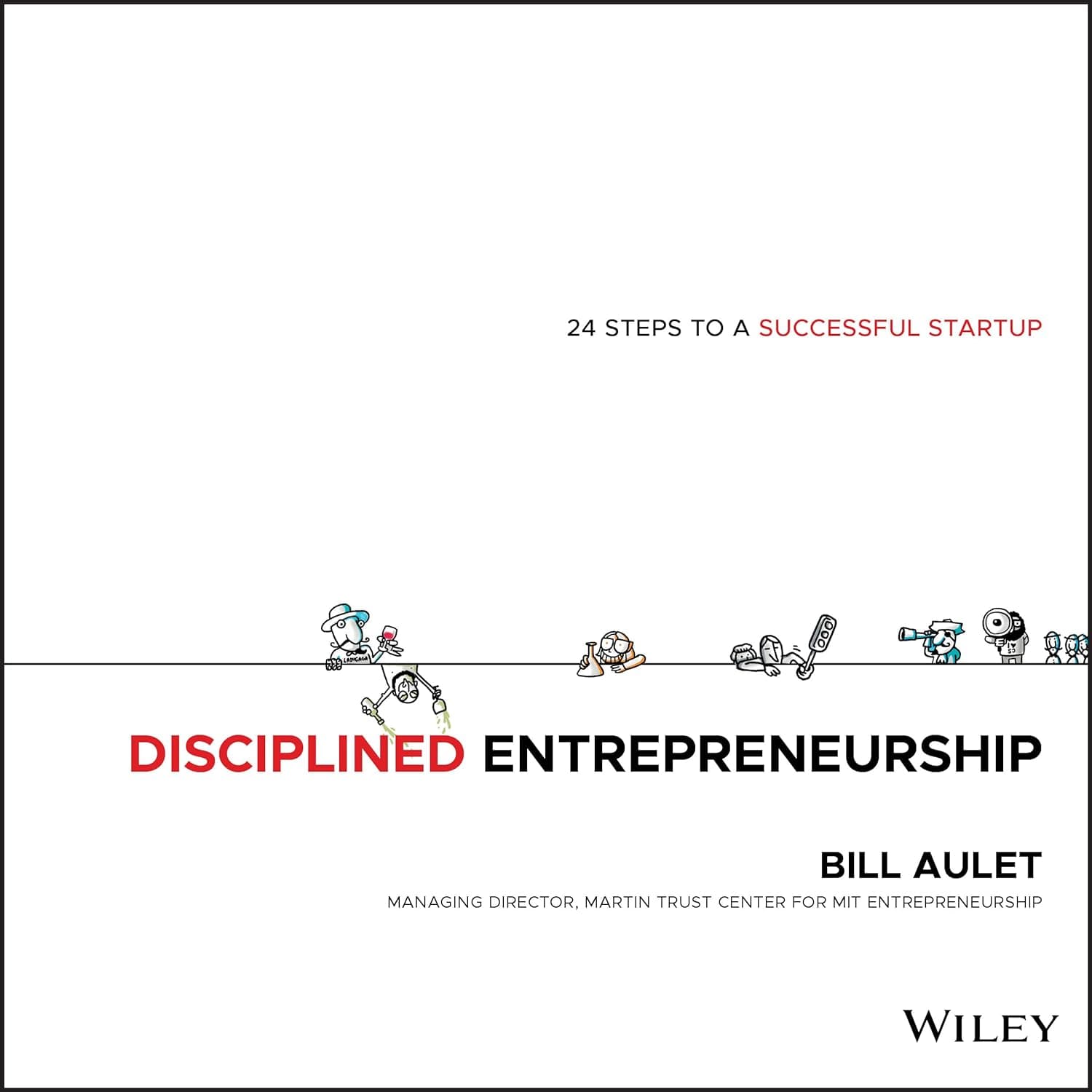
Disciplined Entrepreneurship by Bill Aulet is on our shelf. We only recommend a book when it gives you something you can put to work, not just something to agree with.
Below: who it is for, what it says in short, and how to turn it into a change in how your business runs. Two minutes, and you will know if it belongs on your desk.
Who it's for
Key take-aways
Book summary
Introduction
Entrepreneurship can be taught as a craft a systematic process of creating sustainable and innovative ventures. Bill Aulet's Disciplined Entrepreneurship provides a structured, actionable framework for building a successful startup by addressing the complexity of innovation-driven entrepreneurship (IDE). Through 24 detailed steps, this book demystifies the entrepreneurial process and offers practical tools that can be applied to startups and even intrapreneurship in established organisations.
Six Themes of Entrepreneurship
The 24 steps are divided into six key themes:
- Who is your customer? Defining and understanding the target market and end-user.
- What can you do for them? Creating value through precise solutions.
- How do they acquire your product? Streamlining acquisition and sales processes.
- How do you make money? Designing scalable and profitable business models.
- How do you design and build your product? Iterative and customer-focused product development.
- How do you scale your business? Expanding sustainably and strategically.
Key Concepts
- Market Segmentation and Beachhead Market Selection: Focus on a specific, high-potential market to build credibility and traction.
- Customer-Centric Approach: Build user profiles and personas to understand the specific needs of your core customers, ensuring alignment with your product or service.
- Iterative Product Design: Prototype and gather customer feedback iteratively to refine the product.
- Quantify Value Proposition: Articulate clear and measurable benefits to your customers, ensuring they can see the value of your solution.
- Unit Economics: Balance customer acquisition costs (CoCA) with lifetime value (LTV) to ensure long-term profitability.
- Core Differentiation: Focus on what makes your business unique and hard to replicate, leveraging competitive positioning effectively.
- Business Model Innovation: Select models that align incentives across stakeholders while ensuring scalability.
- Testing and Assumptions: Validate assumptions through low-cost experiments before heavy investments.
Practical Applications
- Disciplined Canvas: Use a visual canvas to track progress across the 24 steps and iteratively refine earlier work as you gain insights.
- Sales and Marketing Alignment: Create a go-to-market strategy that matches the target persona and market.
- Revenue Engine Design: Ensure scalability by defining clear sales motions and aligning them with your product and pricing strategy.
Conclusion
By offering a structured, yet flexible, framework, Disciplined Entrepreneurship equips entrepreneurs with the tools to navigate uncertainty, refine their ideas, and scale their ventures effectively. It’s a must-read for anyone looking to transform innovative ideas into successful and sustainable businesses. The book reinforces that while entrepreneurship is a challenge, discipline and structure can significantly increase the odds of success.