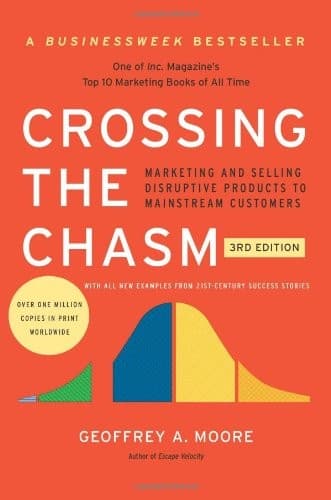
Crossing the Chasm
On this pageWhat I like
What I like about this book
It explains a pattern many young technology companies hit: enthusiasts buy, then sales stall. The answer is specific and a little uncomfortable, which is to pick one narrow market and win it completely. I like that it argues for narrowing focus at the moment every instinct says to widen it.
Why read it
Explains why products stall after the early adopters and how to win one narrow market first in order to reach the mainstream.
The problem it solves
A new product often finds a handful of enthusiastic early customers quickly. They like trying new things, accept rough edges and pay for a promise. Then the next group of buyers does not respond to the same pitch, deals slow down, and growth stalls even though the product keeps improving.
Moore's point is that feature for feature the product that loses is often as good as the one that wins, and that blaming marketing explains nothing. His explanation is a gap between two kinds of customer, which the book calls the chasm, and a plan for getting across it.
What changes in how you work
You stop treating the market as one lump of potential customers. You ask who has bought, why, and how the next group differs. You pick one segment that has a strong reason to buy, serve it completely, and measure yourself by whether its members refer each other.
You also change what you call the product. For a pragmatic buyer the product is the whole package, including integrations, support and partners, not only the thing you ship.
When to read it, and when not
Read it when you have early traction and cannot turn it into a repeatable market, or when you are tempted to widen the target to find growth. It is also useful if you sell to businesses, where references and trusted channels matter.
It is less useful if you have no customers yet, or if you sell a simple product to individuals in a market that is already mainstream. The third edition refreshes the examples to 2013, but the core is aimed at technology companies.
What to be careful about
The book is written as marketing for high-tech companies, and many of its channel and pricing examples are about enterprise sales. Check each idea against how your own customers buy. Its war metaphors are memorable, but a niche is not an enemy to be driven out. Treat the D-Day framing as a way to remember the focus.
Moore also says the choice of niche is a high-risk, low-data decision. He does not promise certainty, and you should expect to be wrong sometimes.
Connecting it to a repeatable system
Choosing a beachhead is a decision you can write down: the scenarios you considered, how each scored and why you committed to one. Log the result of every campaign in that niche so you can tell whether the word of mouth is working. Once a niche works, the steps that win it, such as the whole-product checklist, the references you collect and the channel set-up, are repeatable work that can become a playbook for the next adjacent segment.
Who it's for
Key take-aways
Book summary
Moore argues that high-tech products spread through a market in stages, and that the move from the early market to the mainstream is the most dangerous step. He calls the gap between the two the chasm. The book gives a plan for crossing it that is modelled on an invasion: focus on one narrow target, assemble everything the buyer needs, define the competition and secure the channel. This summary follows the third edition, which updates the examples to the 2010s.
Introduction: If Mark Zuckerberg Can Be a Billionaire
The introduction asks why so many technology ventures with good products fail, and why the marketing department is blamed. Moore says the usual model of marketing does not suit high tech, and that the book is written for the leadership of such companies. Crossing the chasm, he says, is a do-or-die moment that needs the whole company to agree on one plan.
High-Tech Marketing Illusion
The chapter introduces the Technology Adoption Life Cycle, a bell curve of innovators, early adopters, early majority, late majority and laggards. The usual marketing model says to work the curve from left to right, using each group as a reference for the next. Moore says there are gaps between the groups. Two are small cracks, and the real danger is between early adopters and the early majority, which goes unnoticed because the customer list and order size can look the same.
High-Tech Marketing Enlightenment
Here the groups are renamed for high tech: technology enthusiasts, visionaries, pragmatists, conservatives and skeptics. Visionaries want a breakthrough and will tolerate gaps, but each wants something unique. Pragmatists want references from their own industry, a complete solution and a trusted supplier, and they take patience to win. A market, in Moore's sense, is a group whose members reference each other, so that word of mouth works.
The D-Day Analogy
The chasm is a bad place to be: few new customers, falling cash and competitors who now notice you. Moore compares the situation with the 1944 invasion of Normandy: you must concentrate overwhelming force on one narrow point. Win a tightly bounded niche, then use it as a base to move into adjacent ones.
Target the Point of Attack
You must choose one niche, and you will have to do it with little data. Moore advises informed intuition: write a handful of vivid target customer scenarios, then rate each against a checklist covering the target customer, a compelling reason to buy, the whole product, partners, distribution, pricing, competition, positioning and the next target. Commit to one beachhead, and when in doubt favour the scenario with the strongest reason to buy.
Assemble the Invasion Force
Marketing, he says, is warfare and not wordfare, so you need to deliver the whole product. Using Levitt's model, he separates the generic product, the expected product, the augmented product and the potential product, and he explains that pragmatists care most about the outer layers. Partners and allies fill the gaps, so that your product becomes the only reasonable way to meet that customer's need.
Define the Battle
Pragmatists want to see credible competition, so you may need to create the competitive set. His rule is that any force can defeat any other force if it can define the battle. The Competitive Positioning Compass has four domains of value, technology, product, market and company, with product and technology mattering early and market and company mattering in the mainstream. You then write a clear positioning statement for the target customer.
Launch the Invasion
The last two pieces are distribution and pricing. The first corporate goal when crossing the chasm is a channel into the mainstream that pragmatists trust, ahead of revenue, profit and even customer satisfaction. Pricing has a matching job, which is to motivate that channel. Moore sets out five types of buyer, from enterprise executives to small business owners, and the channel each prefers.
Conclusion: Leaving the Chasm Behind
The company that emerges from the chasm is bound by the promises made to get an early market, and some of them cannot be kept. Moore urges leaders to avoid damaging commitments in advance and to change finance, organisational development and research and development for a profit-driven mainstream business. All organisations, he says, are market-driven whether they admit it or not.
Appendices
The first appendix places the chasm inside Moore's wider model, which runs from early market through the chasm to the bowling alley, the tornado and main street. The second, on the Four Gears model, covers digital consumer products such as Skype, Yammer and Prezi, where he is less sure a chasm applies.
What to do with it
- Write down who your current customers are and whether they are visionaries who bought a change or pragmatists who bought a solution.
- List three to five candidate niches as short customer scenarios, and score each on a reason to buy and the whole product it needs.
- Commit to one beachhead for a fixed period, and write the decision and its reasons down.
- Map the whole product for that niche, mark what you lack and name the partners who could fill it.
- Write a one-sentence positioning statement for that customer, then check which channel they trust and whether your pricing motivates it.