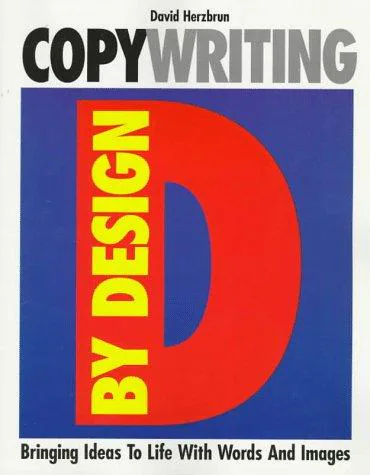
Copywriting by Design
On this pageWhat I like
What I like about this book
It treats an advert as one thought made of a picture and the words that go with it, and it teaches you to plan both before you write a line. The running example, a made-up range of canned soups, is followed through print, radio, TV and outdoor, so you see one idea tested in every medium. It is a 1997 textbook, so the production detail is dated, but the habit of thinking visually still applies to a landing page or a sales email.
Why read it
A practical course in making words and pictures work as one message, from first idea to billboard test.
The problem it solves
Most small businesses write copy and brief design as two separate jobs. Someone writes the headline, then someone else finds a picture to sit beside it. The book argues that this split is where adverts go weak. In its opening chapter the author says the picture and the words only mean something together, and he shows it with a Volkswagen advert in which neither half works alone.
What changes in how you work
You stop starting from the words. You start from the strategy, find the idea, and then list every visual element the page needs, including the headline and the copy, because copy takes up space too. That one habit makes a brief clearer for a designer, a freelancer or an agent, because you can hand over a list of what must appear and why.
The book also gives you a test for the idea itself. If a campaign cannot be reduced to a single board that a driver reads in about two seconds, the book says something is probably wrong with the concept. You can run the same test on a homepage headline, an email subject line or an ad in a feed.
How it connects to a business
The positioning statement in Chapter 2 is the most reusable page in the book. It has a fixed form: for a target audience, the product is a principal claim, because of a main support. A sentence like that is a decision you can write down, check against later and hand to anyone who produces work for you.
Chapter 3 adds a discipline that most owners skip: read the research as quotes from real customers, not only the summary. That is cheap advice and it works for sales calls and support emails as much as for focus groups.
When to read it, and when not to
Read it when you are about to brief a campaign, or when your own advertising looks busy and unfocused. The first five chapters repay a careful read.
Do not expect current practice. The print production chapter covers photostats, rubber cement and film engravers, and the TV chapters assume broadcast commercials, film labs and storyboard pads. The drawing lessons are written for students who have never drawn a layout. Skim those parts for the logic of who does what and why, and keep the thinking.
A playbook you can reuse
The book is built from repeatable routines: the strategy brief, the visual list, the thumbnail, the headline and tone check, the storyboard, the bid review, the pre-production meeting. Each one is a step you can write down once and run again, which is the kind of work a team or an agent can take over. The decision at the top of each routine, who the audience is and what single claim you are making, is the part worth logging.
Who it's for
Key take-aways
Book summary
Copywriting by Design is a textbook for people who make advertising, written by David Herzbrun, who spent decades as a creative director at agencies including Doyle Dane Bernbach and Ogilvy & Mather. Its argument is that a copywriter and an art director should both think of themselves as communicators, and that the picture and the words should grow from one idea instead of being made in turn. It teaches this by following a single invented product, Grand Tour Soups, through print, radio, TV and outdoor, with an assignment at the end of most chapters. The book is organised in six parts and ends with a glossary and a short chapter on finding a first job.
Chapter 1: See What I Mean
Television taught audiences to read pictures quickly, as commercials shrank from sixty seconds to thirty and then fifteen. The author tells the reader to stop thinking as a writer or a designer and to think as a communicator. A picture joined to a few right words, he says, beats a thousand words. His proof is a 1963 Volkswagen advert he created, where the image and the headline only mean something together. He calls this visual and verbal thinking, as opposed to compartmental thinking, where the art director waits for the headline.
Chapter 2: Why Advertising?
Sales are only one reason to advertise. Car advertising builds a favourable view of the brand, and an oil company campaign in the book was aimed at a few legislators to prevent something from happening. So every job starts from an advertising strategy. It names the target market, using demographics and psychographics, and a positioning statement in a set form. It also states the goal, the media, the usage, the tone and a plan that links promotion, packaging and public relations by one theme. The author says the strategy makes you more creative, because it tells you what to be creative about. His exercise has you write headlines for a touring bicycle aimed at two different age groups.
Chapter 3: Where Do Ideas Come From?
Good ideas are already in the product or the customer. Learn the product, visit the factory, find a selling point that competitors have not claimed, and read the focus group reports, including the verbatim quotes. An idea is not an ad, and the book uses the Sunkist orange campaign as proof that the idea is what moves buyers. Then comes the key method of the book: think visually before you draw anything. For the soup launch, the author picks a French chef tasting the soup, because it says French, good tasting and authoritative at once, and because it can pool out into a long campaign. Last, he turns that picture into a list of the visual elements the ad needs.
Chapter 4: If You're Not a Designer, Don't Act Like One
Writers should not try to invent a layout. The author starts with a classic layout, a big picture with the headline beneath it, and notes that it worked for David Ogilvy and again for Volkswagen, because a layout is a packing crate and what counts is what goes in it. The principle, in the author's words, is "Let the layout grow from the idea". You work in thumbnails, test where the headline, subhead, copy and pack shot sit, and keep a swipe file of layouts to borrow from. The chapter also covers justified, ragged and centred type and how to indicate each in a rough.
Chapter 5: Learning Your ABCs
Good writing looks good, so avoid long solid blocks of copy. The author has copywriting students trace and then freehand an alphabet, first capitals and then lowercase, to learn how letters are formed. The point is that type is a writer's tone of voice: bold type speaks strongly, italics look urgent, and serif faces feel more conversational. Typefaces also suggest a period or a country, so a writer who cares about the craft needs to know typography.
Chapters 6 and 7: Making Faces and Helping Hands; Bodies to Put Your Hands On
These two chapters teach rough drawing as communication, not illustration. You build expressive faces from ovals, hands from a ball with a thumb, and bodies from triangles and stick figures. You then assemble the French chef, the soup bowl and the can into a full-size layout, using layers of tracing paper. The author insists that good enough is good enough for hands, because a rough only has to communicate. Chapter 7 adds a swipe file and tells you to make ads for things you already know as a consumer, with a Taco Bell breakfast assignment to practise on.
Chapter 8: Time to Start Writing
Now the headline arrives, and it changes the layout: a headline that promises a story needs room for long copy. The author argues that long copy is easier to write than short copy. He asks you to cast the writer as if an actor would read the ad aloud, so the copy has a single voice. He then covers subheads, bold lead-ins and crossheads for copy of about 150 to 250 words, which let a reader skim or rest. After you write freely, you cut, and he repeats the advice of Arthur Quiller-Couch to "murder your darlings". He also says long copy signals that an advertiser respects its audience, even when few people read it all.
Chapter 9: Life After Layouts
This chapter follows a print advert after the layout. The art director chooses photographers and has the final say on location, casting and props, and a good photographer may improve the idea. Type is set and pasted with the photographs into a mechanical, and an engraver separates the colour into four plates and produces a proof. The copywriter's own job in this process is proofreading, so the chapter ends with the standard proofreader's marks. Much of the technology has since been replaced, but the sequence of responsibilities is clear.
Chapter 10: The Theater of the Mind
Radio is called the most visual medium, because the listener builds the pictures. The tools are the human voice, sound effects and music. Before writing, you cast the voice and decide where the speaker is. Placing sounds at different distances can even give the listener a camera angle, and music can set a place or a decade. The author warns against choices that are fun but not relevant to what you sell. He gives timing rules, such as reading your own copy at least 15 percent shorter than the spot, and includes a sample script for the American Heart Association.
Chapter 11: TV: Show Business Is All Business
TV can show nearly anything, but money is the limit, and the storyboard is the TV equivalent of a rough layout. It sells the idea to the creative director and the client, goes to lawyers for clearance and tells production companies what to bid on. The chapter covers three kinds of board: key frame, working and shooting. You learn to plan the scenes as a list, write in two columns of video and audio, and use cuts, dissolves, supers and mortises. It then explains animatics, cheap test versions made before a commercial is shot, and photomatics. It ends on music, showing how the same scene changes meaning with different songs.
Chapter 12: It's Show Time
Once the animatic tests well, the author warns that you are at the mercy of experts, and the way to keep control is to understand the process. You work with an agency producer, view directors' show reels for strengths, and compare bids line by line instead of picking the cheapest. The pre-production meeting must align everyone on look, tone and intent, including casting and locations. On the set you are told to ask questions and focus on everything. Post-production runs through dailies, editing, the rough cut, the mix and the final tape. An appendix lists the crew on a set and what each person does.
Chapter 13: The Last Frontier
Outdoor is the hardest medium because a driver gives the board about two seconds. The Outdoor Advertising Institute suggests about nine words at most, but the author prefers simplicity and singularity, and he cites an Avis campaign that broke the rules with no picture. He then applies the billboard test to the soup campaign, where the French family idea fails and the chef idea works. Outdoor works best as a reminder of other advertising, so a campaign that cannot be reduced to a billboard probably has a weak concept.
Chapter 14: How to Get a Job in Advertising
The last chapter is about the portfolio, which the author calls a book. A campaign in it should have three full-page magazine ads, two or three small-space ads, one TV spot and one outdoor board. It should sit in the middle of the book, with several copies in circulation. He also tells his own route into the industry, which took seven years of varied jobs, and urges new entrants not to be too picky about a first role.
What to do with it
- Write a positioning statement for your own offer in the book's form: for a target, a product is a claim, because of a support.
- Before briefing any design or ad, list every visual element the page needs, including headline and copy, and agree what the one idea is.
- Cast a voice for your copy by deciding who is speaking, where they are and how they sound, then check each line against it.
- Cut your draft once without mercy, and remove the line you are proudest of first.
- Run the billboard test on your current campaign: can the theme survive on a sign read in two seconds.
- Keep a swipe file of work you admire, and note in one line why each piece works.