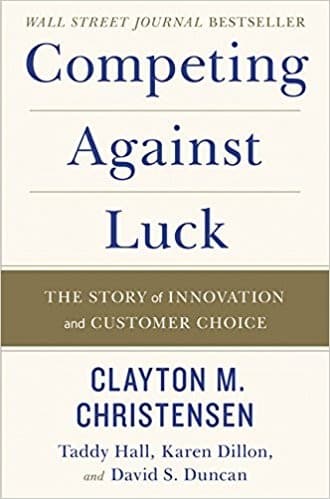
Competing Against Luck
On this pageWhat I like
What I like about this book
It swaps the question of who your customer is for what they are trying to get done, and that one change clears up a lot of muddled product work. The milk shake story carries the main idea and sticks in the mind. I also like that the book is about causes, not demographics, and that the authors say plainly where the theory stops.
Why read it
Explains why people buy by treating a purchase as hiring a product to make progress in a given situation, so you build for that situation.
The problem it solves
Most companies know their customers in great detail and still struggle to predict what they will buy. They have segments, personas and survey scores, yet launches miss and growth slows. The authors cite a poll in which most executives rated innovation as extremely important to growth while almost all were unhappy with their own results.
Their diagnosis is that the data describes people and not causes. Christensen makes the point with himself: his height, age and car do not explain why he buys a newspaper on a given day. The book argues you need the circumstance that creates the need, and that product success is otherwise left to luck.
What changes in how you work
You stop asking customers what they want and start asking what they were trying to do when they bought, what else they considered and what they gave up. The book frames this as hiring and firing, and it asks what the customer must stop doing before they can start using yours.
You also redraw your competition. The milk shake was up against bagels and protein bars in the morning, not other milk shakes, and some jobs are done by nothing at all. That opens markets and customers that your category definition hides.
When to read it, and when not
Read it before you set a roadmap, reposition a product or interview customers. It is most useful when you have a product that sells but cannot say why, or when a feature list is growing without a reason.
It is less use if you want a step-by-step method. The authors say there is no one right way to find jobs, and the book teaches through stories. It is also longer on large-company examples than on a five-person team, so you will need to translate.
What to be careful about
The theory is built from cases, and the final chapter is open about its limits: not every human motive is a job, and calling something a job should take work. Stories of hindsight are tidy, so treat each example as a prompt to test in your own market.
Do not turn the idea into a slogan. Writing a job statement in an afternoon without talking to buyers gives you a guess dressed up as insight.
Connecting it to a repeatable system
A well-worded job is a decision you can record: who, in what circumstance, wants what progress, and which choices follow. Log it and check later choices against it, including what you will not build. The authors describe the job working like a commander's intent, so people can decide without asking. Once the job is clear, the processes that serve it, such as response times and follow-up, can be written down as playbooks and measured by the customer benefit they deliver.
Who it's for
Key take-aways
Book summary
Christensen and his co-authors argue that innovation fails so often because companies try to predict behaviour from data about customers, when they should understand the progress customers are trying to make. The book presents Jobs to Be Done as a theory of why people buy, and shows how to use it for research, product design and the way a company is organised. It is split into three sections: the theory, applying it, and building an organisation around it.
Introduction: Why You Should Hire This Book
The introduction sets the problem. Companies spend heavily on research and development and hold more data than ever, but the data says who customers are and not why they choose. Correlation is not cause. The better question, in the authors' words, is what job did you hire that product to do. The authors present themselves and explain the book's format, which ends each chapter with takeaways and questions for leaders.
The Milk Shake Dilemma
A fast-food chain tried to sell more milk shakes by asking typical buyers to describe a better one, and nothing changed. When researchers watched who bought and when, many shakes were sold early in the morning to commuters hiring them to make a long drive more interesting. In the afternoon, parents hired them for another job. Each job had different competitors, and the same story is told for margarine, whose rivals included Teflon and cooking spray. The chapter also explains why disruption theory does not say where to look for opportunities.
Progress, Not Products
This chapter defines the idea. A job is the progress a person wants to make in a particular circumstance, with functional, social and emotional dimensions. Needs such as wanting to eat are too general to guide a design. As the authors put it, customers pull products into their lives "to make progress". Jobs are discovered and persist, while solutions change, from letters to email. The chapter also states the limits of the theory.
Jobs in the Wild
Here the theory meets real organisations. Southern New Hampshire University found that the working adults it served online were hiring it for a very different job than the school-leavers on campus. The chapter introduces competing with nothing, meaning people who hire no solution because none fits, and shows the idea applies in business-to-business markets too.
Job Hunting
Jobs are found by watching, not by running tools. The authors give five places to look: your own life, nonconsumption, workarounds and compensating behaviours, things people do not want to do, and unusual uses of a product. Each marks a place where progress is blocked. They add that there is no single right way to do this.
How to Hear What Your Customers Don't Say
People cannot describe their motives fully, so you rebuild the story of a purchase. The chapter separates the Big Hire, the moment of buying, from the Little Hire, the moment of actually using it, and stresses that something must be fired for your product to be hired. Forces for change are the push of the situation and the pull of the new solution, and forces against are habits of the present and anxiety about the new. Interview with a beginner's mind.
Building Your Résumé
Once you understand the job you write a job spec: the dimensions of the progress, the trade-offs, the competing solutions and the obstacles. Solutions must include the experiences of buying and using, since a product becomes a service when it removes obstacles. Amazon's customer reviews are one example, and a purpose brand, such as Uber, is one that stands for the job.
Integrating Around a Job
Experiences must be delivered the same way every time, and that is the work of processes. The chapter opens with Toyota, which let rivals tour its factories and lost nothing, because its edge lay in processes that are hard to see and hard to copy. The authors argue that reorganising rarely helps, and that firms should integrate around the job and measure customer benefit, such as response time for SNHU, delivery date for Amazon and peace of mind for OnStar.
Keeping Your Eye on the Job
Companies drift from the job that created them. The authors use the quarter-inch drill and the quarter-inch hole to make the point and name three fallacies. The fallacy of active versus passive data favours operations numbers over data about the job. The fallacy of surface growth chases more sales to the same customers. The fallacy of conforming data collects only what fits the existing model.
The Jobs-Focused Organization
A clearly stated job works as a north star. The authors list four benefits: decisions made across the company, better use of resources, inspiration for staff and better measurement. They use GM's OnStar to show how a clear job decides what to build and what to leave out, and tell how the TurboTax team stopped chasing a 150-item wish list once the job gave it a compass.
Final Observations About the Theory of Jobs
The last chapter answers whether innovation is a matter of luck, and says no. Christensen explains that the theory was built inductively from observation, sets boundaries on what counts as a job, and shows the lens at work in home life, public education and health care. His closing argument is that theories teach us how to think.
What to do with it
- Interview five recent buyers about the day they decided, what else they considered, what they stopped using and what held them back.
- Write the job in one sentence with the circumstance and the progress sought, and add the functional, emotional and social parts.
- List your real competitors for that job, including doing nothing and workarounds.
- Write a job spec of obstacles and experiences, then change one part of your offer or onboarding to remove an obstacle.
- Choose one metric that reflects customer benefit, such as time to first result, and track it instead of an internal figure.