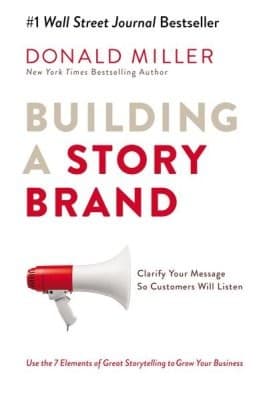
Building a StoryBrand
On this pageWhat I like
What I like about this book
It fixes the most common marketing mistake, which is talking about yourself. The seven-part framework is short enough to remember and strict enough to apply to a homepage in an afternoon. I like how plainly it says that the customer is the hero and you are the guide.
Why read it
A seven-part framework for writing clear marketing messages that put the customer at the centre of the story.
The problem it solves
Most company websites and sales decks are about the company: its history, its features, its team. Visitors skim, cannot tell in a few seconds what is on offer or why it matters, and leave. The company has plenty to say and the customer hears nothing.
Building a StoryBrand argues that the problem is the story you tell. If the customer is not the centre of it, they have no reason to listen. The book gives you a framework to put them there and to cut everything that does not help them decide.
What changes in how you work
You start with the customer's problem instead of your product. You ask what they want, what stands in their way and what happens if they do nothing. Then you shape the message so those answers are clear in the first few seconds on a page.
You also get a one-sentence description of what you do that people can repeat. That helps in sales calls, in introductions and when briefing a freelancer or writing an email. A clear message saves a surprising amount of time.
When to read it
Read it before you rewrite a homepage, build a pitch, plan an email sequence or brief a designer. It suits businesses that sell something people find hard to understand at first glance, which is common in software and services.
It is less useful if your message is already clear and your issue is the product, the price or the delivery. Fixing the words will not help if the offer is weak.
What to be careful about
The framework is a template, and templates produce similar results. If everyone in your market applies the same seven steps, you will sound alike again. Use it to get clear, then add what is specific to you. Also check the claims you make: a clear message that overpromises damages trust more than a muddy one.
Making the message repeatable
There is a link to how I work. A message framework is a decision you can write down once: who the customer is, what problem you solve, what the plan is. Once it is on paper, you can reuse it for every page, email and call, and hand the drafting to a colleague or a tool with the brief already in place. That is repeatable work built on a clear decision, which is what I like to see.
Who it's for
Key take-aways
Book summary
Miller argues that people respond to stories, and that most businesses fail to use that. His claim is that if you clarify your message by casting the customer as the hero and yourself as the guide, more people will listen and buy. The book, first published in 2017, is built on a seven-part framework that Miller calls the StoryBrand BrandScript. Miller runs a company by the same name that teaches the method.
The customer is the hero
The starting point is a change in roles. In most marketing the company acts as the hero, telling the audience how great it is. Miller says the customer should be the hero, and the company the guide who helps them succeed.
This reframes your material. Every line asks whether it helps the customer take a step, or whether it is just about you. It is an uncomfortable test, and a useful one.
A character with a want
The first part of the framework is a character who wants something. Miller stresses that you should define one clear, simple desire that your product helps with, because a story needs a goal. If the customer's want is vague, the message will be as well.
For a business, this means choosing the one thing you want customers to associate with you. The more focused the want, the clearer the story.
The problem at three levels
Next comes the problem. Miller describes it at three levels: the external problem, which is the practical obstacle; the internal problem, which is how it makes the customer feel; and the philosophical problem, which is why it is wrong that they should have to put up with it.
The key point is that people buy to solve the internal problem as much as the external one. A message that speaks only to the practical issue misses the emotion that drives the decision. A villain, which can be a thing or a situation, helps to personify the problem.
The guide, the plan and the call to action
The guide combines empathy and authority. Empathy shows you understand the customer's difficulty, and authority shows you can solve it, through results, testimonials or credentials. You need both.
The plan removes the fear of the unknown. Miller suggests a simple process of a few steps, and an agreement plan that lowers the perceived risk. The call to action then tells people what to do next. He separates direct calls, such as buying or booking, from transitional ones, such as downloading a guide, for people who are not ready yet.
Why a simple message wins
Miller's argument rests on how people take in information. Customers are busy, distracted and short of attention, so a message that makes them work to understand it loses to one that is easy to grasp. He compares the brain to something that saves effort wherever it can, and says clear messages help the customer survive and thrive, which is why they get attention.
The practical rule is to cut. Remove the extra claims, the clever wordplay and the long history. Keep the lines that tell the customer what you offer and what to do next. Clarity is a form of respect for the reader's time.
Failure and success
A story needs stakes. The framework asks you to say what the customer risks if they do nothing, and what life looks like if they succeed. Miller recommends being honest about the stakes without using fear as a weapon.
The success picture matters as much. People move toward a clear image of a better situation, so describe it in plain terms.
Sorting what stays and what goes
Once you have the seven parts, the framework works as a filter. Each sentence on a page should serve one of them. If a line is about the founders' history, a feature nobody asked about or an award with no link to the customer's problem, it either supports the story or it goes.
Miller also asks you to think about how the customer gets from the problem to the plan without friction. A visitor who must hunt for the next step will leave. Make the next step obvious, repeat it at sensible points on the page, and avoid offering six different options at once.
Applying it to a website
The later chapters show how to apply the framework to a homepage, email and other material. Miller proposes a simple test: could a visitor, in a few seconds, say what you offer, how it improves their life, and what they need to do to buy it? If not, the page is too complicated.
He also covers a one-line description of the business, built from the problem, the solution and the result. It gives you a sentence you can use everywhere.
What to do with it
- Write out the seven parts for your main offer, one or two lines each.
- Check your homepage: can a stranger state what you offer, and what to do next, in five seconds?
- Rewrite your headline around the customer's problem, not your product.
- Add one direct call to action and one transitional call to action to your key pages.
- Draft a one-sentence description of your business and test it on three people.