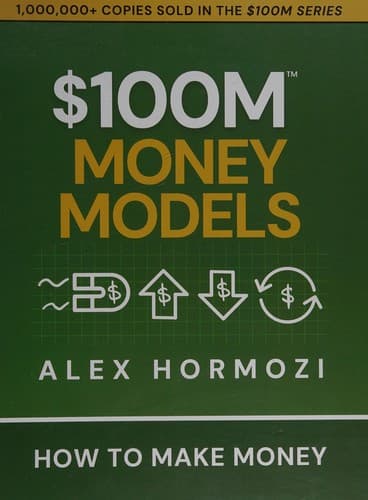
100M Money Models
On this pageWhat I like
What I like about this book
It is a catalogue of specific moves, not a theory. Each chapter names one offer, tells where Hormozi first saw it, explains how it works and ends with a tight list of points, so you can pick one and try it this week. I also like the 30-day rule, which gives you one number to judge your sales process by.
Why read it
A catalogue of named offers, from attraction to continuity, built around earning back the cost of a customer within 30 days.
The problem it solves
Most small businesses make one offer at one price and wait. If the customer says no, the sale is gone. If they say yes, there is nothing more to sell until they come back. Meanwhile the ads, the sales time and the delivery all cost money up front, so each new customer drains cash before it returns any. Hormozi describes the usual spiral: you spend more than you make in a month, cut back on advertising, get fewer customers, and end up funding the business from loans and personal cash.
The book's fix is to treat the whole path of offers as the thing you design, and to judge it by one test: how much profit a customer produces in the first 30 days compared with what they cost.
What changes in how you work
After reading it you stop asking what your price should be and start asking what you offer first, what next, what to the person who says no, and what to the person who stays. You also stop seeing a refusal as the end of a conversation. The book treats a no as a signal to change how the customer pays or what they get.
The second change is that you count. You work out your cost to win and serve a customer, then check how quickly they pay it back. Hormozi's point is that if customers pay for themselves fast, you can spend the same money again straight away, and growth stops depending on outside cash.
When to read it, and when not
Read it once you have a product people buy and some way to get leads. Hormozi places it as the third book after one on what to sell and one on how to find buyers, so it answers the question of how to get those buyers to purchase.
Skip it if you have no offer yet or no customers to talk to. A better sequence will not rescue a product nobody wants. It also reads best with a real business in front of you, because every chapter is easier to judge against your own numbers.
What to be careful about
Most examples come from gyms, licensing and other businesses where a person sells to a person. Some tactics, such as trial fees and waived setup fees, build a cost to leaving into the deal. I would test those against how much trust matters in your market before copying them.
Hormozi himself adds some guardrails: check the law before you advertise anything free, be transparent, and hand back money if a customer asks for it. Treat the offers as inspiration to adapt, not scripts to paste.
Turning it into a repeatable system
Each offer in the sequence is a decision you can write down: what you offer, to whom, at what price, on what terms, and what it produced. Log those and you learn which offers earn their place. Once a sequence works, the handling around it (follow-up after a no, payment reminders, check-in meetings) is repeatable work that can become a written playbook and later be handed to a person or an agent.
Who it's for
Key take-aways
Book summary
Hormozi argues that cash is the usual brake on growth, and that you release it by designing a money model: a deliberate series of offers that wins customers, earns back what they cost within 30 days, and then keeps making money from them. The book sorts the offers into four types and gives three to five named plays for each, followed by a way to assemble them into your own model.
Start Here
Hormozi opens with his own story: a gym he could barely fund, and a storage-unit owner who showed him that a "free month" earns money through the lock, boxes and other add-ons that follow. He then tells how he used a simple sequence to open gyms with almost no debt, and how a marketer told him he held a level-10 skill in a level-2 opportunity, which led to Gym Launch. The point of the opening is that the sequence of offers, more than the product, earned the money.
What's A Money Model?
The first section defines the idea. He uses a car rental counter that turned a $19 a day booking into about $100 a day through a vehicle upgrade, late return, insurance and prepaid fuel, each solving a problem the customer had. As Hormozi puts it, "A Money Model is a sequence of offers." He contrasts good models, where customers pay fast, with bad ones, where the slow drip of profit starves the business.
The Four Types of Offers That Make Money Models
Attraction offers turn strangers into customers, upsells get people to spend more, downsells win a yes where there would have been a no, and continuity offers keep people buying. Any offer can be used alone, but together they make the model. He also sets rules for himself: refund anyone who asks, do not hard sell, obey advertising law and stay transparent.
Win Your Money Back
The customer pays now and gets the money back, or store credit, if they hit a goal you set. Good criteria are easy to track, likely to get results and make the customer advertise you. He recommends applying winnings as a long discount on a bigger package, and says the real money comes from the winners you then have something else to offer.
Giveaways
You advertise a chance to win a big prize in exchange for contact details and answers to a few questions, then offer everyone else the prize at a discount. Hormozi suggests a discount of 10% to 30% of your gross margin and an expiry date on claiming it. The entry form also gives you information to make better offers later.
Decoy Offer
You advertise something free or cheap, then present a stronger premium option beside it when leads ask for details. The decoy is stripped down, with fewer features and no guarantee, so that the premium looks far better. Advertise benefits, not features, and make the contrast larger if the premium is not selling.
Buy X Get Y Free
Free draws more interest than a discount, so the book suggests offering more free items than paid ones, such as buy one pair and get two free. It also lengthens how long customers stay and pulls in cash early. His warning: if a year of payments arrives in a month, you still have to deliver the whole year.
Pay Less Now or Pay More Later
The customer chooses between paying full price later, with a conditional guarantee, or paying a discounted price now with bonuses. The discount runs from 20% to 50%. The promise has to be easy to track and give a clear yes or no.
The Classic Upsell
Your first offer reveals a problem, and the upsell solves it the moment the customer feels it. Hormozi uses the burger shop to show that the first sale rarely carries the profit. He suggests bundling items so one ask yields many sales, and ending every meeting by booking the next one.
Menu Upsell
Here you tell customers what they do not need, then prescribe what they do, offer a choice between two options and ask whether to use the card on file. Unselling lower-margin items nudges people towards higher-margin ones. It works best when you have several offers to choose from.
Anchor Upsell
Show the expensive offer first, let the customer react, then present the main offer as the sensible alternative. Make the premium five to ten times the price, keep the primary features the same and change only secondary ones. Some customers will buy the premium, which adds profit with fewer sales.
Rollover Upsell
You credit some or all of a previous purchase toward your next offer. It suits current customers, upset customers and old customers you want back. Price the new offer at least four times the credit, so the discount stays near 25%, and make it a one-time offer. He reports a win-back campaign of personalised videos that brought roughly one in five past customers back.
Payment Plan Downsells
When someone says they cannot afford it, you step down gradually: financing or card options, half now and half at payday, three payments, then equal payments over time. Align payments with pay dates to cut declines. Check that they still want it, on a scale of 1 to 10, before you keep working on terms.
Trial With Penalty
A free trial on condition that the customer does a few things, such as training or check-ins, with a small fee for each one they skip. The aim is to get results and turn them into paying customers, not to collect fees. Hormozi reuses the criteria from the money-back offer, and uses mid-trial check-ins to make more offers.
Feature Downsells
Instead of cutting the price, you cut something from the offer: lower quantity, lower quality, a cheaper alternative or a missing feature. He notes that customers often see the value of what you removed once they see the lower price. The book also says never to negotiate on price and to ask for a favour, such as reviews or introductions, in return for a small reduction.
Continuity Bonus Offers
You give an extra bonus to those who sign up for the ongoing plan today, ideally worth more than the first payment. The book gives price ratios between a one-off option and a membership to steer how many pick the membership. If you want more up-front cash, sell the bonus as a separate one-time offer that costs more.
Continuity Discount Offers
Free time is given to customers who commit. You can apply it up front, at the end, spread evenly or after the first months, and each choice trades conversion against churn. Your cancellation terms matter too, because lighter terms get more sign-ups and more exits.
Waived Fee Offer
The customer picks month-to-month with a large setup fee, or a commitment of at least a year with the fee waived. The bigger the fee, the more people commit, and the smaller it is, the more cash you take at the start. If they leave early, they pay the fee they would have avoided.
Ten Years In Ten Minutes
The last section gathers everything into a single list and shows how to build your own model in stages: reliable customers, then payback, then profit that funds more customers, then long-term value. He warns that when the model starts working the business starts breaking, so you need people to run it. Start offers cheap, raise the price as the yeses come in, and use affiliate products to fill gaps.
What to do with it
- Work out how many days a new customer takes to pay back the cost of winning and serving them, and set 30 days as the target.
- Write your current offers in order and mark which of the four jobs each one does, so the gaps show.
- Add one missing stage first, usually an attraction offer, then an upsell, then a downsell, then continuity.
- Change one thing at a time and record the cash it brings in during the first 30 days.
- Keep the offers that pay back, drop the rest, and write the working sequence down as a playbook someone else can run.